
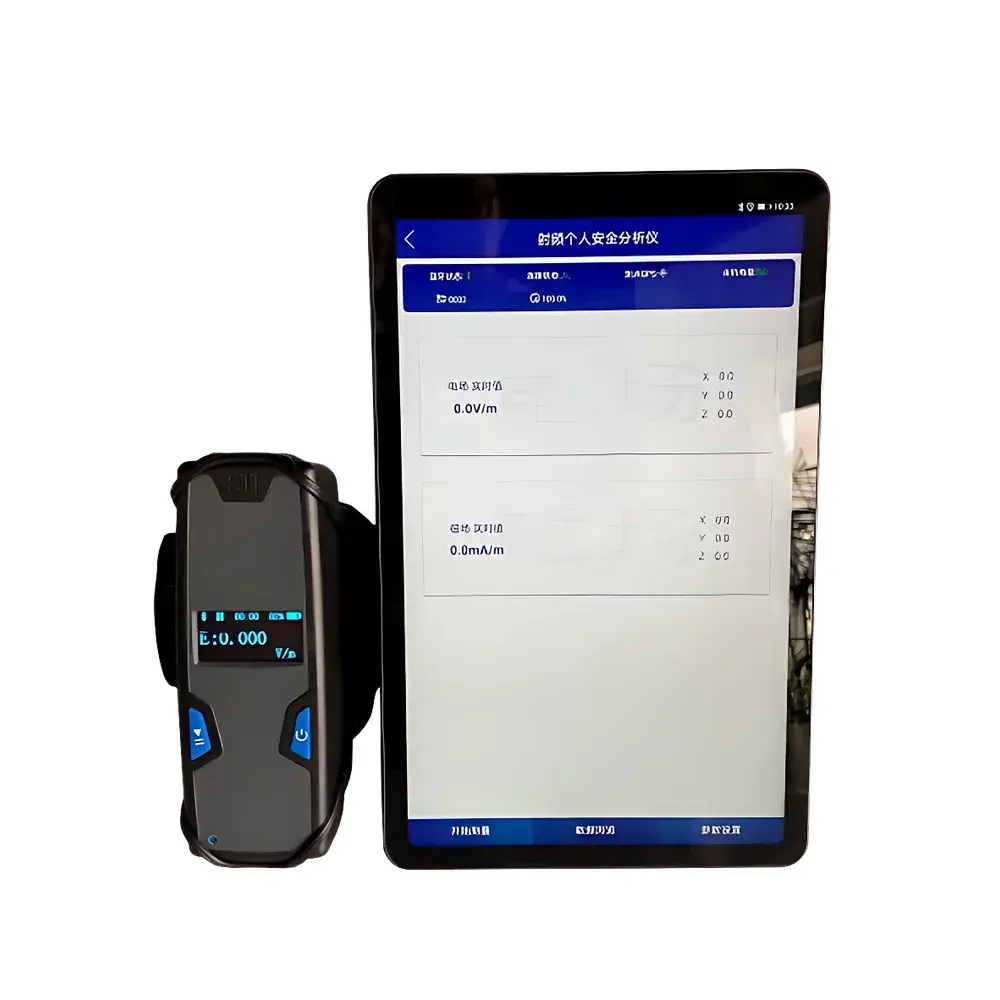
STT SEM-350 Electromagnetic Field (EMF) Exposure Safety Monitor
| Brand | STT |
|---|---|
| Origin | Beijing, China |
| Manufacturer Type | Direct Manufacturer |
| Instrument Category | Domestic |
| Model | SEM-350 |
| Pricing | Upon Request |
| Instrument Class | RF Field Strength Meter (Exposure Assessment Device) |
| Form Factor | Portable |
| Measured Quantity | Radiofrequency Electromagnetic Fields |
| Detector Type | Triaxial Isotropic Electric Field Probe (Dipole-Based) |
| Frequency Range | 100 kHz – 6 GHz |
| Sensitivity | 0.01 V/m |
| Compliance Context | ICNIRP 2020, IEEE C95.1-2019, GB 8702-2014, and Occupational EMF Exposure Limits |
Overview
The STT SEM-350 Electromagnetic Field (EMF) Exposure Safety Monitor is an integrated, handheld instrument engineered for real-time assessment of radiofrequency (RF) electric field exposure in occupational and environmental settings. Based on triaxial isotropic sensing architecture, it measures the root-mean-square (RMS) electric field strength (E-field) across the full frequency band from 100 kHz to 6 GHz—covering AM/FM broadcasting, mobile communication (2G–5G), Wi-Fi (2.4/5/6 GHz), Bluetooth, radar, and industrial RF sources. Unlike single-axis or broadband power-density meters, the SEM-350 employs a calibrated, three-orthogonal-dipole probe that ensures angular independence and eliminates orientation-dependent measurement error—a critical requirement for compliance with ICNIRP 2020 and IEEE C95.1-2019 exposure evaluation protocols. Its embedded firmware applies frequency-weighted averaging per established exposure limits, automatically computing time-weighted averages over user-selectable intervals (e.g., 6-minute peak and 8-hour occupational reference periods). Designed explicitly for occupational hygiene practitioners, telecom site auditors, and safety officers, the device operates without external calibration during field deployment and delivers traceable measurements aligned with national standards including China’s GB 8702-2014.
Key Features
- Integrated triaxial isotropic E-field probe with dipole-based sensor elements—no manual rotation or repositioning required
- OLED display with real-time numeric readout of instantaneous, maximum, minimum, and time-weighted average E-field values (V/m)
- On-device alarm triggering based on customizable threshold levels aligned with ICNIRP, IEEE, or GB exposure limits
- Bluetooth 5.0 interface supporting secure, low-latency bidirectional communication with iOS and Android devices
- Dual-mode operation: standalone use for rapid screening; synchronized control and extended logging via companion mobile application
- Built-in non-volatile memory storing up to 10,000 timestamped measurement records with metadata (GPS optional via smartphone)
- IP54-rated enclosure with ergonomic grip and battery life exceeding 12 hours under continuous monitoring
Sample Compatibility & Compliance
The SEM-350 is not sample-based but field-based: it evaluates ambient electromagnetic fields in situ without physical contact or material sampling. It complies with international exposure assessment frameworks requiring spatial averaging, frequency weighting, and time-domain integration. Its measurement methodology satisfies technical prerequisites for workplace assessments under ISO/IEC 17025-accredited laboratories performing EMF surveys. The device meets mechanical and electrical safety requirements per IEC 61000-4-2 (ESD immunity) and IEC 61000-4-3 (radiated RF immunity). Calibration certificates are issued traceable to NIM (National Institute of Metrology, China), and factory calibration intervals are recommended every 12 months or after mechanical shock or environmental stress.
Software & Data Management
The STT EMF Mobile App (iOS/Android) provides full remote configuration, live visualization, and post-processing capabilities. It displays real-time E-field waveforms, time-history plots, and exposure ratio indicators (% of limit). All logged data—including raw samples, averaged metrics, alarm events, and geotags—is exportable in CSV and PDF formats for audit reporting. The PC Desktop Application (Windows/macOS) enables advanced spectral trend analysis, multi-session comparison, and automated report generation compliant with GLP documentation practices. Both applications maintain immutable audit trails for parameter changes and data exports, supporting regulatory readiness for OSHA, NIOSH, or provincial health authority inspections.
Applications
- Occupational health and safety audits at base stations, broadcast towers, and smart city infrastructure sites
- Pre-commissioning and periodic RF safety verification for 5G small-cell deployments and indoor DAS systems
- Compliance screening in hospitals near MRI suites or RF ablation equipment
- Field validation of shielding effectiveness in laboratories, control rooms, and military facilities
- Educational use in university EMF safety training programs and engineering labs
- Regulatory enforcement support for municipal environmental protection bureaus conducting public exposure investigations
FAQ
Does the SEM-350 require annual recalibration?
Yes—annual traceable calibration against accredited reference fields is recommended to maintain measurement uncertainty within ±1.5 dB (k=2) across its operating range.
Can it measure magnetic fields (H-field) or only electric fields?
The SEM-350 is optimized exclusively for electric field (E-field) measurement using its triaxial dipole array; it does not provide H-field or power density (S) output natively.
Is the device suitable for measuring pulsed or modulated RF signals?
Yes—the instrument’s RMS detector and digital signal processing chain are designed to accurately capture amplitude-modulated, TDMA, and OFDM signals common in modern wireless systems.
How is exposure compliance determined in real time?
The firmware applies frequency-dependent weighting factors defined in ICNIRP 2020 and computes running 6-minute and 8-hour averages, comparing them continuously against selected exposure limits and triggering visual/audio alarms when thresholds are exceeded.
What data security protocols are implemented in the mobile app?
All Bluetooth communication uses AES-128 encryption; no measurement data is transmitted to cloud servers unless explicitly exported by the user. Local storage adheres to GDPR and China’s PIPL privacy principles.
Related Products







