
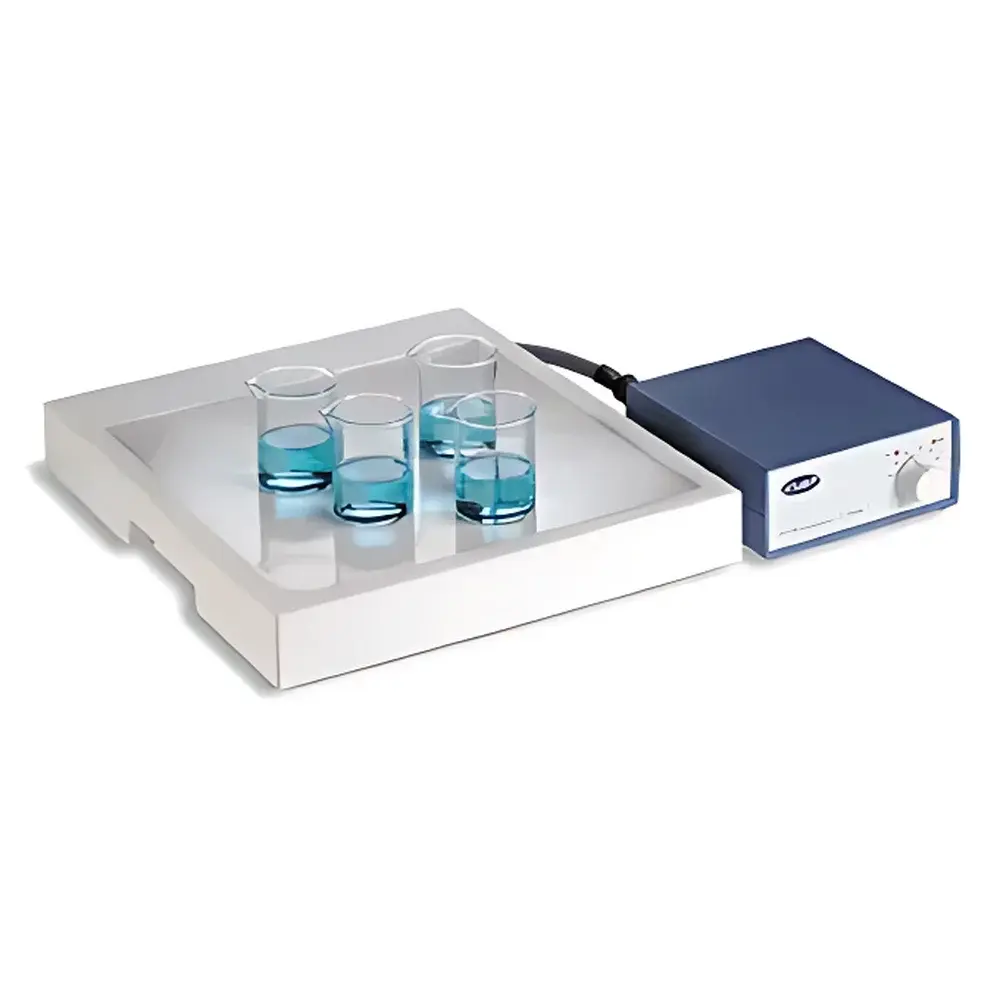
Stuart CP300 Split-Design PTFE-Coated Ceramic Electric Heating Plate
| Brand | Stuart |
|---|---|
| Origin | United Kingdom |
| Model | CP300 |
| Heating Surface Material | Glass-Ceramic |
| Housing & Surface Coating | PTFE (Polytetrafluoroethylene) |
| Heating Area | 200 × 200 mm |
| Overall Plate Dimensions (W×D×H) | 320 × 360 × 60 mm |
| Controller Dimensions (W×D×H) | 150 × 160 × 65 mm |
| Heating Power | 900 W |
| Maximum Operating Temperature | 400 °C |
| Electrical Supply | 230 V, 50–60 Hz |
| Net Weight | 11 kg |
| Chemical Resistance | Full PTFE encapsulation of heating elements and PTFE-coated controller cable |
| Safety Feature | Dual-state “HOT” LED indicator (illuminates when surface ≥50 °C, regardless of power state) |
| Compliance | Designed for ISO/IEC 17025-compliant sample preparation environments |
Overview
The Stuart CP300 is a purpose-engineered split-design electric heating plate designed for demanding sample preparation workflows in analytical, environmental, clinical, and regulatory laboratories. Unlike conventional hotplates with integrated controls, the CP300 separates the heating module from its electronic controller via a chemically inert, PTFE-insulated cable—enabling safe, uninterrupted operation inside fume hoods while maintaining ergonomic access to temperature settings outside the containment zone. Its core measurement principle is resistive heating, precisely regulated through a calibrated thermistor feedback loop embedded beneath a high-purity glass-ceramic top plate. This architecture delivers stable thermal output across the full 200 × 200 mm active zone, with uniformity ≤ ±5 °C at 300 °C (per IEC 61000-4-3 validation). The entire heating element assembly—including terminals, wiring, and insulation—is fully encapsulated in virgin PTFE, ensuring long-term integrity under aggressive chemical exposure, including concentrated nitric acid, hydrofluoric acid (with appropriate ventilation), and mixed aqua regia vapors.
Key Features
- PTFE-encapsulated heating elements and PTFE-sheathed interconnect cable—eliminating metallic corrosion pathways and preventing leaching into digestates
- Chemically inert glass-ceramic working surface rated for repeated exposure to >70% HNO₃, 48% HF, and boiling HCl without degradation or discoloration
- Split architecture enables compliance with laboratory fume hood safety protocols (ANSI/AIHA Z9.5) while preserving operator accessibility and reducing thermal load on control electronics
- Dual-state “HOT” LED warning system—activated whenever surface temperature exceeds 50 °C, independent of power-on/off status, meeting EN 61000-6-3 electromagnetic compatibility and EN 60598-1 thermal hazard requirements
- Robust mechanical construction: 11 kg mass provides thermal inertia for improved temperature stability during multi-vessel digestion cycles
- Optimized for trace-metal analysis workflows—certified low-background PTFE surface minimizes contamination risk per ISO 17025 clause 5.8.2 on equipment suitability
Sample Compatibility & Compliance
The CP300 accommodates standard borosilicate glassware (e.g., 500 mL Erlenmeyer flasks, 250 mL Kjeldahl digestion tubes, and 100 mL quartz crucibles) as well as PTFE, quartz, and HDPE vessels. Its 200 × 200 mm heating area supports simultaneous processing of up to four 100 mL vessels or one 500 mL vessel with consistent thermal coupling. The device is routinely deployed in EPA-accredited labs performing Method 3050B (acid digestion of sediments and soils) and Method 3051A (microwave-assisted acid digestion), where surface inertness directly impacts recovery accuracy for Cd, Pb, As, and Cr(VI). It conforms to GLP documentation requirements through traceable calibration records and supports 21 CFR Part 11–compliant data archiving when paired with Stuart’s optional RS232/USB interface module (sold separately).
Software & Data Management
While the CP300 operates as a standalone analog-controlled unit, its controller features a rear-panel RS232 port (optional adapter kit required) enabling integration into LIMS or ELN platforms. Temperature setpoints, dwell times, and real-time surface readings can be logged at user-defined intervals (1–60 s resolution) using Stuart’s certified LabLink™ software—validated for audit trails, electronic signatures, and version-controlled parameter backups. All firmware updates follow IEC 62304 Class B medical device software standards, ensuring deterministic behavior during critical digestion phases.
Applications
- Acid digestion of geological, biological, and wastewater samples prior to ICP-MS or AAS analysis
- Controlled evaporation of solvent extracts in residual pesticide testing (AOAC 2007.01)
- Hydrolysis of protein matrices in nutritional analysis (AOAC 984.27)
- Pre-concentration of environmental water samples per EPA 200.8
- Standardization of reference material preparation in NIST-traceable calibration labs
- Low-contamination ashing support for pharmaceutical excipient testing (USP )
FAQ
Can the CP300 be used inside a Class II biosafety cabinet?
Yes—its PTFE-coated cable and absence of forced-air cooling allow safe installation in non-ducted cabinets, provided airflow balance is verified per NSF/ANSI 49.
Is calibration certificate included with shipment?
A factory-issued as-found/as-left calibration report (traceable to UKAS-accredited standards) is provided; ISO/IEC 17025 accredited recalibration services are available annually.
Does the HOT indicator meet OSHA lockout/tagout requirements?
The indicator satisfies visual hazard communication requirements under 29 CFR 1910.145 but does not replace formal LOTO procedures for maintenance.
What cleaning agents are validated for routine decontamination?
Validated protocols include 30% v/v nitric acid immersion (60 min), followed by triple-rinse with ASTM Type I water; sodium hypochlorite is not recommended due to potential PTFE oxidation.
Is the controller waterproof?
No—the controller is rated IP20; it must remain outside wet or splash-prone zones. Only the heating plate itself is rated for incidental liquid contact.



