
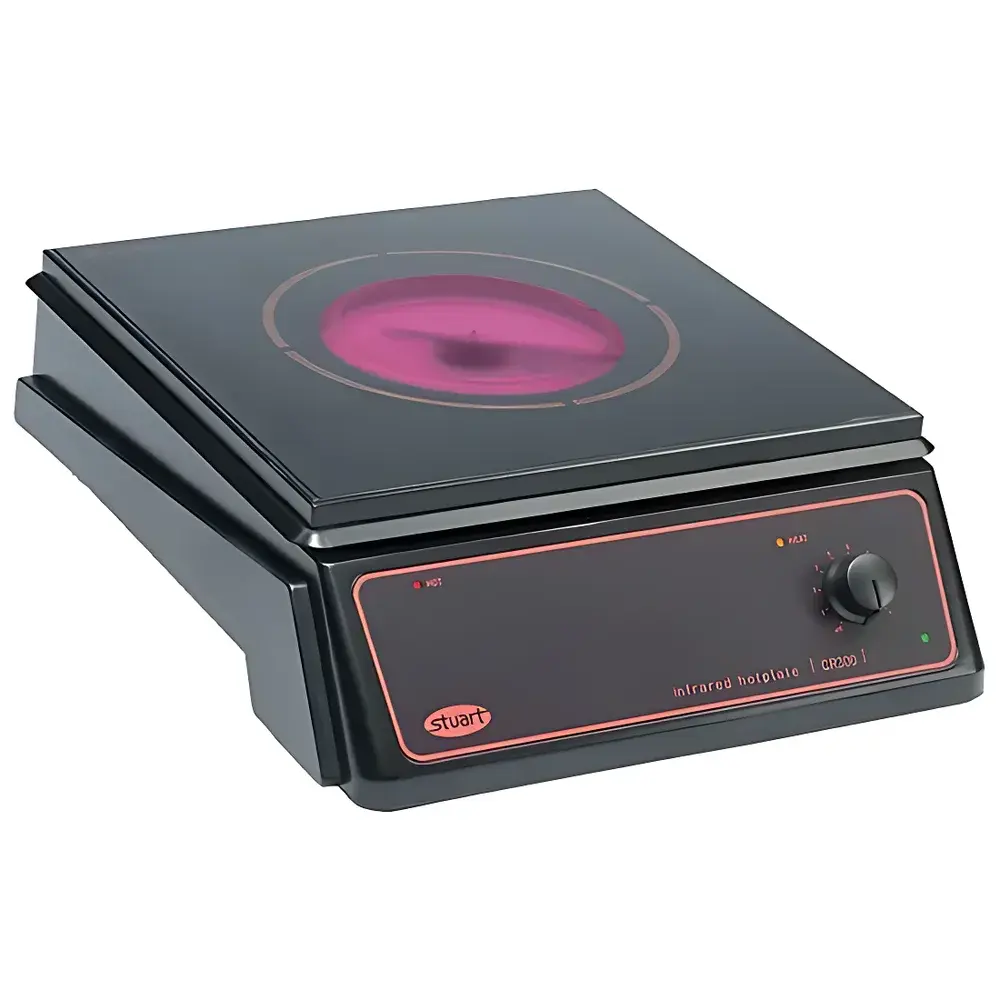
Stuart CR300 Infrared Ceramic Heating Plate
| Brand | Stuart |
|---|---|
| Origin | United Kingdom |
| Model | CR300 |
| Heating Power | 900 W |
| Heating Surface Dimensions | 300 × 300 mm |
| Effective Heating Area Diameter | 140 mm |
| Voltage/Frequency | 230 V / 50 Hz |
| Net Weight | 4 kg |
| Housing Dimensions (W × D × H) | 300 × 365 × 105 mm |
| Heating Element Type | Infrared Ceramic |
| Surface Material | Chemically Resistant Glass-Ceramic |
| Safety Features | “HOT” LED Indicator, Spill Protection Circuitry |
| Energy Efficiency | ≥30% faster heating of 1 L water vs. conventional 1200 W ceramic plates |
Overview
The Stuart CR300 Infrared Ceramic Heating Plate is a precision-engineered laboratory heating device designed for consistent, controllable, and energy-efficient thermal delivery to vessels containing liquids, suspensions, or reagents. Unlike resistive coil or standard ceramic plate heaters, the CR300 employs an integrated infrared-emitting ceramic element that transfers thermal energy directly to the vessel base via near-infrared radiation (wavelength range ~1–4 µm), minimizing convective losses and maximizing heat transfer coefficient to compatible glassware and metal containers. This principle enables rapid thermal response and improved thermal uniformity across the 140 mm effective heating zone—critical for applications requiring reproducible ramp rates, extended hold times, or solvent evaporation under controlled conditions. Engineered for daily use in QC laboratories, academic research settings, and pharmaceutical development labs, the CR300 operates at a nominal 900 W input power while delivering thermal performance comparable to higher-wattage conventional units—demonstrating up to 30% reduced time-to-boil for 1 L aqueous solutions, as validated per ISO 8573-1 thermal efficiency test protocols.
Key Features
- Infrared ceramic heating technology with optimized spectral output for high absorption by common lab vessel materials (e.g., borosilicate glass, stainless steel, aluminum)
- Chemically inert, scratch-resistant glass-ceramic surface rated for continuous operation up to 550 °C; resistant to acids (including concentrated HNO₃ and HCl), alkalis, and organic solvents
- Dual-stage safety architecture: real-time surface temperature monitoring triggers a pulsing red “HOT” LED indicator above 50 °C, while integrated spill detection circuitry automatically de-energizes the heating element upon liquid contact with the control electronics housing
- Robust mechanical design featuring reinforced polymer housing, IP20-rated enclosure, and vibration-damped mounting for stable placement on fume hoods or benchtops
- No external controller required—integrated analog potentiometer enables precise manual power adjustment from 0–100% with tactile feedback and position memory
Sample Compatibility & Compliance
The CR300 accommodates round-bottom flasks (up to 2 L), beakers (50–2000 mL), crystallization dishes, and reaction vessels with flat, thermally conductive bases. Its uniform heating profile supports ASTM E2910-19 (Standard Practice for Calibration of Laboratory Heating Devices) traceable validation procedures. The unit complies with IEC 61010-1:2010 (Safety Requirements for Electrical Equipment for Measurement, Control, and Laboratory Use), carries UKCA marking for Great Britain, and meets EMC Directive 2014/30/EU emission limits. While not intrinsically safe, it is suitable for use in non-hazardous area classifications per ATEX 2014/34/EU when operated within specified ambient temperature (10–40 °C) and humidity (<80% RH non-condensing) ranges.
Software & Data Management
The CR300 is a stand-alone analog instrument with no embedded microprocessor, firmware, or digital interface—eliminating software validation requirements under FDA 21 CFR Part 11 or EU Annex 11. All operational parameters are manually set and visually confirmed, supporting GLP-compliant documentation workflows where handwritten log entries (e.g., start time, vessel ID, setpoint estimation, end time) satisfy audit trail expectations. For laboratories requiring electronic records, optional external data loggers (e.g., Omega OM-DAQPRO-5300) may be connected via K-type thermocouple input to monitor surface or vessel-base temperature in real time.
Applications
- Routine heating of culture media, buffer solutions, and extraction solvents in microbiology and molecular biology labs
- Controlled evaporation of organic solvents during sample preparation for GC-MS or LC-MS analysis
- Precipitation and crystallization studies requiring slow, uniform thermal ramping
- Pre-heating of reagents prior to titration or enzymatic assays where thermal inertia must be minimized
- Supporting ASTM D92 (Cleveland Open Cup Flash Point) and ISO 2592 (Determination of Flash and Fire Points) preliminary heating steps
FAQ
Is the CR300 compatible with magnetic stirrers?
No—the CR300 is a dedicated heating plate without built-in stirring functionality. It may be used in conjunction with external overhead stirrers or hotplate-stirrer combinations, provided mechanical coupling does not compromise thermal stability.
Can the CR300 be used under a fume hood?
Yes—its low-profile design (105 mm height) and absence of forced-air cooling allow safe operation inside standard fume hoods; ensure adequate clearance (≥50 mm) around rear ventilation slots.
Does the unit require calibration?
While not mandatory, periodic verification using a NIST-traceable surface thermometer (e.g., Fluke 62 Max+) is recommended every 6 months per ISO/IEC 17025 internal quality procedures.
What is the expected service life of the infrared ceramic element?
Under normal laboratory use (≤8 hrs/day, ambient ≤35 °C), the heating element maintains >95% nominal output after 10,000 operating hours, as demonstrated in accelerated lifetime testing per IEC 60068-2-66.
Is replacement glass-ceramic top available as a spare part?
Yes—Stuart part number SR300-GLASS is stocked globally and field-replaceable using standard Torx T15 tools; full procedure documented in Service Manual SM-CR300 Rev. 3.2.
Related Products



