
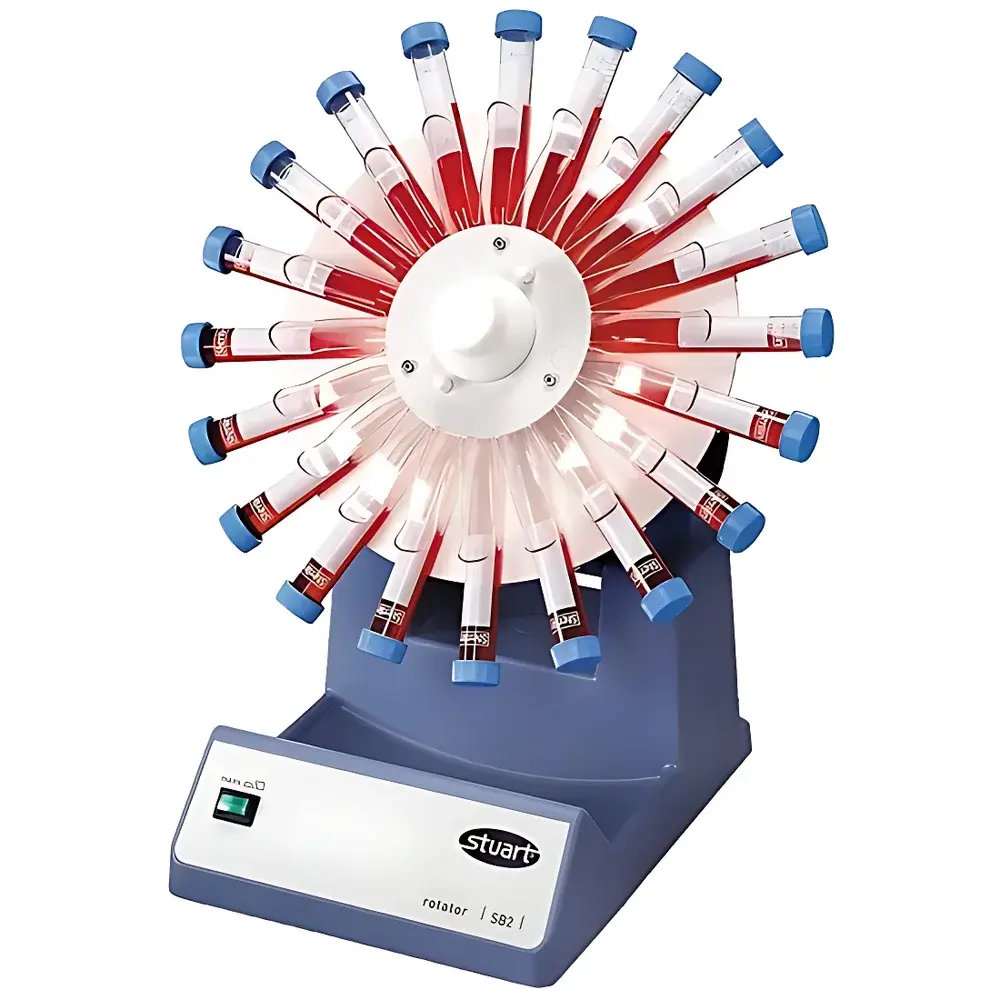
Stuart SB2 Fixed-Speed Rotational Mixer
| Brand | Stuart |
|---|---|
| Origin | United Kingdom |
| Model | SB2 |
| Speed | Fixed at 20 rpm |
| Operating Mode | Continuous |
| Motion Type | Rotational |
| Dimensions (W × D × H) | 200 × 270 × 230 mm |
| Net Weight | 3.2 kg |
| Power Supply | 230 V, 50 Hz, 50 W |
| Leak-Resistant Base | Integrated |
| Tube Holder Compatibility | Six interchangeable holders (SB3/1 to SB3/6) + optional dual-layer holder (SB2/DUAL) |
Overview
The Stuart SB2 Fixed-Speed Rotational Mixer is an engineered laboratory device designed for gentle, consistent, and reproducible sample agitation under controlled thermal environments. Unlike vortex or orbital shakers, the SB2 employs a precise rotational motion—where the entire platform rotates around a central axis—to maintain homogeneous suspension of delicate biological specimens without inducing shear stress or foaming. This principle of constant-axis rotation ensures uniform mixing kinetics across all tube orientations, making it particularly suitable for applications requiring minimal mechanical perturbation, such as whole blood homogenization prior to hematocrit analysis, reagent resuspension in diagnostic assays, or maintaining cell viability during incubation. The mixer operates reliably within environmental chambers ranging from 4 °C to 60 °C, enabling integration into cold-room workflows or CO₂ incubator-based protocols without performance degradation.
Key Features
- Governed fixed-speed operation at 20 rpm ensures repeatable mixing intensity—eliminating variability introduced by manual speed adjustment or inconsistent user input.
- Full 360° rotational angle adjustment allows optimization of mixing dynamics: from low-shear horizontal rotation (ideal for sedimentation prevention in viscous samples) to full vertical inversion (enabling thorough resuspension of pellet-prone suspensions).
- Integrated leak-resistant base captures incidental drips or condensate from tubes, supporting GLP-compliant benchtop hygiene and reducing cross-contamination risk in shared lab environments.
- Six standardized tube holder options (SB3/1–SB3/6) accommodate common laboratory vessels—from 0.5 mL microcentrifuge tubes to 50 mL conical centrifuge tubes—ensuring compatibility with routine clinical and research workflows.
- Optional SB2/DUAL dual-layer holder enables concurrent processing of two distinct tube formats (e.g., microtubes and standard culture tubes), improving throughput without compromising positional stability or rotational balance.
- Simple ON/OFF rocker switch interface minimizes operational complexity and supports rapid deployment in high-turnover settings such as clinical laboratories or QC testing suites.
Sample Compatibility & Compliance
The SB2 is validated for use with aqueous, buffered, and low-viscosity biological suspensions—including whole blood, serum, plasma, bacterial cultures, and antibody conjugates—within ISO 15195:2018 and CLSI EP15-A3 guidelines for precision assessment of analytical measurement systems. Its sealed motor housing and IP20-rated enclosure meet IEC 61010-1 safety requirements for laboratory electrical equipment. While not certified for sterile applications, its smooth stainless-steel and polypropylene contact surfaces support routine decontamination using 70% ethanol or 0.5% sodium hypochlorite solutions. No internal timers or data logging functions are present; therefore, the device does not require FDA 21 CFR Part 11 compliance—making it appropriate for non-GxP environments where procedural traceability is maintained manually.
Software & Data Management
The Stuart SB2 operates as a standalone electromechanical instrument with no embedded firmware, connectivity interfaces (e.g., USB, Bluetooth, or Ethernet), or software dependencies. All operational parameters—including runtime—are managed externally via manual supervision or integration with external timer-controlled incubators. This architecture eliminates cybersecurity risks associated with networked lab devices and simplifies validation documentation for ISO/IEC 17025-accredited laboratories. Users may record usage logs in accordance with internal SOPs using paper-based or LIMS-integrated tracking methods.
Applications
- Pre-analytical preparation of whole blood specimens for hematological analysis (e.g., CBC, coagulation panels), ensuring uniform cellular distribution without hemolysis.
- Reconstitution and homogenization of lyophilized reagents, standards, and calibrators in clinical chemistry and immunoassay workflows.
- Maintenance of suspension cultures during extended incubation periods—particularly for non-adherent cell lines or microbial cultures sensitive to orbital shaking.
- Uniform mixing of viscous matrices such as agarose gels, glycerol stocks, or protein storage buffers prior to aliquoting or downstream processing.
- Supporting ASTM D4097-18 (Standard Practice for Mixing Liquid Samples in Laboratory Glassware) through consistent rotational energy delivery.
FAQ
Is the SB2 suitable for use inside a CO₂ incubator?
Yes—the unit is rated for continuous operation between 4 °C and 60 °C and features thermally stable components that resist humidity-induced corrosion. Ensure adequate airflow clearance around the base to prevent heat buildup.
Can the SB2 be used with glass test tubes?
Yes, provided the selected tube holder (e.g., SB3/2 or SB3/3) matches the outer diameter and length of the glass vessel. Avoid over-tightening clamps to prevent microfractures.
Does the SB2 offer variable speed control?
No—this model operates exclusively at a fixed 20 rpm. For adjustable-speed alternatives, consider the Stuart SR1 or SM1 series.
What maintenance is required?
Routine cleaning of the base and holder surfaces with lint-free wipes and isopropyl alcohol. Annual inspection of motor coupling integrity is recommended for labs operating >8 hours/day.
Is calibration required?
As a fixed-speed mechanical device with no feedback sensors, formal calibration is not mandated per ISO/IEC 17025. However, users may verify rotational consistency using a handheld tachometer during initial installation and annually thereafter.



