
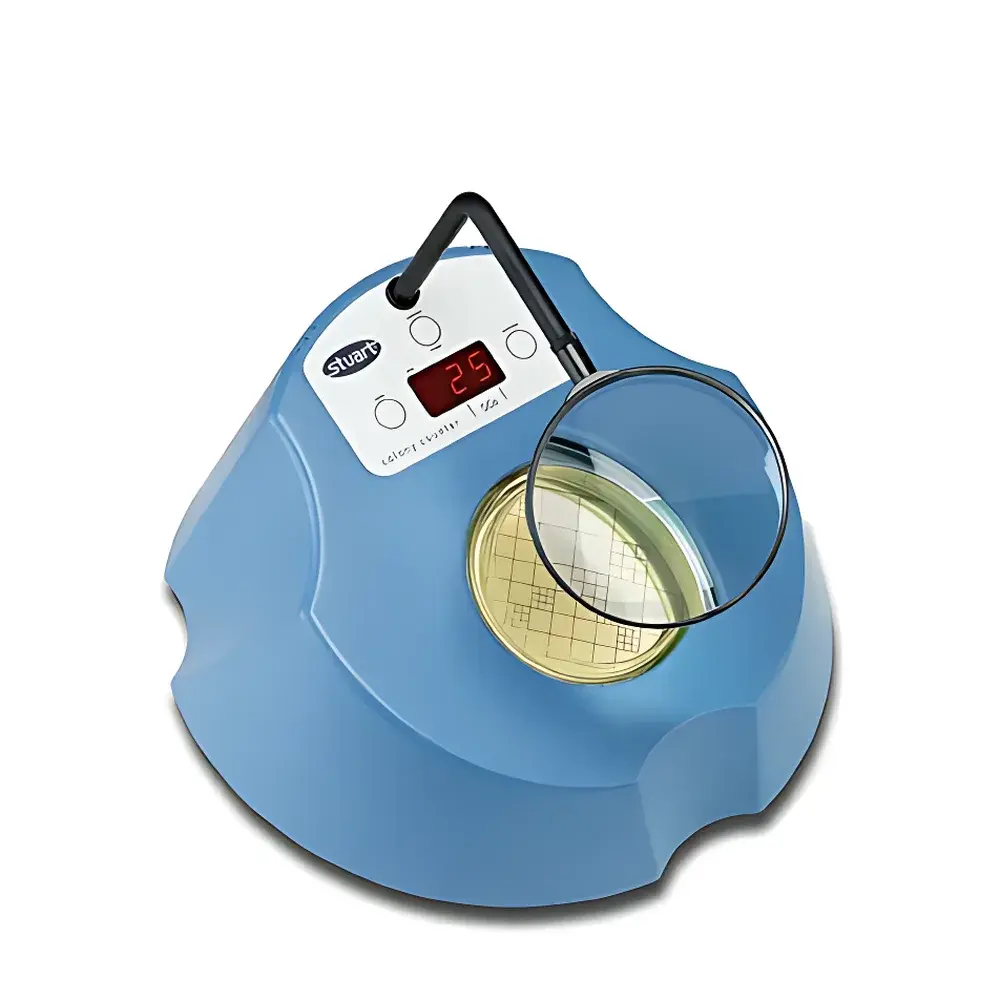
Stuart SC6 Dark-Field and Bright-Field Colony Counter
| Brand | Stuart |
|---|---|
| Origin | United Kingdom |
| Model | SC6 |
| Counting Range | 0–999 |
| Display | 3-digit LED |
| Petri Dish Compatibility | 50–99 mm diameter |
| Dimensions | 310 × 300 × 140 mm |
| Weight | 1.5 kg |
| Power Supply | 230 V AC, 50 Hz, 70 W |
| Accessories Included | Wolffhuegel grid, protective plate, user manual, power cord |
| Optional Accessories | SC6/1 (1.7× magnifier), SC6/1/3 (3× magnifier), SC6/2 (Wolffhuegel grid pack, 10 pcs), SC6/3 (centering adjustment disc, 2 pcs), SC6/4 (transparent protective plate, 5 pcs), SC6/5 (receptacle dish) |
Overview
The Stuart SC6 Dark-Field and Bright-Field Colony Counter is a precision-engineered microbiological counting instrument designed for reliable enumeration of microbial colonies on standard agar plates under controlled illumination conditions. Utilizing dual-mode optical illumination—adjustable between bright-field (transmitted white light) and dark-field (oblique, edge-illuminated contrast enhancement)—the SC6 enables high-contrast visualization of both pigmented and non-pigmented colonies, including translucent, mucoid, or faintly hemolytic isolates that are often difficult to resolve under conventional lighting. Its ergonomic benchtop design integrates a fixed-height viewing stage with integrated grid overlay and mechanical centering mechanism, ensuring consistent sample positioning and minimizing inter-operator variability. The device operates without image capture or digital analysis; instead, it supports manual, GLP-aligned colony enumeration in accordance with ISO 4833-1:2013 (microbiology of food and animal feeding stuffs — horizontal method for the enumeration of microorganisms — Part 1: Colony count at 30 °C) and FDA Bacteriological Analytical Manual (BAM) Chapter 3 guidelines.
Key Features
- Dual-illumination system: Independently switchable bright-field and dark-field modes optimized for differential colony contrast across diverse media types (e.g., TSA, VRBA, PCA, Sabouraud dextrose agar)
- Wolffhuegel grid overlay: Precision-etched stainless-steel grid with 10 × 10 mm square subdivisions, facilitating systematic quadrant-based counting and reducing visual fatigue during prolonged sessions
- Adjustable centering disc: Mechanically stabilized petri dish alignment ensures reproducible radial positioning relative to the grid origin—critical for standardized counting protocols
- LED-based illumination: Cold-white LEDs provide uniform, flicker-free, low-heat illumination with >10,000-hour service life; no UV emission or thermal distortion of agar surfaces
- Compact footprint & low power draw: Designed for shared lab environments—occupies minimal bench space and consumes only 70 W at nominal operation
- Compliance-ready configuration: No embedded software or data storage; fully compatible with paper-based recordkeeping systems required under ISO/IEC 17025 and FDA 21 CFR Part 11 non-electronic workflows
Sample Compatibility & Compliance
The SC6 accommodates standard circular Petri dishes ranging from 50 mm to 99 mm in diameter—including common formats such as 60 mm, 90 mm, and 100 mm (with minor overhang). Its open-stage architecture permits rapid plate exchange without mechanical clamping, supporting high-throughput workflows in QC laboratories performing routine environmental monitoring, raw material testing, or finished product release assays. All optical and mechanical components comply with IEC 61010-1:2010 safety standards for laboratory electrical equipment. The absence of digital imaging or automated recognition algorithms renders the SC6 inherently compliant with audit requirements where manual verification and operator signature are mandated per GLP and GMP Annex 11 interpretations.
Software & Data Management
The Stuart SC6 is a hardware-only counting aid with no onboard processor, firmware, or connectivity interfaces. It does not generate electronic records, store counts, or interface with LIMS or ELN platforms. This architecture eliminates validation burden associated with software qualification (e.g., IQ/OQ/PQ), making it suitable for regulated environments where manual transcription into bound logbooks or validated spreadsheet templates is the approved data handling procedure. Count values are entered directly by the analyst via external documentation systems adhering to ALCOA+ principles (Attributable, Legible, Contemporaneous, Original, Accurate, Complete, Consistent, Enduring, Available).
Applications
- Quantitative aerobic plate counts (APC) in food, beverage, and pharmaceutical manufacturing
- Environmental monitoring (EM) programs in cleanrooms per ISO 14644-1 and EU GMP Annex 1
- Water and wastewater microbiology testing per ISO 9308-1 and EPA Method 1604
- Validation of sterilization efficacy (e.g., steam, dry heat, ethylene oxide) using biological indicators
- Educational microbiology labs requiring robust, low-maintenance enumeration tools
- Reference laboratory confirmation testing where traceability to manual counting is required
FAQ
Does the SC6 support automatic colony recognition or image analysis?
No. The SC6 is a manual counting instrument with optical enhancement only. It does not include cameras, software, or AI-based detection algorithms.
Can the SC6 be used with Petri dishes larger than 99 mm?
Dishes exceeding 99 mm diameter will overhang the stage and may obstruct grid visibility or compromise centering accuracy. For 100 mm or larger plates, alternative staging accessories or dedicated large-format counters are recommended.
Is the dark-field illumination adjustable in intensity?
Illumination intensity is fixed per mode but optimized for maximum contrast-to-noise ratio across typical agar thicknesses (3–4 mm); no user-adjustable dimming is provided to maintain calibration stability.
Are calibration certificates or traceable verification procedures available?
As a Class I non-measuring optical aid (per ISO/IEC 17025 scope definitions), the SC6 does not require formal calibration. Verification of illumination uniformity and grid alignment can be performed in-house using NIST-traceable rulers and photometric reference cards.
What maintenance is required for long-term reliability?
Routine cleaning of the glass stage surface and grid with lint-free isopropyl alcohol wipes; periodic inspection of LED output consistency; no scheduled servicing or consumable replacement beyond optional accessory replenishment (e.g., SC6/4 protective plates).




