
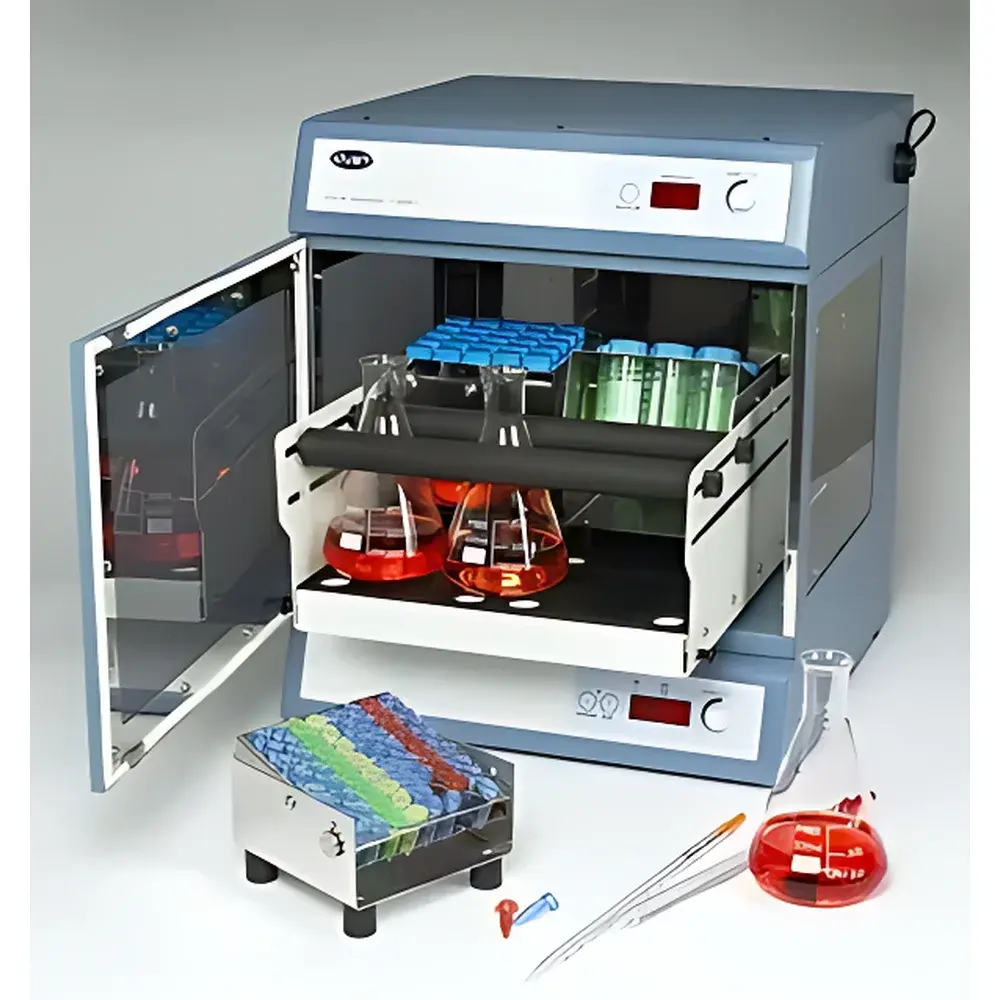
Stuart SI500 3D Temperature-Controlled Orbital Shaking Incubator
| Brand | Stuart |
|---|---|
| Origin | United Kingdom |
| Model | SI500 |
| Temperature Range | Ambient +5°C to 60°C |
| Temp Resolution | 0.1°C |
| Temp Accuracy | ±0.5°C |
| Temp Uniformity | <0.5°C |
| Speed Range | 30–300 rpm |
| Orbit Diameter | 16 mm |
| Platform Size | 335 × 335 mm |
| Internal Dimensions (W×D×H) | 422 × 408 × 297 mm |
| Max Vessel Height | 250 mm |
| Max Load Capacity | 10 kg |
| Heating Power | 250 W |
| Input | 230 V, 50 Hz, 300 W |
| Net Weight | 30 kg |
| Timer Range | 1 s – 9 days |
| USB Interface | Yes |
| Platform | Retractable with Magnalock-compatible accessory mounting |
Overview
The Stuart SI500 is a precision-engineered 3D temperature-controlled orbital shaking incubator designed for demanding life science applications requiring simultaneous thermal regulation and controlled agitation. It integrates a microprocessor-controlled orbital shaker with a forced-air circulated incubation chamber—enabling uniform thermal distribution across the entire platform while maintaining stable, reproducible shaking dynamics. Unlike conventional static incubators or standalone shakers, the SI500 delivers true three-dimensional mixing through its patented retractable platform architecture combined with adjustable-angle tube racks and orbital motion (16 mm diameter), facilitating enhanced oxygen transfer and homogenization in suspension cultures—including mammalian, bacterial, and yeast cell lines. Its compact footprint (450 × 474 × 522 mm) allows seamless integration into biosafety cabinets or standard laboratory benchtops without compromising performance or accessibility.
Key Features
- Microprocessor-controlled orbital shaking (30–300 rpm) with soft-start function and digital LED speed display
- Independent high-resolution temperature control (0.1°C resolution) from ambient +5°C to 60°C, with accuracy of ±0.5°C and uniformity <0.5°C across load
- Forced-air convection system ensuring rapid thermal equilibration and minimal spatial gradient within the chamber
- Retractable 335 × 335 mm platform with mechanical locking—enables full front-access extraction for easy loading/unloading of rear-positioned vessels
- Magnalock magnetic attachment system for rapid, tool-free installation and removal of stainless-steel accessory racks (SI500/1 to SI500/4)
- Adjustable-angle tube holders (up to 30° tilt) optimized for 1.5 mL, 15 mL, and 50 mL centrifuge tubes, as well as universal 30 mL containers
- Dual digital LED displays for real-time monitoring of temperature and speed settings
- Programmable countdown timer (1 second to 9 days); automatic shaker stop and audible alert upon completion
- Integrated USB port enabling continuous external logging of temperature profiles over extended periods (e.g., 7-day monitoring)
- Triple-glazed transparent front and side windows for non-invasive visual inspection without disturbing chamber conditions
Sample Compatibility & Compliance
The SI500 accommodates a wide range of culture vessels up to 1 L volume, including Erlenmeyer flasks (12 × 250 mL, 9 × 500 mL, or 6 × 1000 mL configurations), microcentrifuge tubes, and custom bioreactor vessels. Its internal chamber (422 × 408 × 297 mm) supports maximum vessel heights of 250 mm and total loads up to 10 kg. All wetted components are constructed from corrosion-resistant stainless steel or medical-grade polymers compliant with ISO 13485 manufacturing standards. While not certified for GMP production environments, the instrument meets essential requirements for GLP-compliant research workflows—including traceable temperature logging via USB export and stable thermal performance validated per ASTM E2500-13 (Standard Guide for Specification, Design, and Verification of Pharmaceutical and Biopharmaceutical Manufacturing Systems). The device operates within IEC 61010-1 safety limits for laboratory equipment.
Software & Data Management
The SI500 includes dedicated PC-based software accessible via its native USB interface, supporting time-stamped temperature acquisition at user-defined intervals (minimum 1-second sampling). Data exports directly to CSV format for downstream analysis in MATLAB, Python (Pandas), or Excel. The software enables creation of audit-ready reports—including start/stop timestamps, mean temperature deviation, and duration of out-of-spec excursions—supporting documentation requirements under FDA 21 CFR Part 11 when used with institutional electronic signature protocols. No cloud connectivity or proprietary firmware updates are required; all configuration remains local and deterministic, ensuring long-term operational consistency across multi-user labs.
Applications
- Suspension cell culture (CHO, HEK293, Sf9) under controlled O2/CO2-compatible conditions (when paired with optional gas modules)
- Microbial growth kinetics studies requiring precise temperature–agitation coupling
- Protein expression optimization in liquid media using E. coli or Pichia pastoris
- Enzyme reaction profiling under dynamic mixing and thermal ramping
- Media preparation and pre-incubation of diagnostic reagents prior to assay deployment
- Long-duration stability testing of biologics formulations under accelerated thermal stress
FAQ
Does the SI500 support CO2 or humidity control?
No—the SI500 is a temperature- and agitation-controlled incubator only. It does not include integrated CO2 sensing, humidification, or gas blending capabilities. For CO2-dependent cultures, users should pair it with external gas-regulated enclosures or select Stuart’s dedicated CO2 incubator series.
Can the USB interface be used for remote control or real-time parameter adjustment?
No—the USB port is read-only for temperature data logging. All operational parameters (temperature setpoint, speed, timer) must be configured locally via the front-panel controls.
Is the Magnalock system compatible with third-party accessories?
Magnalock is a proprietary mechanical interface developed by Stuart. Only officially certified SI500-series racks (SI500/1 through SI500/4) are guaranteed to engage correctly and maintain alignment during operation.
What maintenance is required to ensure long-term calibration stability?
Annual verification using NIST-traceable thermistors and tachometers is recommended. Cleaning of the air intake filter and fan housing every 6 months prevents thermal drift caused by dust accumulation in the forced-air system.
Related Products





