
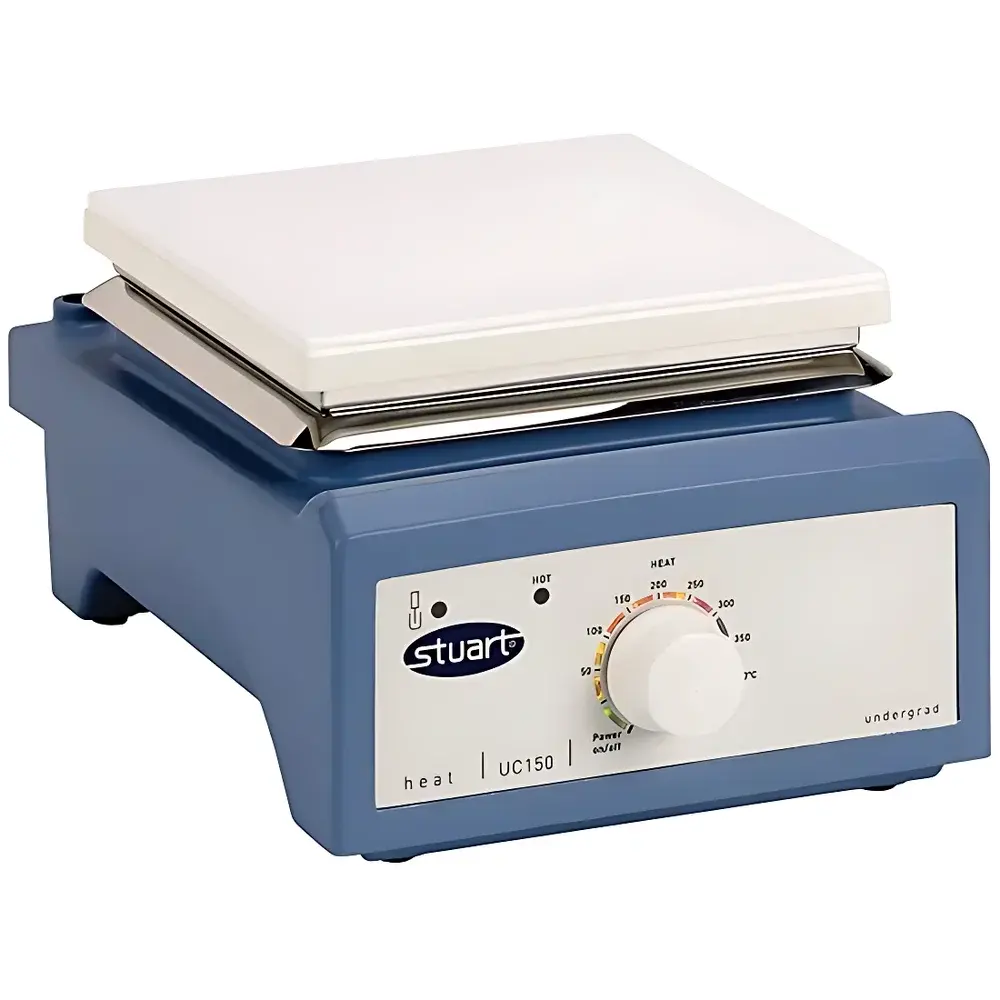
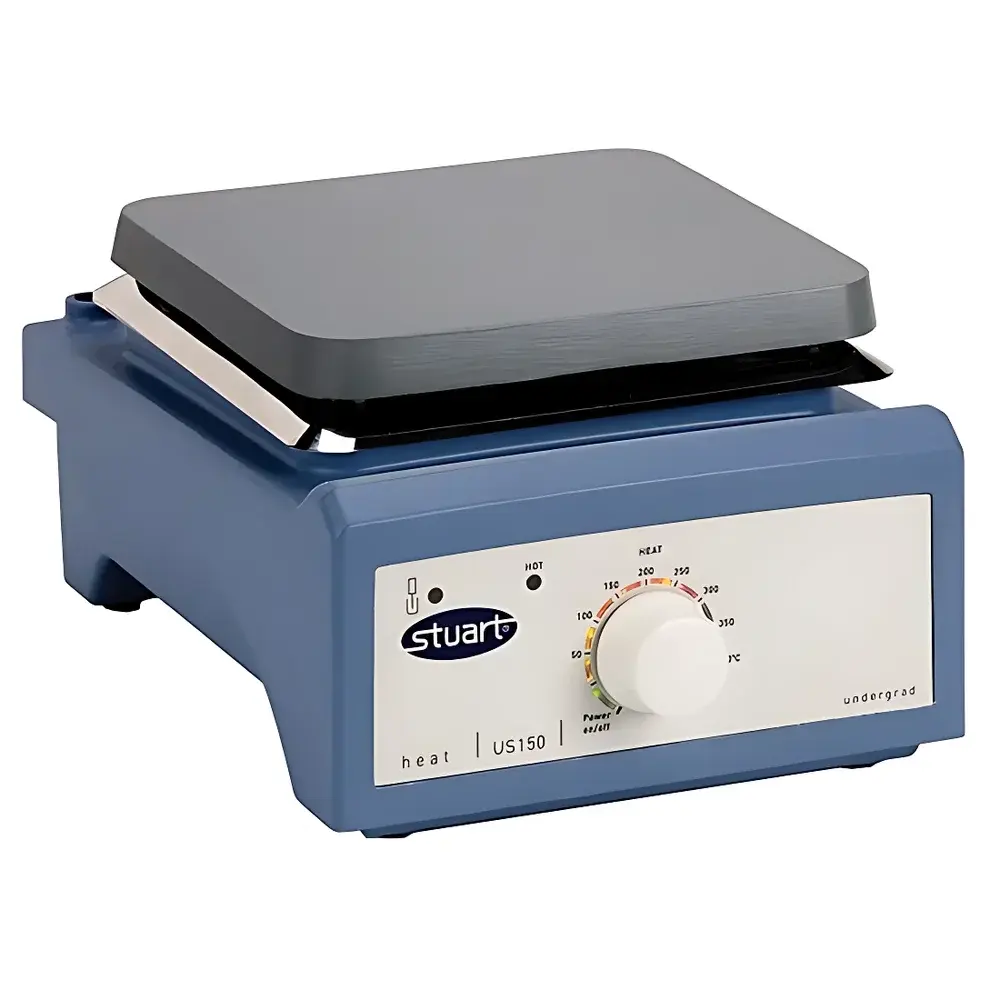
Stuart US150 Undergraduate Series Ceramic-Coated Aluminum Heating Plate
| Brand | Stuart |
|---|---|
| Origin | United Kingdom |
| Model | US150 |
| Panel Material | Ceramic-coated Al-Si alloy |
| Panel Dimensions | 150 × 150 mm |
| Heating Zone | 150 × 150 mm |
| Heater Power | 700 W |
| Max Panel Temperature | 325 °C |
| Temperature Control | Microprocessor-controlled with LED setpoint display |
| Overheat Indicator | Visual LED warning (flashes if surface >50 °C post-shutdown) |
| Integrated Probe Socket | Yes (for external temperature monitoring) |
| Dimensions (W×D×H) | 172 × 248 × 120 mm |
| Net Weight | 2.2 kg |
| Power Supply | 230 V, 50 Hz |
| IP Rating | IP32 |
| Mounting Option | Dedicated support rod port (12 mm diameter) |
Overview
The Stuart US150 Undergraduate Series Heating Plate is a compact, microprocessor-controlled laboratory heating device engineered for precision, safety, and reproducibility in teaching and routine analytical laboratories. Designed using Couette-type conductive heating principles, it delivers uniform thermal energy across its entire 150 × 150 mm ceramic-coated aluminum-silicon (Al-Si) alloy surface—optimized for rapid thermal response and stable plateau temperatures. Unlike analog rheostat-based units, the US150 employs digital PID control logic to maintain setpoint accuracy within ±3 °C over time, minimizing thermal drift during extended experiments. Its low-profile form factor (120 mm height) and integrated support rod port enable seamless integration with clamps, stands, and probe assemblies—reducing benchtop clutter while supporting GLP-compliant experimental setups. The unit operates at 230 V / 50 Hz and complies with IEC 61010-1:2010 for electrical safety in laboratory environments.
Key Features
- Ceramic-coated Al-Si alloy heating surface: Combines high thermal conductivity (≈150 W/m·K) with exceptional chemical resistance to common solvents, acids, and bases—enabling safe use with reaction vessels containing HCl, NaOH, ethanol, or acetone.
- Microprocessor-based temperature regulation: LED-displayed setpoint (range: ambient to 325 °C, resolution: 1 °C) eliminates subjective interpretation of analog dials; real-time feedback ensures consistent thermal profiles across replicates.
- Active overtemperature safeguard: Independent thermal cutoff circuit triggers a flashing red LED whenever surface temperature exceeds 50 °C—even after power disconnection—preventing accidental contact burns during cooldown phases.
- Dual-interface capability: Built-in 4-mm probe socket accepts Pt100 or thermistor-based contact sensors (e.g., SCT1), allowing closed-loop sample temperature control rather than open-loop plate temperature management.
- Space-optimized mechanical design: 172 × 248 mm footprint with recessed support rod port (12 mm diameter) permits vertical mounting of universal stands (e.g., SR1), freeing horizontal workspace without compromising stability.
- IP32-rated enclosure: Protects internal electronics against vertically falling droplets and solid objects ≥2.5 mm—suitable for wet-lab environments where splash exposure is routine.
Sample Compatibility & Compliance
The US150 accommodates standard borosilicate glassware (Erlenmeyer flasks, beakers, round-bottom flasks up to 1 L), stainless steel containers, and PTFE-coated vessels. Its flat, non-porous surface ensures even heat transfer to flat-bottomed receptacles and supports magnetic stirring when paired with compatible stir bars (not included). The unit meets CE marking requirements under Directive 2014/30/EU (EMC) and 2014/35/EU (LVD), and conforms to ISO/IEC 17025:2017 clause 6.4.7 for equipment suitability in accredited testing laboratories. It is routinely deployed in undergraduate chemistry curricula aligned with Royal Society of Chemistry (RSC) lab safety guidelines and supports ASTM E29–23-compliant temperature verification protocols.
Software & Data Management
While the US150 operates as a standalone instrument, its analog-compatible probe socket enables connection to third-party data loggers (e.g., Omega OM-DAQPRO-5300) for time-stamped temperature acquisition. When used with the optional SCT1 digital contact thermometer, users can record traceable temperature readings compliant with FDA 21 CFR Part 11 Annex 11 requirements—including electronic signatures, audit trails, and data integrity controls—when integrated into validated LIMS or ELN platforms. No proprietary firmware or cloud dependency is required; all calibration and operational parameters remain locally configurable via front-panel interface.
Applications
- Controlled solvent evaporation in organic synthesis workflows
- Pre-heating reagents prior to titration or calorimetry assays
- Temperature-dependent solubility studies (e.g., recrystallization optimization)
- Standardized drying of filter papers or gravimetric crucibles per ISO 6879
- Support heating for reflux condensation systems in teaching labs
- Pre-conditioning of viscosity standards before rotational rheometry (ASTM D2196)
FAQ
Can the US150 be used with a magnetic stirrer?
Yes—its flat, non-magnetic ceramic-coated surface is fully compatible with standard PTFE-coated stir bars and external magnetic stirrer bases placed beneath the unit.
Is calibration certificate included with purchase?
No—calibration is performed at factory level per ISO/IEC 17025; a UKAS-accredited calibration certificate is available as an optional add-on (order code CAL-US150).
What is the recommended maintenance interval?
Visual inspection and cleaning with isopropanol every 3 months; annual verification of temperature accuracy using a NIST-traceable reference thermometer is advised for GLP environments.
Does the unit support continuous operation at maximum temperature?
Yes—the 700 W heater and optimized thermal mass allow sustained operation at 325 °C for ≥8 hours, provided ambient temperature remains ≤30 °C and ventilation clearance ≥5 cm is maintained on all sides.
How does the overheat LED behave during normal shutdown?
The LED flashes continuously until panel temperature falls below 50 °C, providing unambiguous tactile-safety feedback independent of power status—critical for student lab supervision protocols.



