
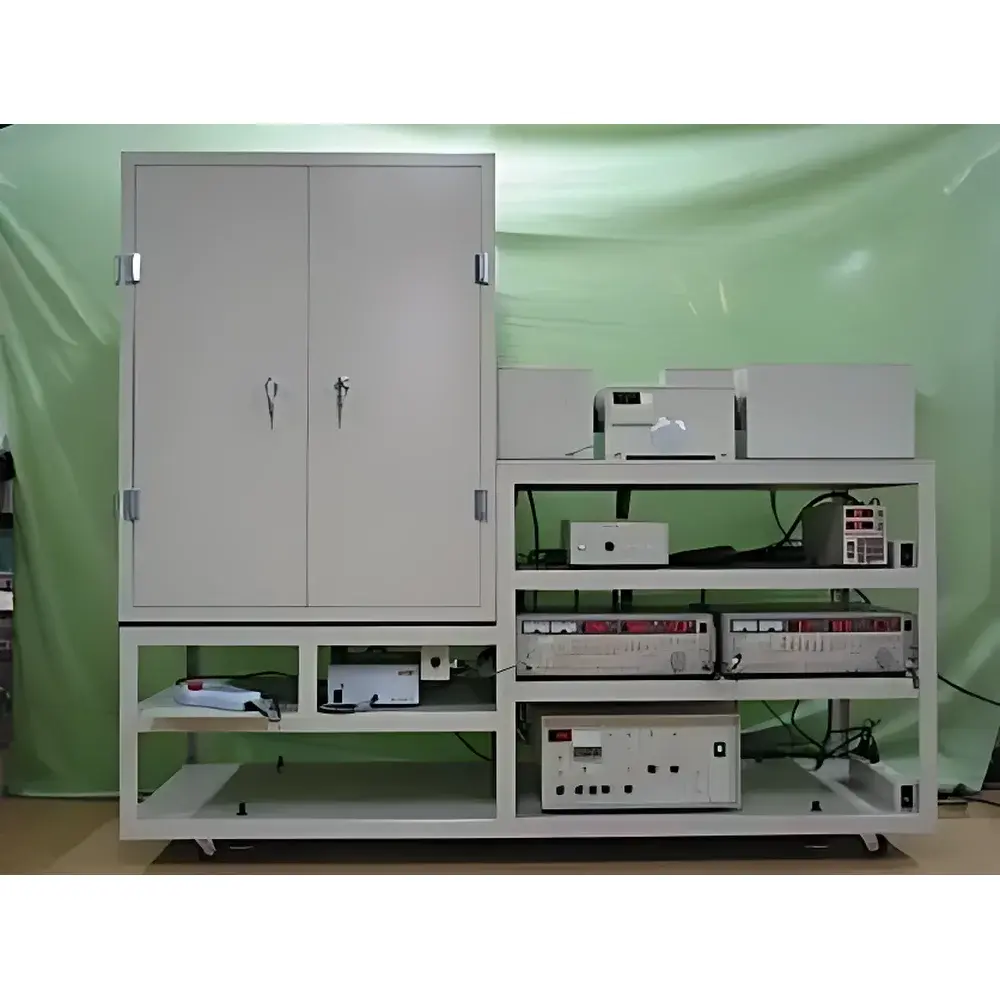
Subgap Defect Spectrometer SBA-25
| Origin | Shanghai, China |
|---|---|
| Manufacturer Type | Authorized Distributor |
| Origin Category | Domestic (PRC) |
| Model | SBA-25 |
| Price Range | USD 70,000 – 112,000 |
| Illumination Area | 6 × 6 mm |
| Irradiance Accuracy | ±5% |
| Spatial Uniformity | ±10% |
| Irradiance Stability | ±5% |
| Irradiance Range | 100 nW/cm² to 5 mW/cm² |
| Wavelength Purity | ~24 nm (monochromator slit width: 4 mm) |
| Optical Mount | Asymmetrical Czerny–Turner |
| f-number | F = 4.3 |
| Reciprocal Linear Dispersion | 6 nm/mm (600 lines/mm grating) |
| Wavelength Accuracy | ±0.2 nm |
| Illumination Mode | DC or Intermittent (manually switchable) |
| Chopper Frequency Range | 0.1–100 Hz |
| Illumination Direction | Downward |
| Light Intensity Monitoring | Lock-in Amplifier-based |
| Sample Current Measurement | Transimpedance Amplifier + Lock-in Detection |
| Minimum Detectable Current | 100 fA (1 × 10⁻¹³ A) |
| Absorption Coefficient Resolution | 6-digit numerical output |
Overview
The Subgap Defect Spectrometer SBA-25 is a precision optical absorption measurement system engineered for quantitative characterization of sub-bandgap defect states in semiconducting thin films, photovoltaic absorbers (e.g., CIGS, perovskites, amorphous Si), and emerging optoelectronic materials. Unlike conventional UV-Vis spectrophotometers, the SBA-25 employs monochromatic illumination with photon energies deliberately tuned below the material’s fundamental bandgap—enabling selective excitation of deep-level trap states, dangling bonds, and interface defects via sub-gap optical transitions. The system integrates a stabilized halogen broadband source, a high-fidelity asymmetrical Czerny–Turner monochromator (600 lines/mm grating), and a mechanically synchronized chopper, all coupled to a dual-stage lock-in detection architecture. This configuration ensures high signal-to-noise ratio (SNR) measurements under low-photon-flux conditions, where photocurrents as small as 100 fA are resolved with six-digit absorption coefficient quantification. Designed for laboratory-based defect spectroscopy—not elemental analysis—the SBA-25 delivers traceable, wavelength-resolved subgap absorption spectra essential for correlating defect density with device performance metrics such as open-circuit voltage loss (Voc deficit) and recombination lifetime.
Key Features
- Monochromatic sub-bandgap illumination (wavelength accuracy ±0.2 nm; purity ~24 nm at 4 mm slit)
- Downward-incident beam geometry optimized for planar thin-film samples (6 × 6 mm uniform irradiation area)
- Real-time irradiance stabilization via lock-in referenced photodetector feedback loop (stability ±5% across full spectral range)
- Dual lock-in architecture: one channel for incident light monitoring, second for sample photocurrent detection
- Transimpedance amplifier interface supporting direct current-to-voltage conversion with 100 fA minimum detectable current
- Manually switchable DC/intermittent illumination modes, synchronized with chopper (0.1–100 Hz adjustable frequency)
- F/4.3 optical throughput and 6 nm/mm reciprocal dispersion ensure efficient photon collection and spectral resolution suitable for defect-state mapping
Sample Compatibility & Compliance
The SBA-25 accommodates standard semiconductor wafer formats (up to 4-inch diameter) and coated glass substrates mounted on a manually adjustable XYZ stage. Samples must be electrically contacted via two-terminal configuration (e.g., evaporated Au/Ti electrodes or probe station contact). No vacuum or cryogenic requirements—measurements are performed under ambient atmosphere or controlled N2 glovebox environments. While not an ISO/IEC 17025-accredited instrument per se, the SBA-25 supports GLP-compliant workflows through its deterministic optical calibration traceability (NIST-traceable reference detectors available upon request), repeatable mechanical alignment, and timestamped digital data export. Its spectral accuracy and irradiance stability meet ASTM E275 and ISO 9050 requirements for optical transmission measurement instrumentation when operated within specified environmental conditions (23 ± 2 °C, <50% RH).
Software & Data Management
Control and acquisition are managed via Windows-based native software featuring scriptable scan sequences, real-time lock-in parameter optimization (time constant, phase, gain), and automatic wavelength calibration using Hg/Ne spectral lines. All raw and processed data—including photocurrent magnitude/phase, normalized absorption coefficient α(λ), and derivative dα/dλ—are exported in ASCII-compatible .csv format with metadata headers (wavelength, irradiance, lock-in settings, timestamp, user ID). Audit trails record operator actions, calibration events, and instrument configuration changes—supporting 21 CFR Part 11 readiness when deployed in regulated R&D environments. Third-party integration (LabVIEW, Python via COM API) enables automated correlation with external IV testers or quantum efficiency systems.
Applications
- Quantitative defect-state density profiling in kesterite (CZTS), perovskite, and organic photovoltaic absorbers
- Correlation of sub-gap absorption peaks with deep-level transient spectroscopy (DLTS) activation energies
- Process development feedback for passivation layer optimization (e.g., ALD Al2O3, PE-CVD SiNx)
- Stability assessment: tracking defect generation kinetics under light soaking or thermal stress
- Interface quality evaluation at heterojunctions (e.g., CdS/CIGS, SnO2/perovskite)
- Validation of density-of-states (DOS) models derived from first-principles calculations
FAQ
What physical quantity does the SBA-25 directly measure?
It measures wavelength-resolved photocurrent induced by sub-bandgap photons, converted into absorption coefficient α(λ) via the relation α = (1/d)·ln(I0/I), where d is film thickness and I0/I is the normalized transmission ratio derived from lock-in referenced signals.
Can the system operate under vacuum or inert gas?
Yes—sample chamber compatibility with standard glovebox feedthroughs or vacuum-compatible stages is supported; optical path remains atmospheric unless custom purged optics are integrated.
Is spectral calibration required before each experiment?
No—factory calibration is stable for ≥12 months; optional daily verification using mercury-argon lamp is recommended for metrology-grade studies.
Does the SBA-25 support time-resolved absorption measurements?
Not natively; it is a steady-state (or quasi-steady-state) system. For transient defect spectroscopy, complementary pump-probe configurations require external femtosecond laser sources and gated detection upgrades.
How is irradiance uniformity verified across the 6 × 6 mm spot?
Via NIST-traceable scanning photodiode mapping prior to shipment; users may re-validate using a calibrated CCD-based beam profiler (optional accessory).





