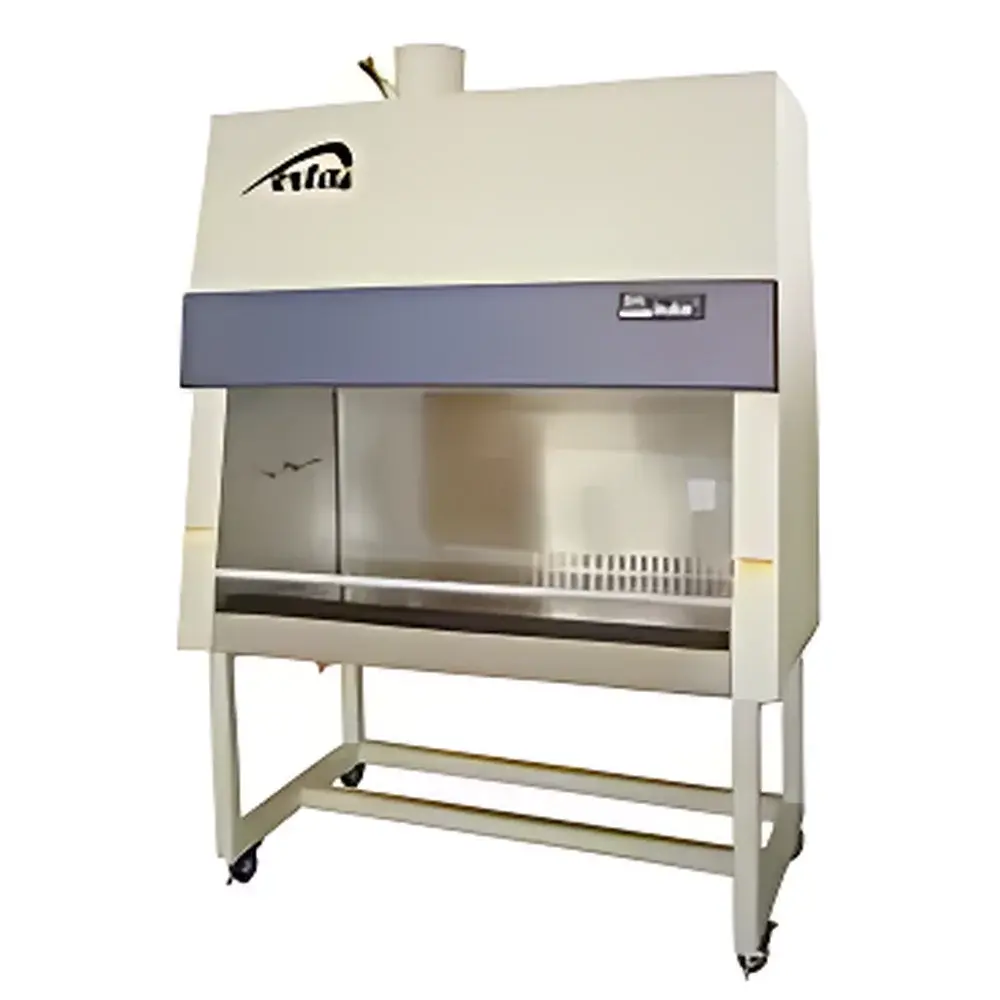
SuJie BHC-1100IIA2 and BHC-1300IIA2 Class II A2 Biological Safety Cabinets
| Brand | SuJie |
|---|---|
| Origin | Jiangsu, China |
| Cabinet Type | Class II, Type A2 (NSF/EN 12469 compliant) |
| Cleanliness Class | ISO Class 5 (Federal Standard 209E Class 100) |
| Downflow Velocity | ≥0.35 m/s |
| Inflow Velocity | ≥0.55 m/s |
| Noise Level | ≤58 dB(A) |
| Vibration Peak-to-Peak | ≤6 µm |
| Power Supply | AC 220 V, 50 Hz, Max. 1 kW |
| Lighting Intensity | ≥650 lx |
| UV Lamp | 20 W ×1 or 30 W ×1 |
| Fluorescent Lamp | 20 W ×2 or 30 W ×2 |
| Work Area Dimensions (W×D×H) | 1100×600×640 mm / 1300×600×640 mm |
| External Dimensions (W×D×H) | 1300×815×2210 mm / 1500×820×2210 mm |
| Weight | 300 kg / 340 kg |
| Personnel Protection | ≤10 CFU (impact sampling), ≤5 CFU (slit sampling) |
| Product Protection | ≤5 CFU per agar plate |
| Cross-Contamination Protection | ≤2 CFU per agar plate |
| Supply Filter Size | 1015×460×70 mm (BHC-1100) / 1315×460×70 mm (BHC-1300) |
| Exhaust Filter Size | 490×400×70 mm (BHC-1100) / 890×460×70 mm (BHC-1300) |
Overview
The SuJie BHC-1100IIA2 and BHC-1300IIA2 are NSF/EN 12469–certified Class II, Type A2 biological safety cabinets engineered for reliable personnel, product, and environmental protection during low- to moderate-risk microbiological and cell culture work. These cabinets operate on the principle of laminar downflow air—filtered through a HEPA (H14, ≥99.995% @ 0.3 µm) supply filter—to maintain ISO Class 5 (formerly Federal Standard 209E Class 100) conditions within the work area. Approximately 70% of the total airflow is recirculated after passing through the supply HEPA filter; the remaining 30% is exhausted via a dedicated ducted or thimble-connected system following filtration through a second HEPA filter. This dual-filter architecture ensures containment of aerosols generated during procedures involving Risk Group 1–2 agents, while enabling safe handling of small volumes of low-volatility chemicals when used with appropriate chemical compatibility assessments.
Key Features
- Robust stainless steel work surface and seamless monoblock inner chamber construction for corrosion resistance and ease of decontamination
- Dual HEPA filtration system: supply and exhaust filters independently certified to EN 1822 H14 efficiency standard
- Precisely calibrated airflow monitoring with real-time digital display of inflow and downflow velocities, meeting NSF 49 minimum velocity thresholds (≥0.55 m/s inflow, ≥0.35 m/s downflow)
- Low-noise centrifugal blower assembly delivering stable airflow at ≤58 dB(A) — optimized for extended operator comfort in shared lab environments
- Integrated UV germicidal lamp (20 W or 30 W) with safety interlock that deactivates UV emission when sash is raised above operational height
- High-intensity fluorescent lighting (≥650 lx at work surface) with uniform illumination distribution validated per EN 12469 Annex C
- Vibration-damped base design ensuring ≤6 µm peak-to-peak displacement—critical for sensitive microscopy or micromanipulation tasks conducted inside the cabinet
Sample Compatibility & Compliance
These cabinets support open-vessel manipulations of bacterial cultures, mammalian cell lines, and recombinant nucleic acid constructs under Biosafety Level 2 (BSL-2) containment. They are validated for use with non-volatile, low-toxicity chemical reagents (e.g., ethanol, sodium hypochlorite, dilute acids/bases) when operated with the exhaust ducted externally. All performance testing—including microbial challenge assays using Bacillus atrophaeus spores—conforms to EN 12469:2020 and NSF/ANSI 49–2022 protocols. Personnel protection is verified via iodine vapor or potassium iodide (KI) tracer gas tests; product protection is confirmed by settle plate assays demonstrating ≤5 CFU per 4-hour exposure. Cross-contamination control is assessed using spatial agar plate mapping across adjacent work zones, with acceptance criterion ≤2 CFU per plate.
Software & Data Management
While these models do not incorporate embedded microprocessor-based data logging, they feature analog/digital hybrid airflow monitoring with visual and audible alarms for sash position deviation, filter saturation, and airflow failure. Optional retrofit kits enable integration with building management systems (BMS) via 4–20 mA or Modbus RTU outputs for centralized HVAC oversight. For GLP/GMP-aligned laboratories, third-party validation packages—including IQ/OQ documentation templates, calibration certificates traceable to NIST standards, and audit-ready test reports—are available upon request. All cabinets ship with full compliance documentation supporting FDA 21 CFR Part 11 readiness when paired with validated electronic record systems.
Applications
- Aseptic transfer of primary cell isolates and immortalized lines in academic and contract research organizations
- Preparation of sterile media, reagents, and master cell banks under cGMP Annex 1–aligned workflows
- Handling of diagnostic specimens in clinical microbiology laboratories accredited to ISO 15189
- Genetic engineering workflows involving plasmid transfection, CRISPR-Cas9 editing, and lentiviral vector production
- Quality control testing of pharmaceutical intermediates where particulate and microbial contamination control is mandated per USP and
FAQ
What biosafety level does the BHC-IIA2 series support?
Class II A2 cabinets are designed for BSL-2 applications and may be used for certain BSL-3 procedures when combined with additional engineering controls and institutional biosafety committee approval.
Is external ducting mandatory?
Yes—Type A2 cabinets require either hard-ducted exhaust to the outside or connection to a thimble system with dedicated make-up air; recirculation-only operation is not permitted per NSF 49.
How often should HEPA filters be certified?
Initial certification is required post-installation; thereafter, annual certification is recommended—or semiannually in high-utilization labs—as defined by ISO 14644-3 and local regulatory policy.
Can this cabinet be used for volatile organic solvents?
No—Type A2 cabinets are not suitable for high-volatility, toxic, or flammable chemicals such as chloroform, ether, or benzene; a Class II Type B2 (total exhaust) or Class III cabinet is required instead.
Does the unit comply with international electromagnetic compatibility (EMC) standards?
Yes—tested and certified to EN 61326-1:2013 for laboratory equipment EMC immunity and emissions, ensuring stable operation in electromagnetically dense research facilities.