
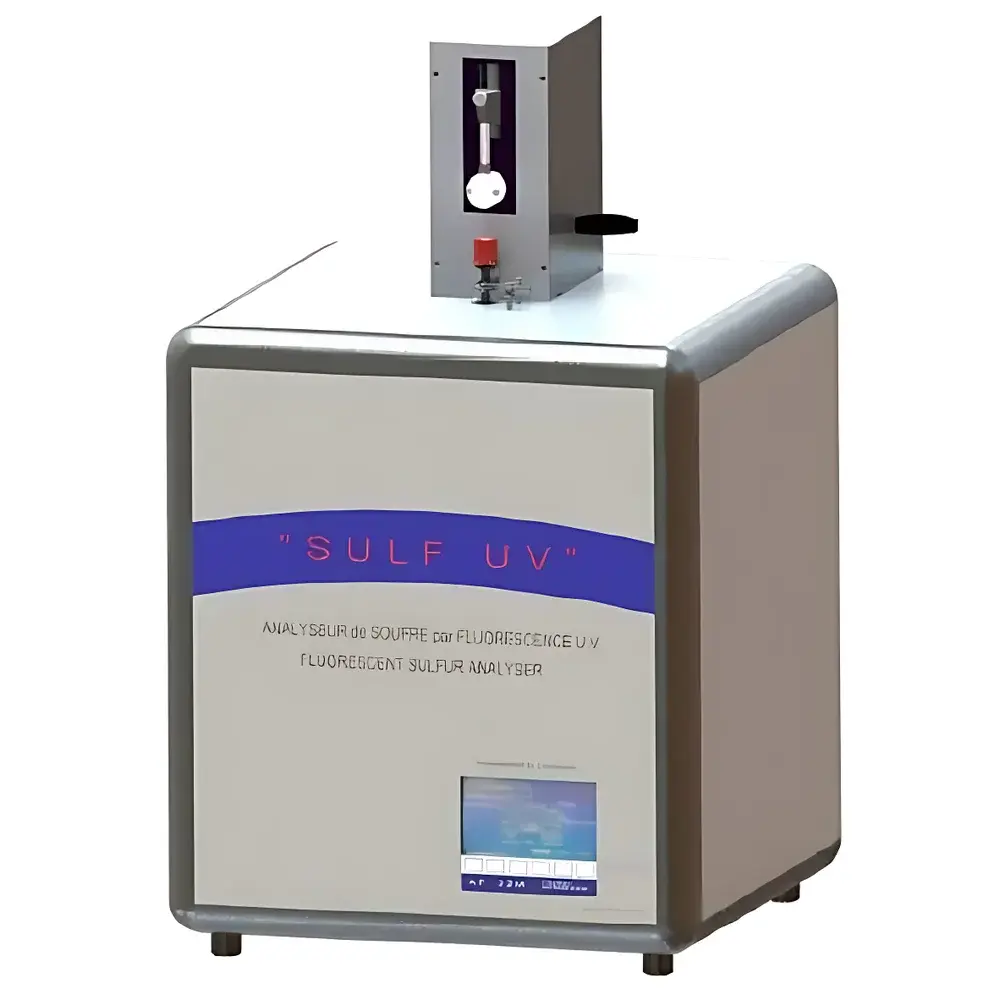
SULF UV Ultraviolet Fluorescence Total Sulfur Analyzer
| Origin | France |
|---|---|
| Manufacturer Type | Authorized Distributor |
| Origin Category | Imported |
| Model | SULF UV |
| Detection Target | Total Sulfur |
| Compliance Standards | ASTM D5453, AFNOR M-07-059, ISO 20846, SH/T 0689 |
Overview
The SULF UV Ultraviolet Fluorescence Total Sulfur Analyzer is a high-precision, benchtop combustion-based analytical instrument engineered for quantitative determination of total sulfur content in liquid, solid, and gaseous samples—primarily petroleum products including crude oil, distillates, naphthas, liquefied petroleum gas (LPG), and refinery streams. It operates on the fundamental principle of ultraviolet fluorescence detection following high-temperature oxidative combustion. In this process, sulfur-containing compounds are completely oxidized at up to 1000 °C in a controlled oxygen-rich environment, converting all sulfur species quantitatively to sulfur dioxide (SO₂). The resulting SO₂ molecules are carried via inert carrier gas into a dedicated UV fluorescence detector, where excitation by pulsed ultraviolet light induces photon emission upon relaxation to the ground electronic state. This emitted fluorescence—centered near 320 nm—is captured by a photomultiplier tube (PMT) with high quantum efficiency and low dark current, enabling linear, selective, and highly reproducible quantification over an extended dynamic range.
Key Features
- High-temperature programmable combustion furnace with dual-zone thermal control: one zone for sample introduction and pyrolysis, another maintained at a stable 1000 °C for complete oxidation of refractory sulfur species
- Quartz combustion tube assembly resistant to thermal shock and sulfuric acid condensate corrosion
- Dual independent gas delivery system with precision mass flow controllers (MFCs) for oxygen and carrier gas (e.g., argon or helium), each equipped with real-time pressure monitoring and digital flow regulation
- Optimized UV fluorescence detector featuring narrow-band optical filtering, temperature-stabilized PMT housing, and low-noise signal amplification circuitry
- Automated liquid sample introduction via syringe pump with programmable injection speed, volume, and rinse cycle—minimizing carryover and operator dependency
- Integrated PC-based control software supporting method storage, sequence automation, real-time chromatogram display, peak integration, calibration curve generation, and audit-trail-enabled data logging compliant with GLP/GMP requirements
Sample Compatibility & Compliance
The SULF UV analyzer accommodates a broad spectrum of matrices without matrix-specific method development: hydrocarbon liquids (gasoline, diesel, jet fuel, lubricants), viscous residues (fuel oils, bitumen), solids (catalysts, polymers, rubber, plastics, coal ash), and compressed gases (natural gas, refinery off-gas). Its performance meets or exceeds the precision, accuracy, and repeatability criteria defined in ASTM D5453 (Standard Test Method for Determination of Total Sulfur in Light Hydrocarbons, Spark Ignition Engine Fuels, and Motor Fuels by Ultraviolet Fluorescence), ISO 20846 (Petroleum Products — Determination of Sulfur Content — Ultraviolet Fluorescence Method), AFNOR M-07-059, and Chinese standard SH/T 0689. Instrument validation protocols support 21 CFR Part 11-compliant electronic records and signatures when configured with appropriate software modules and access controls.
Software & Data Management
The embedded Windows-based acquisition and analysis platform provides full instrument control—including furnace temperature ramping, gas flow sequencing, injection timing, detector gain adjustment, and baseline correction. All raw spectral data, integrated peak areas, calibration coefficients, and QC metrics (e.g., %RSD of replicate injections, recovery rates from certified reference materials) are timestamped and stored in a relational database structure. Data export options include CSV, PDF reports with embedded chromatograms, and XML formats compatible with LIMS integration. Audit trails record user login/logout events, parameter modifications, calibration updates, and result overrides—retained for minimum 12 months per internal SOP or regulatory requirement.
Applications
- Refinery quality assurance: monitoring sulfur levels in feedstocks, intermediates, and finished fuels to comply with Euro 5/6, Tier 3, and IMO 2020 marine fuel specifications
- R&D laboratories evaluating desulfurization catalysts and hydrotreating process efficiency
- Independent testing labs performing third-party certification for ASTM/ISO-compliant reporting
- Polymer and specialty chemical manufacturers verifying low-sulfur compliance in elastomers, synthetic fibers, and pharmaceutical excipients
- Environmental laboratories analyzing sulfur content in emissions control scrubber solutions and waste streams
FAQ
What is the lower limit of detection for the SULF UV analyzer?
The instrument achieves a method detection limit (MDL) of 0.1 ppm (mass/mass) for liquid hydrocarbon samples under optimized conditions, validated using ASTM D5453 protocol.
Can the system analyze solid samples without prior dissolution?
Yes—solid samples are introduced via ceramic boat or quartz crucible and combusted directly; optional sample homogenization and weighing modules are available for improved precision.
Is the UV fluorescence detector susceptible to quenching by CO₂ or H₂O vapor?
No—the system incorporates a membrane dryer and CO₂ scrubber in the gas train upstream of the detector, ensuring consistent fluorescence yield and eliminating interferences from combustion byproducts.
How frequently does the quartz combustion tube require replacement?
Under normal operation with clean fuels, the quartz tube exhibits service life exceeding 1,500 analyses; replacement intervals are tracked automatically in the software maintenance log.
Does the analyzer support multi-point calibration with non-linear curve fitting?
Yes—calibration curves may be generated using linear, quadratic, or cubic regression models, with weighting options (e.g., 1/x, 1/x²) applied to optimize low-concentration accuracy.





