
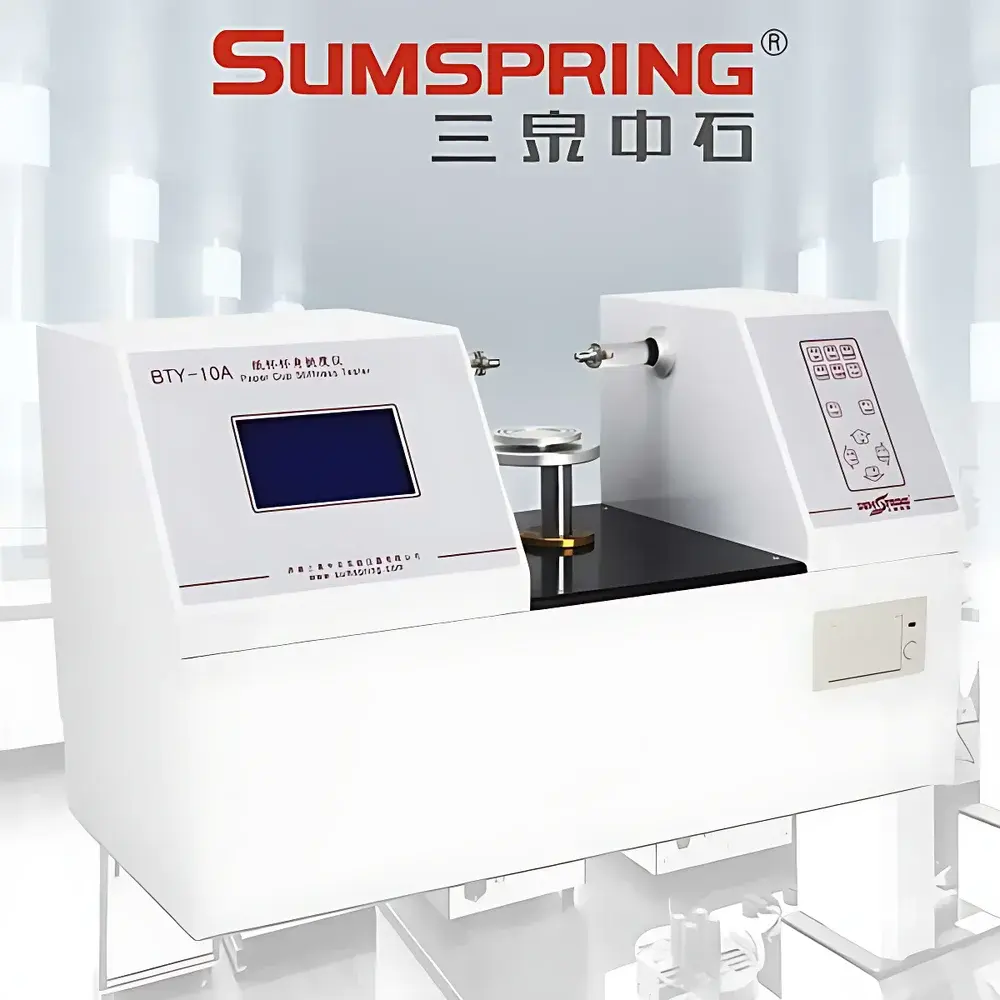
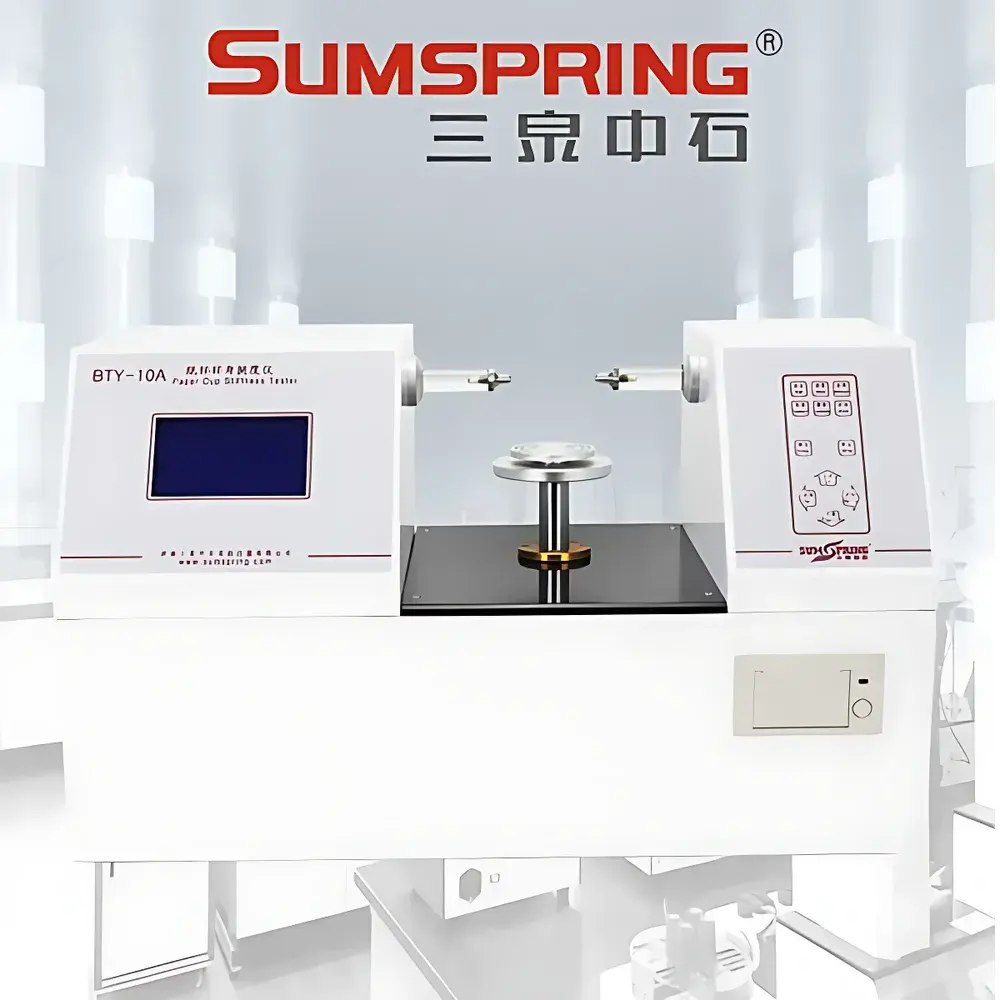
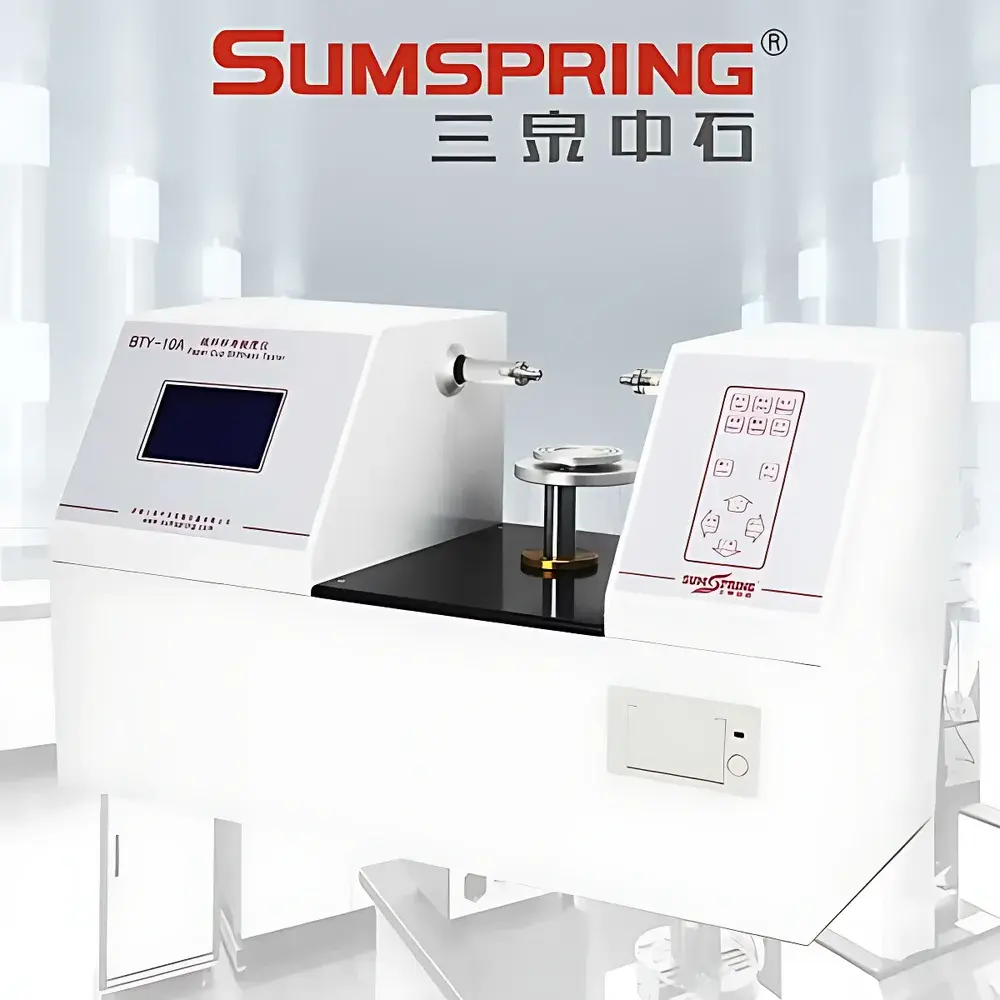
SumSpring BTY-10S Paper Cup and Bowl Stiffness Tester
| Brand | SumSpring |
|---|---|
| Origin | Shandong, China |
| Manufacturer Type | Direct Manufacturer |
| Country of Origin | China |
| Model | BTY-10S |
| Price | Upon Request |
| Measurable Cup Diameter | 20–150 mm |
| Measurable Cup Height | 15–120 mm |
| Force Measurement Range | 0–20 N |
| Force Resolution | 0.01 N |
| Accuracy | ±1% of full scale |
| Dimensions (L×W×H) | 560 × 270 × 350 mm |
| Weight | ≤34 kg |
| Operating Temperature | 10–35 °C |
| Power Supply | 220 V, 50 Hz |
| Relative Humidity | ≤80%, non-condensing |
Overview
The SumSpring BTY-10S Paper Cup and Bowl Stiffness Tester is an electromechanical bending resistance instrument engineered for quantitative evaluation of sidewall rigidity in disposable paper-based food containers—including single-wall and double-wall paper cups, laminated hot-drink cups, wax-coated frozen-dessert cups, corrugated bowls, and molded fiber containers. It operates on the principle of controlled angular deflection under axial load: a precision-driven probe applies incremental vertical force to the mid-height lateral surface of a vertically oriented cup or bowl, while high-resolution load cell feedback records the resulting deformation resistance in newtons (N). This method aligns with standardized mechanical testing paradigms used in packaging materials characterization—specifically reflecting cup-body stiffness under simulated functional loading (e.g., hand-held grip, stacking pressure, or liquid-induced wall bulge). The device does not measure tensile strength, burst resistance, or seal integrity; rather, it isolates and quantifies the structural rigidity essential for user safety, thermal insulation retention, and dimensional stability during service.
Key Features
- Motorized linear actuation system with programmable speed control ensures repeatable probe displacement across test cycles.
- High-accuracy S-type load cell calibrated to ISO 376 Class C accuracy, delivering 0.01 N resolution and ±1% full-scale error compliance.
- Adjustable sample holder accommodates cylindrical and tapered containers with diameters from 20 mm to 150 mm and heights between 15 mm and 120 mm—covering standard coffee cup, soup bowl, and takeaway container geometries.
- Integrated digital display with real-time force curve visualization enables immediate pass/fail assessment against internal specification thresholds.
- Robust aluminum alloy frame and anti-vibration base minimize environmental interference, supporting stable measurements in QC laboratories and production-floor environments.
- No consumables or calibration fluids required; annual verification via traceable dead-weight standards satisfies ISO/IEC 17025 metrological traceability requirements.
Sample Compatibility & Compliance
The BTY-10S is validated for use with paperboard substrates ranging from 180 g/m² solid bleached sulfate (SBS) to composite structures incorporating polyethylene (PE), polylactic acid (PLA), or paraffin coatings. It supports testing of both dry-state and conditioned specimens (per ASTM D685 and ISO 187 preconditioning at 23 °C / 50% RH). While not itself certified to a specific international standard, its measurement methodology is consistent with the physical principles underlying TAPPI T 813 (Stiffness of Corrugated Board) and ASTM D2923 (Standard Test Method for Stiffness of Rigid Plastic Containers), adapted for thin-walled cylindrical forms. Data output meets GLP documentation requirements when paired with external logging software, and the instrument’s mechanical design conforms to IEC 61000-6-2 (immunity) and IEC 61000-6-3 (emission) electromagnetic compatibility directives.
Software & Data Management
The BTY-10S operates in standalone mode with local display and manual data recording. For integrated quality management systems, optional RS-232 or USB-to-serial interface enables bidirectional communication with third-party LIMS or MES platforms. When connected, raw force vs. displacement datasets—including peak load, yield point, and slope-derived stiffness coefficient—are exported in CSV format. Audit trail functionality (user ID, timestamp, test parameters, result) can be implemented via external software compliant with FDA 21 CFR Part 11 requirements, including electronic signatures and change control logs. Calibration history, operator credentials, and environmental monitoring data (temperature/humidity) may be appended to each test record to support GMP-aligned packaging validation protocols.
Applications
- Quality assurance of hot beverage cups to prevent heat transfer through softened walls during consumer handling.
- Validation of cold-chain packaging integrity for dairy-based desserts where wax migration or moisture absorption reduces structural modulus.
- Comparative analysis of bio-based barrier coatings (e.g., PLA vs. PHA) under accelerated aging conditions.
- R&D screening of recycled fiber blends to quantify stiffness loss attributable to fibrillation or hornification.
- Supplier qualification testing per customer-specified minimum stiffness thresholds (e.g., ≥8.5 N at 10 mm deflection for 12 oz coffee cups).
- Root cause investigation of field complaints related to cup collapse, leakage, or ergonomic discomfort.
FAQ
What standards does the BTY-10S comply with?
The instrument implements a physically grounded stiffness measurement protocol compatible with principles in ASTM D2923 and TAPPI T 813, though it is not pre-certified to any single standard. Users must define acceptance criteria based on product specifications and regulatory expectations.
Can the tester evaluate paper bowls with non-circular cross-sections?
It is optimized for rotationally symmetric containers. Oval or square bowls require custom fixturing and are outside the validated operating envelope.
Is temperature-controlled testing possible?
No built-in environmental chamber is included; however, the unit may be operated within climate-controlled labs meeting ISO 17025 ambient stability requirements (±1 °C over test duration).
How often does the load cell require recalibration?
Annual verification using NIST-traceable weights is recommended; more frequent checks are advised if used in high-cycle production environments or after mechanical shock events.
Does the BTY-10S support automated pass/fail reporting?
Yes—when interfaced with external software, threshold-based logic can trigger alerts, generate PDF certificates, and archive results in structured databases aligned with ISO 9001 Clause 8.6 requirements.




