
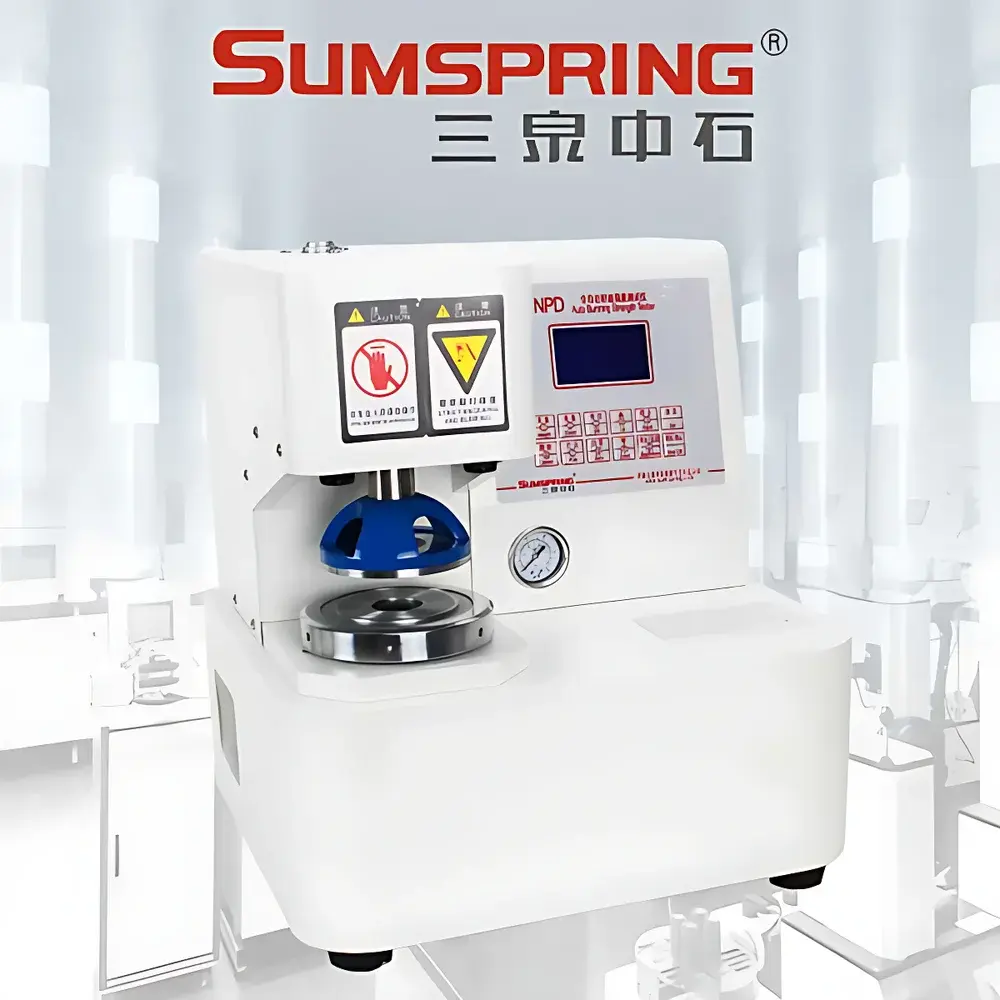
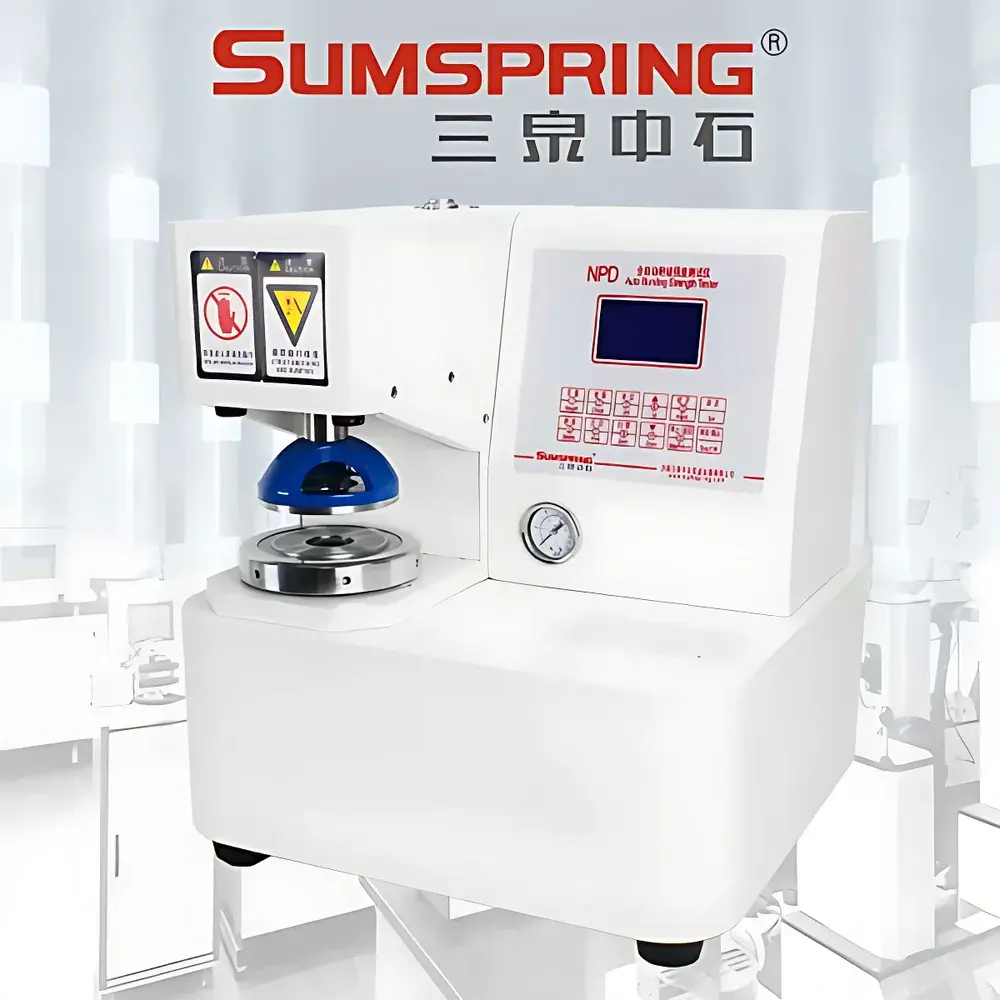
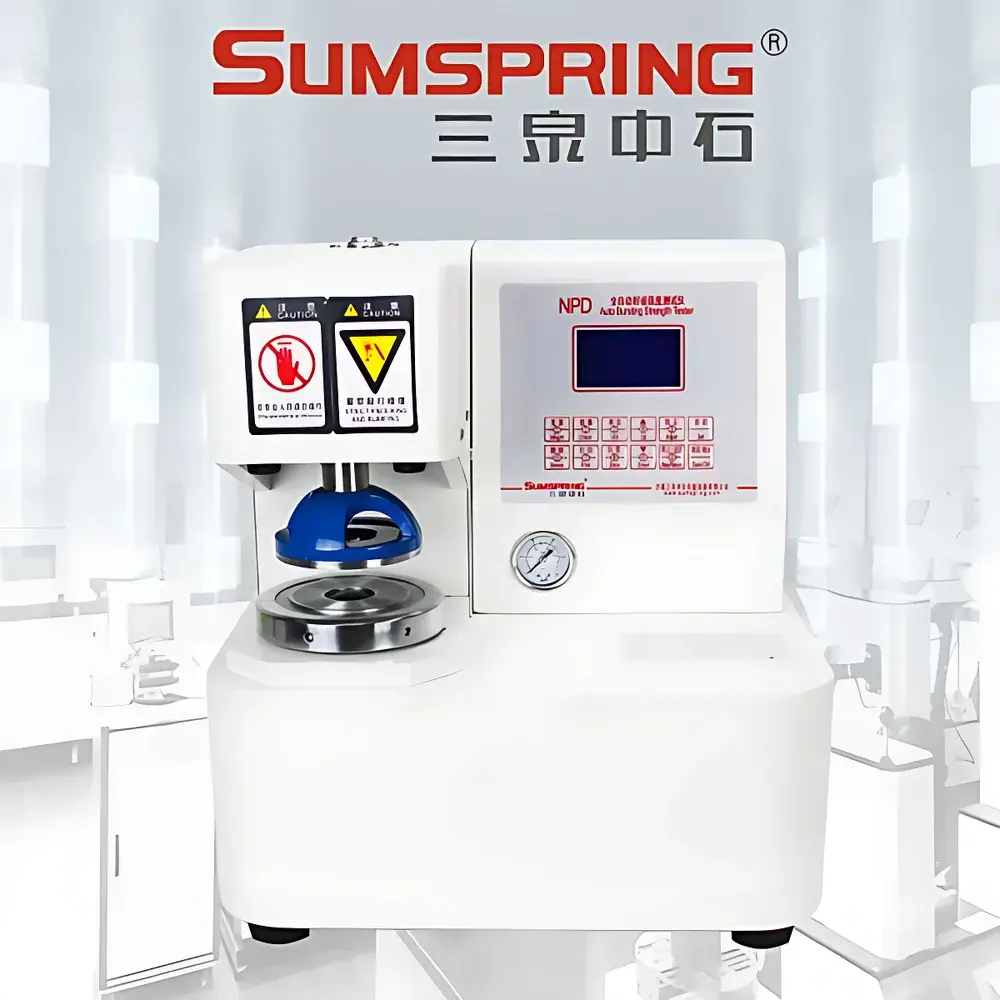
SumSpring NPD-1000S Pharmaceutical Aluminum Foil Bursting Strength Tester
| Brand | SumSpring |
|---|---|
| Origin | Shandong, China |
| Manufacturer Type | Direct Manufacturer |
| Country of Origin | China |
| Model | NPD-1000S |
| Price | Upon Request |
| Measurement Range | 40–1600 kPa |
| Resolution | 0.01 kPa |
| Accuracy | ±0.5% FS |
| Hydraulic Fluid Displacement Rate | 95 ± 5 mL/min |
| Diaphragm Resistance | 25–35 kPa |
| Diaphragm Bulge Height | 9 mm |
| Clamping Force | >430 kPa (adjustable) |
| System Seal Integrity | <10% pressure drop within 1 min at Pmax |
| Pressure Gauge Set Point | 2.5–3.0 kg/cm² |
| Dimensions (L×W×H) | 400 × 350 × 500 mm |
| Weight | 33 kg |
| Required Air Supply | 0.5–0.7 MPa (user-provided) |
| Operating Temperature | 15–50 °C |
| Relative Humidity | ≤80%, non-condensing |
| Power Supply | 220 V, 50 Hz |
Overview
The SumSpring NPD-1000S Pharmaceutical Aluminum Foil Bursting Strength Tester is a precision-engineered instrument designed to quantify the bursting resistance of pharmaceutical-grade aluminum foil under controlled hydraulic loading conditions. It operates on the principle of the diaphragm bulge method, as specified in Chinese Pharmacopoeia (ChP) and aligned with ISO 2758:2014 (Paper and board — Determination of bursting strength) and ASTM D774/D774M (Standard Test Method for Bursting Strength of Paper and Paperboard). In this method, a circular foil specimen is clamped between two concentric annular rings and sealed against a calibrated elastomeric diaphragm. A precisely metered hydraulic fluid is introduced beneath the diaphragm at a constant volumetric rate, causing uniform radial expansion. The foil deforms with the diaphragm until catastrophic failure occurs; the peak pressure recorded at rupture—expressed in kilopascals (kPa)—constitutes the bursting strength value. This measurement directly correlates with the foil’s ability to withstand mechanical stress during blister packaging formation, transportation, and end-user handling—critical parameters influencing barrier integrity, dose containment, and sterility maintenance.
Key Features
- Microprocessor-based control system with real-time pressure monitoring and automatic data capture
- High-resolution LCD interface displaying dynamic pressure curve, peak value, and test duration
- Adjustable clamping force (>430 kPa) ensures consistent specimen immobilization without edge damage or slippage
- Calibrated elastomeric diaphragm with defined bulge height (9 mm) and low intrinsic resistance (25–35 kPa), minimizing baseline offset
- Stable hydraulic displacement pump delivering 95 ± 5 mL/min flow rate per ISO-compliant test protocol
- Integrated thermal-stable pressure transducer with ±0.5% full-scale accuracy and 0.01 kPa resolution
- Sealed test chamber validated for leakage integrity (<10% pressure decay over 60 s at Pmax)
- Thermal management design enabling stable operation across ambient temperatures from 15 °C to 50 °C
Sample Compatibility & Compliance
The NPD-1000S accommodates standard circular specimens of 100 mm diameter (per ChP and ISO 2758), compatible with laminated pharmaceutical aluminum foils (e.g., Al/PVC, Al/PVDC, Al/PE structures) used in cold-forming and thermoforming blister packs. Its mechanical and metrological design conforms to requirements outlined in YY/T 0698.2–2018 (Packaging materials for medical devices — Part 2: Sterile barrier systems for heat sterilization — Requirements for aluminium foil), GB/T 28287–2012 (Aluminum foil for pharmaceutical packaging), and supports audit readiness for GMP environments. While not inherently 21 CFR Part 11 compliant, the instrument’s deterministic analog signal path and manual printout output facilitate integration into laboratory quality systems requiring traceable, operator-verified records. Calibration certificates are traceable to national metrology institutes (NIM, China).
Software & Data Management
The NPD-1000S features embedded firmware with no external PC dependency. All test parameters—including date/time stamp, operator ID input, burst pressure, and pass/fail status relative to user-defined limits—are stored in non-volatile memory (up to 100 test records). Results are automatically printed via integrated thermal printer with permanent, tamper-evident hardcopy output. For laboratories implementing electronic quality management systems (eQMS), raw pressure vs. time data can be manually transcribed or exported via optional RS-232 interface (available upon request) for downstream analysis in validated spreadsheet or LIMS platforms. Audit trail functionality follows ALCOA+ principles when paired with procedural controls (e.g., documented calibration logs, operator training records, and equipment usage logs).
Applications
- Quality control release testing of aluminum foil supplied to pharmaceutical blister packaging manufacturers
- In-process verification during foil lamination and slitting operations
- Stability studies assessing mechanical degradation of foil barriers under accelerated aging conditions
- Supplier qualification and incoming material inspection per ICH Q5C and Q7 guidelines
- Root cause analysis of blister pack seal failures linked to substrate mechanical weakness
- Regulatory submission support for packaging validation dossiers (e.g., CMC sections of IND/NDA filings)
FAQ
What standards does the NPD-1000S comply with?
It is engineered to meet the physical test requirements of YY/T 0698.2–2018, GB/T 28287–2012, and ISO 2758:2014, with operational alignment to ASTM D774 for comparative benchmarking.
Is the instrument suitable for non-pharmaceutical foils (e.g., food-grade or industrial aluminum foil)?
Yes—while optimized for pharmaceutical specifications, its 40–1600 kPa range and adjustable clamping force accommodate broader foil thicknesses (typically 20–100 µm) and composite structures used in food and consumer packaging.
Does the system require periodic recalibration?
Yes—annual calibration against certified reference pressure standards is recommended; calibration intervals should be risk-assessed per ISO/IEC 17025 and internal SOPs.
Can test data be exported digitally for LIMS integration?
The base configuration outputs thermal-printed reports; optional RS-232 serial output enables ASCII-formatted data transfer to validated external systems when configured with appropriate interface protocols and cybersecurity controls.
What maintenance is required for long-term reliability?
Routine checks include diaphragm visual inspection for micro-tears, hydraulic fluid level verification, air filter cleaning (for pneumatic assist models), and annual verification of pressure transducer linearity and zero drift.







