
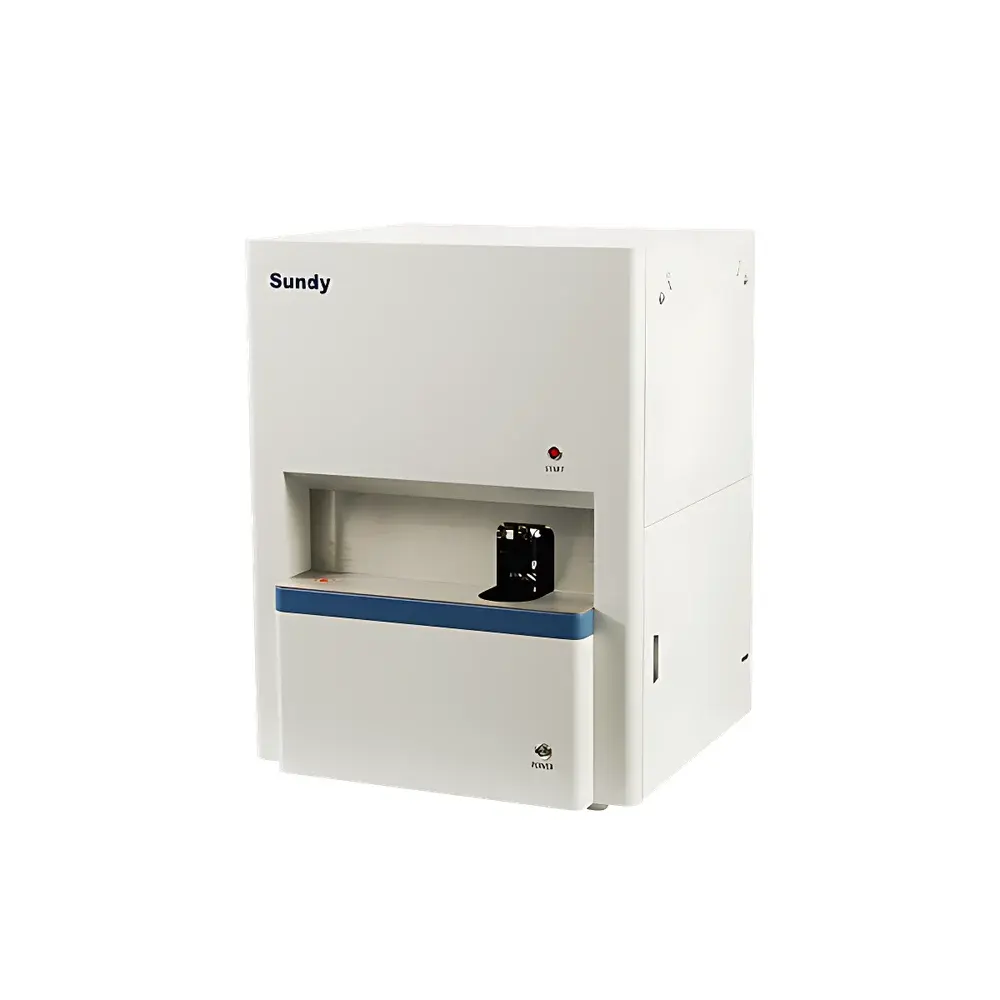
Sundhy SDAF1200(a/b) Ash Fusion Temperature Tester
| Brand | Sundhy |
|---|---|
| Origin | Hunan, China |
| Model | SDAF1200(a/b) |
| Sample Capacity | 1–10 specimens |
| Temperature Range | Ambient to 1600 °C |
| Temperature Resolution | 1 °C |
| Temperature Control Accuracy | ±1 °C |
| Atmosphere Control | Oxidizing / Weakly Reducing (SDAF1200a: Carbon-Sealing Method only |
| SDAF1200b | Carbon-Sealing + Gas-Flow Method with CO/CO₂ or H₂/CO₂ mixtures) |
| Max. Power | 4.2 kW |
| Supply Voltage | AC 220 V ±10%, 50 Hz ±1 Hz |
| Dimensions (W×D×H) | 850 mm × 550 mm × 843 mm |
| Net Weight | ~108 kg |
| Compliance | GB/T 219–2008, GB/T 30726–2014 |
Overview
The Sundhy SDAF1200(a/b) Ash Fusion Temperature Tester is a fully automated, high-temperature furnace system engineered for precise determination of ash fusion temperatures (AFT) in solid fuels—including coal, biomass, and industrial residues—according to internationally referenced national standards. It operates on the principle of controlled thermal ramping under defined atmospheric conditions, while continuously imaging ash cone morphology changes (deformation, softening, hemispherical, and fluid temperatures) via high-resolution digital video capture. The instrument integrates a programmable high-stability heating chamber (up to 1600 °C), dual-atmosphere capability (oxidizing and weakly reducing), and real-time image-based feature detection—enabling objective, repeatable identification of critical AFT transition points without manual observer bias. Designed specifically for routine quality control and research applications in power generation, metallurgical feedstock evaluation, cement raw material assessment, and regulatory compliance testing, the SDAF1200 series delivers metrological traceability aligned with ISO/IEC 17025 laboratory management principles.
Key Features
- Automated sample handling: Patented motorized sample insertion/retrieval mechanism accommodates 1–10 standardized ash cones per batch, reducing operator intervention and improving throughput consistency.
- Dual-atmosphere flexibility: SDAF1200a supports carbon-sealing method only; SDAF1200b extends compatibility to gas-flow atmosphere control using certified CO/CO₂ or H₂/CO₂ mixtures—enabling strict adherence to GB/T 219–2008 Annex B and GB/T 30726–2014 requirements.
- Optimized optical path design: Single-side imaging configuration—co-located with visual observation port—eliminates parallax error and ensures identical perspective for both human and algorithmic interpretation of cone geometry evolution.
- Thermal integrity engineering: High-purity imported refractory materials (including furnace lining, combustion tube, and crucible) withstand sustained operation at 1600 °C; graphite cup design enhances carbon activity uniformity and minimizes atmosphere stratification.
- Integrated safety monitoring: Real-time gas leakage detection with audible/visual alarm and automatic furnace shutdown—compliant with IEC 61508 functional safety guidelines for laboratory equipment.
- Low-maintenance architecture: Anti-spill grooves on ash cone support plates collect molten residue, preventing adhesion to fixtures and extending service intervals between cleaning cycles.
Sample Compatibility & Compliance
The SDAF1200 series accepts standard ash cones prepared per GB/T 219–2008 and GB/T 30726–2014 protocols—including coal ash, biomass ash (wood pellets, agricultural residues), municipal solid waste incineration fly ash, and blended fuel ashes. Its temperature calibration traceability is maintained against NIST-traceable reference materials, and all operational parameters—including ramp rate profiles, dwell times, and atmosphere switching sequences—are programmable to match method-defined procedural constraints. The system meets essential requirements for GLP-compliant laboratories: full audit trail logging (user actions, temperature setpoints, gas flow events), electronic signature support, and data immutability safeguards aligned with FDA 21 CFR Part 11 expectations for regulated environments.
Software & Data Management
Embedded firmware and PC-based analysis software provide synchronized acquisition of thermal, imaging, and gas-control data streams. Video sequences are time-stamped and georeferenced to furnace temperature, enabling frame-by-frame correlation of morphological transitions with thermal history. Automated image processing algorithms apply edge-detection and contour fitting to determine deformation (DT), softening (ST), hemispherical (HT), and fluid (FT) temperatures—outputting results in CSV and PDF report formats compatible with LIMS integration. All raw video archives, processed metadata, and instrument logs are stored with SHA-256 hash verification to ensure data integrity across retention periods exceeding 10 years.
Applications
- Coal quality assurance in thermal power plants and coke production facilities
- Biomass co-firing suitability assessment in utility-scale boilers
- Slagging and fouling propensity prediction for boiler design and operational optimization
- Raw material qualification in cement kiln feedstock blending
- Research into ash behavior under varying oxygen partial pressures and alkali-to-acid ratios
- Regulatory submission support for environmental impact assessments and emissions permit renewals
FAQ
What distinguishes SDAF1200a from SDAF1200b?
SDAF1200a supports only the carbon-sealing method for weakly reducing atmospheres, whereas SDAF1200b adds programmable gas-flow capability using certified CO/CO₂ or H₂/CO₂ mixtures—enabling full compliance with both GB/T 219–2008 and GB/T 30726–2014 Annex C requirements.
Is the system compliant with international standards beyond Chinese national standards?
While primarily validated against GB/T 219 and GB/T 30726, its measurement methodology aligns with ASTM D1857 and ISO 540 practices for ash fusibility determination; users may adapt procedures under method validation per ISO/IEC 17025 Clause 7.2.2.
How is temperature calibration verified during routine use?
Built-in calibration mode allows verification using traceable Pt/Pt–Rh thermocouples at three fixed points (800 °C, 1200 °C, 1500 °C); certificate of calibration is issued annually by accredited third-party metrology labs.
Can the system be integrated into an existing laboratory network?
Yes—Ethernet connectivity supports remote monitoring, scheduled batch execution, and secure data export via TLS 1.2–encrypted API endpoints compatible with common LIMS platforms.
What maintenance intervals are recommended for optimal long-term performance?
Quartermly inspection of quartz viewport cleanliness, annual replacement of high-temperature gaskets and thermocouple assemblies, and biannual verification of gas mass flow controllers—documented in the included Preventive Maintenance Logbook.






