
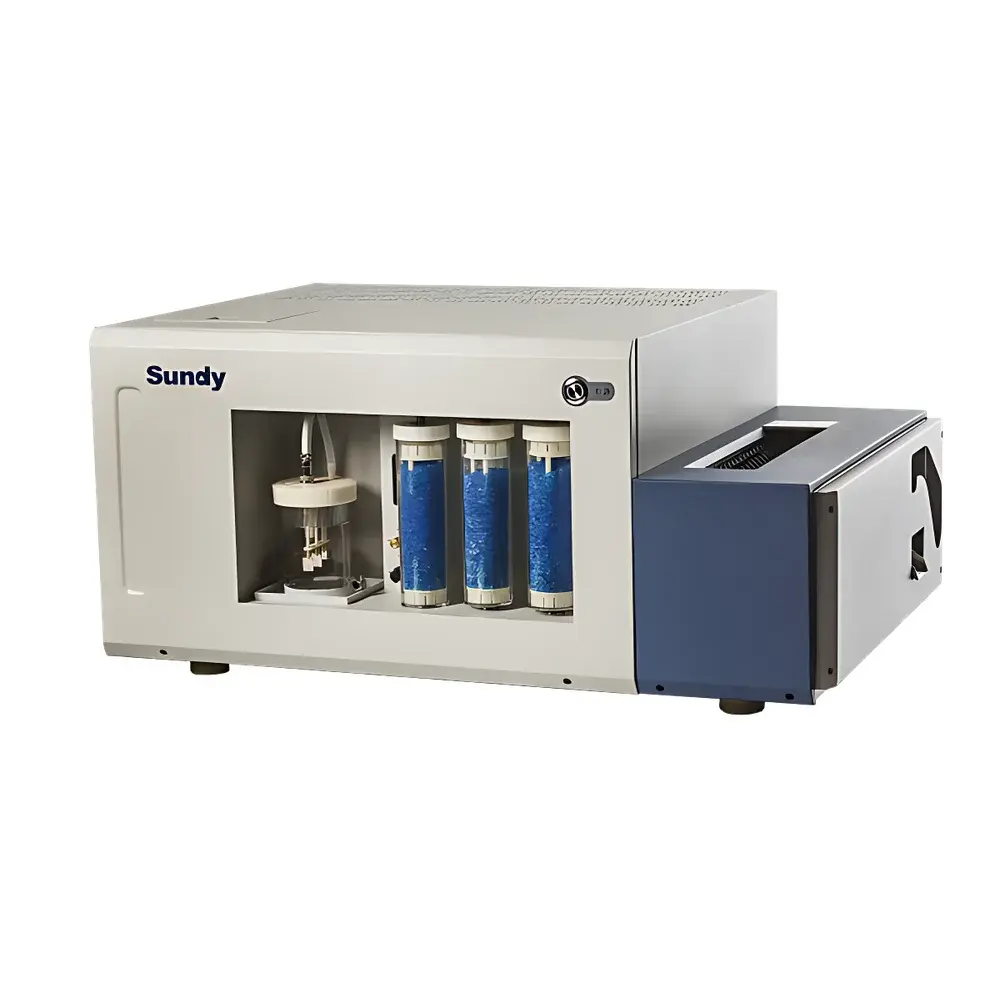
Sundhy SDS720 Automatic Coulometric Sulfur Determinator
| Brand | Sundhy |
|---|---|
| Model | SDS720 |
| Principle | Coulometric Titration |
| Origin | Hunan, China |
| Measuring Range | 0.01–40% S |
| Sulfur Resolution | 0.001% |
| Temperature Control Accuracy | ±1°C |
| Sample Mass | ~50 mg (adjustable) |
| Combustion Furnace Temperature | (1150±5)°C for coal & coke |
| Max. Sample Capacity | 21 positions |
| Avg. Analysis Time | ~200 s per sample |
| Max. Power Consumption | 4 kW |
| Supply Voltage | AC 220 V ±10%, 50 Hz ±1 Hz |
| Dimensions (W×D×H) | 610 × 890 × 410 mm |
| Net Weight | ~81 kg |
| Compliance | GB/T 214–2007, JJG 1006–2005 |
Overview
The Sundhy SDS720 Automatic Coulometric Sulfur Determinator is a high-precision, fully automated instrumentation system engineered for quantitative determination of total sulfur content in solid and liquid combustible materials—including coal, coke, petroleum products, solid biofuels, and cement. It operates on the fundamental principle of coulometric titration: samples are combusted quantitatively in a high-temperature furnace under controlled oxygen flow, converting all sulfur species into sulfur dioxide (SO₂); the evolved SO₂ is carried by carrier gas into an electrolytic cell where it is absorbed and oxidized at the anode, generating a stoichiometric current proportional to sulfur mass. The instrument integrates hardware-based charge integration—implemented via a dedicated microcontroller—to ensure complete and drift-free Faradayic accumulation of electrochemical charge, eliminating data loss inherent in software-only integration methods. This architecture delivers traceable, reproducible results aligned with regulatory requirements for quality control laboratories operating under ISO/IEC 17025, ASTM D3177, and USP .
Key Features
- 21-position automatic sample carousel enabling unattended sequential analysis with real-time sample queue management—users may insert or replace samples mid-run without interrupting ongoing measurements.
- Dual-rod sample delivery mechanism with anti-skip chain design ensures mechanical stability, eliminates sample tipping or jamming, and extends long-term operational reliability under thermal cycling conditions.
- Enhanced electrolytic cell featuring widened and thickened platinum electrodes to maximize SO₂ oxidation efficiency and improve charge collection completeness—directly contributing to measurement accuracy and repeatability (RSD ≤ 0.5% at 1–5% S level).
- High-efficiency thermal insulation furnace constructed with imported refractory composite material, maintaining stable setpoint temperature (±1°C) across extended operation cycles and supporting multi-temperature combustion protocols per matrix-specific standards.
- Integrated moisture management system: optimized gas flow path geometry minimizes water vapor carryover into the desiccant column; paired with a large-capacity drying tube, this reduces desiccant replacement frequency by up to 40% compared to conventional designs.
- Oil-free, maintenance-free diaphragm pump with sealed bearing assembly eliminates elastomer degradation risks and ensures >10,000 hours of continuous service life without consumable replacement.
- One-touch pneumatic integrity check: operator initiates automatic pressure decay test with single manual actuation—no external gauges or calibration tools required.
- Corrosion-resistant electrolyte containment architecture including secondary leak containment tray and chemically inert gasketing—prevents electrolyte migration damage to electronics and structural components.
- Acoustic damping enclosure reduces operational noise to <55 dB(A), meeting occupational health guidelines for laboratory environments.
Sample Compatibility & Compliance
The SDS720 accommodates heterogeneous solid and semi-solid matrices including bituminous and anthracite coals, metallurgical coke, lignite, biomass pellets, cement clinker, and residual fuel oils. Its programmable furnace temperature profiles conform to method-specific thermal requirements defined in GB/T 214–2007 (coal), JJG 1006–2005 (instrument verification), and internationally referenced procedures such as ASTM D4294 (XRF-based sulfur) and ISO 4297 (combustion–coulometric). All measurement outputs include full audit trails compliant with GLP and GMP documentation frameworks—including timestamped raw charge integrals, furnace thermocouple logs, and user action records—facilitating 21 CFR Part 11 readiness when paired with validated LIMS integration.
Software & Data Management
The embedded Windows-based control software provides intuitive workflow navigation, customizable method templates, and real-time visualization of electrolysis current, integrated charge, and temperature profiles. Data export supports CSV, XML, and PDF formats with embedded metadata (operator ID, sample ID, calibration certificate reference, uncertainty budget). Audit trail functionality captures every parameter change, result override, and system event with immutable timestamps and user authentication. Optional network-enabled remote monitoring allows centralized instrument status tracking across multi-lab deployments without compromising local data sovereignty.
Applications
Primary use cases span coal trading QA/QC (ASTM D3177 compliance), power plant fuel acceptance testing, cement manufacturing process control (EN 196-2 sulfur specification), environmental emissions reporting (EPA Method 19), and R&D for low-sulfur alternative fuels. The instrument’s wide dynamic range (0.01–40% S) and sub-milligram resolution make it suitable for both routine high-throughput screening and low-level sulfur speciation studies requiring metrological rigor.
FAQ
What standards does the SDS720 comply with for coal analysis?
It meets the technical and procedural requirements of GB/T 214–2007 and JJG 1006–2005, and its measurement principle aligns with ASTM D3177 and ISO 4297 for coulometric sulfur determination.
Can the instrument analyze liquid samples such as fuel oil?
Yes—the system supports calibrated combustion at 900±5°C for petroleum-based liquids and includes optional ceramic crucibles and ash-trap configurations to prevent splashing and ensure complete volatilization.
Is hardware-based charge integration mandatory for regulatory compliance?
For GLP/GMP environments requiring data integrity and traceability, hardware-integrated Faradayic measurement is strongly recommended over software-only integration due to its immunity to timing jitter, CPU load effects, and buffer overflow artifacts.
How often must the desiccant be replaced during continuous operation?
Under typical coal analysis conditions (20 samples/day), the large-capacity drying tube requires replacement every 7–10 days—significantly extending maintenance intervals versus standard 100-g columns.
Does the SDS720 support remote diagnostics or firmware updates?
Yes—via secure HTTPS-enabled web interface, authorized technicians can perform version-controlled firmware upgrades and access diagnostic logs without physical access to the instrument.







