
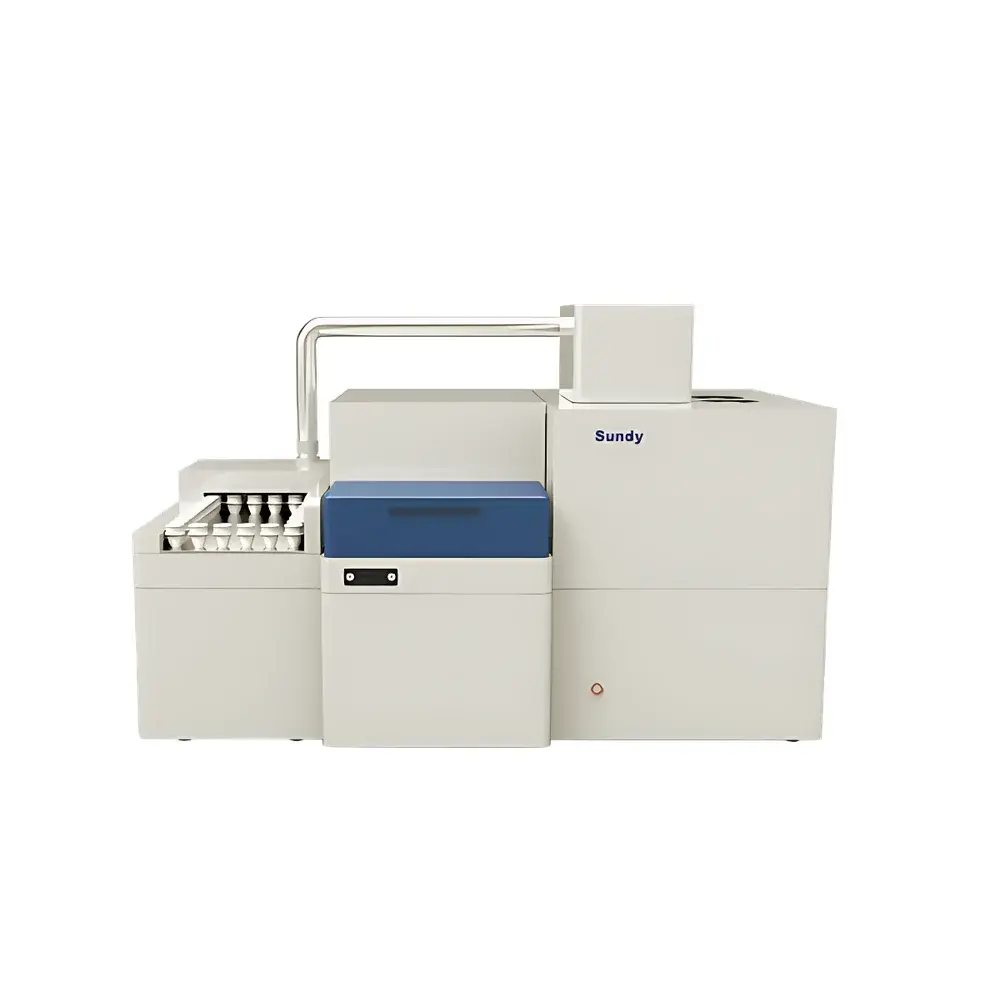
Sundhy SDTGA1200 Coal Quality Industrial Analyzer
| Brand | Sundhy |
|---|---|
| Origin | Hunan, China |
| Model | SDTGA1200 |
| Sample Mass Range | 0.5–1.1 g (user-definable) |
| Furnace Temperature Range | Ambient to 1000 °C |
| Number of Samples per Run | 18 |
| Temperature Control Accuracy | ±2 °C |
| Full Industrial Analysis Cycle Time | ≤8 h for 54 samples (3 batches) |
| Max Power Consumption | 5.5 kW |
| Supply Voltage | AC 220 V ±10 %, 50 Hz ±1 Hz |
| Balance Resolution | 0.1 mg |
| Compliance | GB/T 212–2008, GB/T 30732–2014, ASTM D5142–2009 |
Overview
The Sundhy SDTGA1200 Coal Quality Industrial Analyzer is an automated thermogravimetric system engineered for precise, high-throughput industrial analysis of solid fuels in accordance with internationally recognized standards. It implements sequential and parallel thermal decomposition protocols—moisture loss (105–110 °C), volatile matter evolution (900 °C under inert atmosphere), and ash residue determination (815 °C under oxidizing conditions)—to deliver fully compliant proximate analysis data for coal, coke, solid biomass, fly ash, cement clinker, and calcined petroleum coke. Its dual-furnace architecture, coupled with two physically isolated analytical balances, enables true concurrent measurement of independent sample sets without thermal cross-talk or mass drift—addressing a key limitation of single-balance instruments. The system operates on a rigid aluminum reference base that maintains long-term mechanical alignment between sample trays, robotic handling arms, and crucible transfer stations, ensuring positional repeatability over thousands of cycles.
Key Features
- Dual independent furnace modules with separate temperature control zones—enabling simultaneous moisture/ash or volatile/ash testing per batch.
- Two high-resolution microbalances (0.1 mg resolution), each mounted outside the thermal envelope and shielded from radiant heat, airflow turbulence, and electrostatic interference.
- Integrated balance protection mechanism prevents coal dust ingress during weighing and transfer—reducing cleaning frequency and recalibration intervals by up to 60 % compared to conventional designs.
- Optimized furnace geometry: reduced door aperture, seamless bottom insulation, and controlled oxygen partial pressure minimizes oxidative loss during volatile matter determination—enhancing reproducibility and extending furnace lifetime by ≥3×.
- Automated crucible handling system with reinforced ceramic grippers, anti-tip crucible columns, and dedicated post-analysis transfer platform—eliminating mechanical dropping, cross-contamination, and crucible breakage.
- Onboard secondary combustion unit with multi-stage metal mesh filtration and programmable high-temperature ashing cycle—fully contained smoke abatement without external scrubbers or duct maintenance.
Sample Compatibility & Compliance
The SDTGA1200 supports standardized analysis of heterogeneous solid fuel matrices including bituminous and anthracite coals, metallurgical coke, torrefied biomass pellets, fluidized bed combustion fly ash, cement raw meal, and delayed-coked petroleum coke. All test sequences adhere strictly to gravimetric principles defined in GB/T 212–2008 and GB/T 30732–2014, with full traceability to NIST-traceable mass standards. Instrument validation includes daily balance linearity checks, furnace temperature uniformity mapping (per ASTM E220), and inter-laboratory round-robin verification against certified reference materials (CRMs) such as NIST SRM 1632e (Coal) and SRM 1635a (Coke). Data integrity meets GLP audit requirements, with electronic records retaining full metadata—including operator ID, environmental conditions, calibration logs, and real-time thermal profiles.
Software & Data Management
The embedded Windows-based control software provides ISO/IEC 17025-aligned workflow management: user-level access control (administrator, analyst, reviewer), electronic signatures, and immutable audit trails compliant with FDA 21 CFR Part 11. Each analysis generates a structured XML report containing raw mass-time curves, derivative thermograms (DTG), endpoint detection logic, and uncertainty propagation per GUM (JCGM 100:2008). Export formats include CSV, PDF/A-2b, and LIMS-ready HL7 ADT messages. Optional integration with enterprise laboratory information management systems (LIMS) supports automated result routing, QC flagging, and statistical process control (SPC) charting across shift operations.
Applications
- Proximate analysis (Moisture, Ash, Volatile Matter, Fixed Carbon) for coal procurement, blending, and boiler feedstock qualification.
- Residual carbon quantification in fly ash and bottom ash—critical for evaluating combustion efficiency and ESP performance.
- Loss on ignition (LOI) determination in Portland cement production and limestone quality control.
- Thermal stability assessment of activated carbons, biochars, and carbon black precursors.
- Method validation and routine QA/QC in ISO/IEC 17025-accredited fuel testing laboratories.
FAQ
Does the SDTGA1200 support ASTM D3172-compliant moisture determination?
Yes—the instrument executes the 105–110 °C isothermal drying step under controlled nitrogen purge, meeting all procedural requirements of ASTM D3172 and its harmonized equivalents.
Can the system be validated for GLP-regulated environments?
Yes—full IQ/OQ/PQ documentation packages are available, including balance calibration certificates, furnace mapping reports, and software validation protocols aligned with Annex 11 and ALCOA+ principles.
What maintenance intervals are recommended for the crucible handling mechanism?
The aluminum reference base and ceramic gripper assembly require no scheduled lubrication; visual inspection every 2000 cycles and vacuum filter replacement every 6 months constitute the complete preventive maintenance schedule.
Is remote diagnostics supported?
Yes—secure TLS-encrypted remote access allows authorized service engineers to monitor real-time thermal profiles, motor current draw, and balance stability metrics without compromising network security.
How is data integrity ensured during power interruption?
Non-volatile memory retains all active run states and mass/time data points; upon recovery, the system resumes heating and weighing from the last stable checkpoint without manual intervention.





