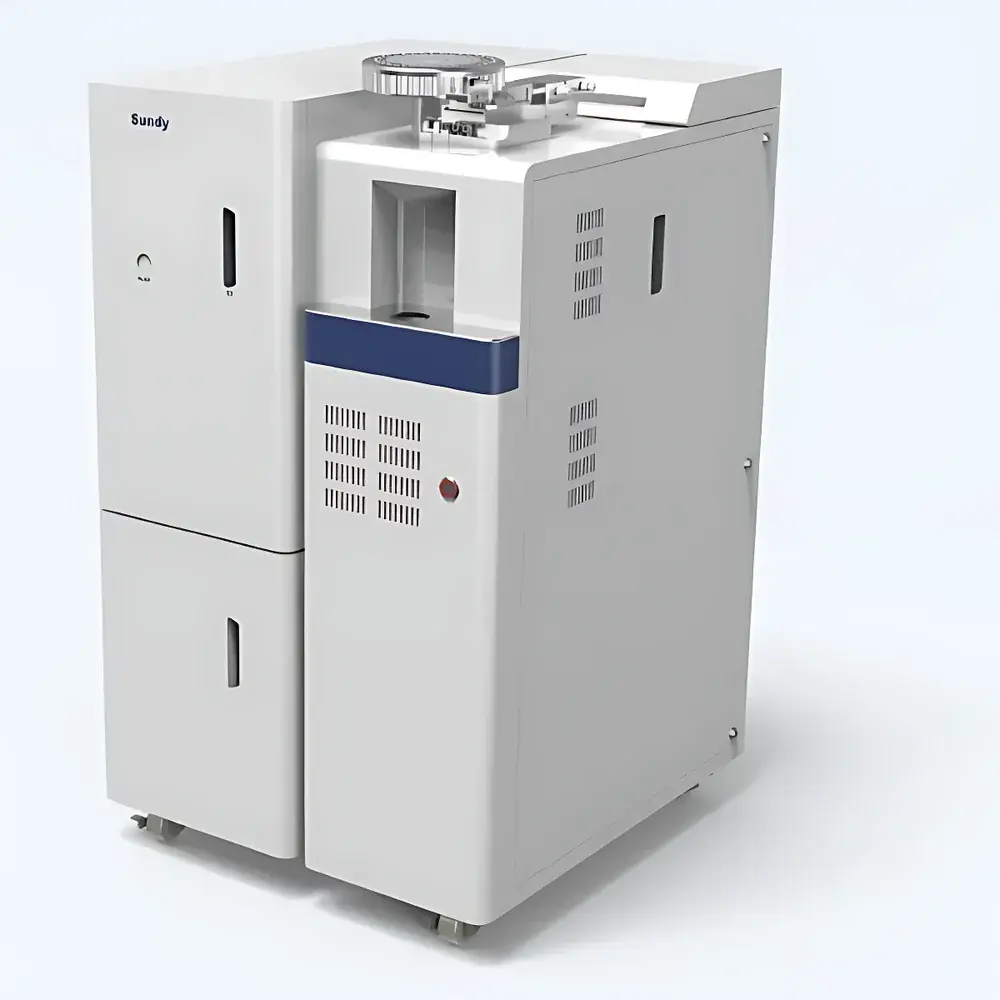
Sundy SDCHN435u Carbon-Hydrogen-Nitrogen Elemental Analyzer
| Brand | Sundy |
|---|---|
| Model | SDCHN435u |
| Origin | Hunan, China |
| Measurement Principle | Infrared Absorption (for C/H) and Thermal Conductivity Detection (for N) |
| Test Range | C (0.005–100 wt%), H (0.01–50 wt%), N (0.01–50 wt%) |
| Sample Capacity | 36 or 72 positions (online sample addition/replacement supported) |
| Sample Mass | 75–105 mg (recommended: 100 mg) |
| Repeatability | Compliant with GB/T 30733-2014 and ASTM D5373-08 |
| Analysis Time per Sample | 6–8 min |
| Power Consumption | ≤4.5 kW |
| Supply Voltage | AC 220 V ±10%, 50 Hz ±1 Hz |
| Gas Requirements | O₂ (≥99.99%, ≥1 MPa), N₂ (≥99.5%, ≥1 MPa), He (≥99.999%, ≥1 MPa |
| flow | 0.7 L/min during analysis, 0.05 L/min standby) |
| Dimensions | 710 × 660 × 1045 mm (L×W×H) |
| Weight | ~140 kg |
Overview
The Sundy SDCHN435u Carbon-Hydrogen-Nitrogen Elemental Analyzer is a fully automated, high-throughput combustion-based elemental analyzer engineered for precise quantification of carbon, hydrogen, and nitrogen in solid and liquid matrices—including coal, coke, biomass, petrochemical feedstocks, urea-based diesel exhaust fluid (AUS 32), cement raw materials, geological samples, and hazardous waste. It operates on a dual-detection principle: infrared absorption spectroscopy for carbon and hydrogen determination, and thermal conductivity detection (TCD) for nitrogen—both following complete high-temperature catalytic oxidation (≥1050 °C) in a controlled oxygen-rich environment. The instrument complies with internationally recognized standard methods including GB/T 30733-2014, ASTM D5373-08, and GB 29518-2013, ensuring data traceability and regulatory acceptability in QA/QC, R&D, and third-party testing laboratories across energy, environmental, and industrial sectors.
Key Features
- Fully automated sample handling: robotic carousel accommodates up to 72 samples; supports online insertion and replacement without interrupting ongoing analyses.
- Integrated crucible auto-replacement system: eliminates manual handling of hot ceramic crucibles, reducing operator exposure to thermal hazards and minimizing risk of combustion tube damage or furnace contamination.
- Dual-detector architecture: high-stability infrared cells with low-drift optical design for C/H measurement; ultra-low temperature-coefficient thermal conductivity cell with precision thermostatic control for N quantification.
- Optimized gas management: helium carrier flow dynamically regulated via integrated throttling valve—0.7 L/min only during injection and combustion phases; reduced to 0.05 L/min during standby—lowering operational cost and extending sensor lifetime.
- User-centric engineering: motorized leak-check sequence initiated via GUI; modular furnace assembly with independent combustion and desulfurization tubes; tool-free reagent cartridge replacement; heavy-duty casters with locking mechanism for stable positioning and safe relocation.
Sample Compatibility & Compliance
The SDCHN435u accepts a broad range of sample types—homogeneous solids (e.g., pulverized coal, activated carbon, catalysts), pressed pellets, and liquids (e.g., AUS 32, bio-oils, solvent extracts). Sample mass is precisely controlled between 75–105 mg, with 100 mg recommended for optimal signal-to-noise ratio and calibration linearity. All analytical protocols adhere to ISO/IEC 17025 requirements for method validation, and the system supports full audit trail generation for GLP/GMP environments. Data integrity is reinforced through hardware-level gas pressure monitoring, real-time furnace temperature logging, and automatic baseline correction algorithms compliant with FDA 21 CFR Part 11 expectations for electronic records.
Software & Data Management
The embedded Windows-based control software provides intuitive workflow navigation, method library management, and multi-level user access control (operator, supervisor, administrator). Each analysis generates timestamped raw spectra, integrated peak areas, calibration curves, and QC metrics—including %RSD against certified reference materials (CRMs). Export formats include CSV, PDF, and XML for LIMS integration. Optional reporting modules support automated certificate generation aligned with ISO 14040, ASTM E1534, and national coal quality reporting templates. All data modifications are logged with user ID, timestamp, and reason code to satisfy regulatory review requirements.
Applications
- Coal and coke quality control in power generation and metallurgical plants per ASTM D3176 and GB/T 211.
- Verification of AUS 32 purity (urea concentration, biuret, aldehydes) in accordance with ISO 22241 and GB 29518-2013.
- Characterization of nitrogen content in catalysts, fertilizers, and polymer precursors.
- Environmental analysis of nitrogen speciation in fly ash, sludge, and contaminated soils under EPA Method 9060A principles.
- Research-grade elemental profiling in biomass conversion studies, carbon capture material development, and geochemical surveys.
FAQ
What standards does the SDCHN435u comply with for coal analysis?
It meets GB/T 30733-2014 and ASTM D5373-08 for instrumental determination of C, H, and N in coal and related solid fuels.
Can the instrument analyze liquid samples such as urea solution without modification?
Yes—equipped with a dedicated liquid autosampler option and vaporization chamber; no hardware retrofit required for AUS 32 or similar aqueous solutions.
How is calibration maintained across long-term operation?
Calibration stability is ensured via daily drift correction using certified coal CRMs (e.g., NIST SRM 1632E) and internal reference gas pulses; optional scheduled recalibration routines are configurable in software.
Is helium consumption optimized during idle periods?
Yes—the system reduces helium flow to 0.05 L/min outside active analysis cycles, achieving >85% reduction in average carrier gas usage versus fixed-flow architectures.
Does the software support 21 CFR Part 11 compliance for pharmaceutical or regulated labs?
Full electronic signature capability, audit trail export, and role-based access control are available; validation documentation packages (IQ/OQ/PQ) can be supplied upon request.