
Sundy SDED Industrial Dust Extraction System
| Brand | Sundy |
|---|---|
| Origin | Hunan, China |
| Manufacturer Type | Authorized Distributor |
| Country of Origin | China |
| Model | SDED |
| Pricing | Available Upon Request |
| Airflow Capacity | 6000 m³/h or 10000 m³/h |
| Cleaning Method | Pulse-jet Reverse-air Filtration |
| Power Supply | 380 V AC, 7.5 kW / 11 kW |
| Control System | PLC-based Automated Control |
| Dust Removal Efficiency | ≥99.9% |
| Exhaust Emission Concentration | <4 mg/m³ |
| Minimum Capturable Particle Size | >0.5 µm |
| Operating Noise Level | <75 dB(A) |
| Vibration Acceleration | <6.5 mm/s² |
Overview
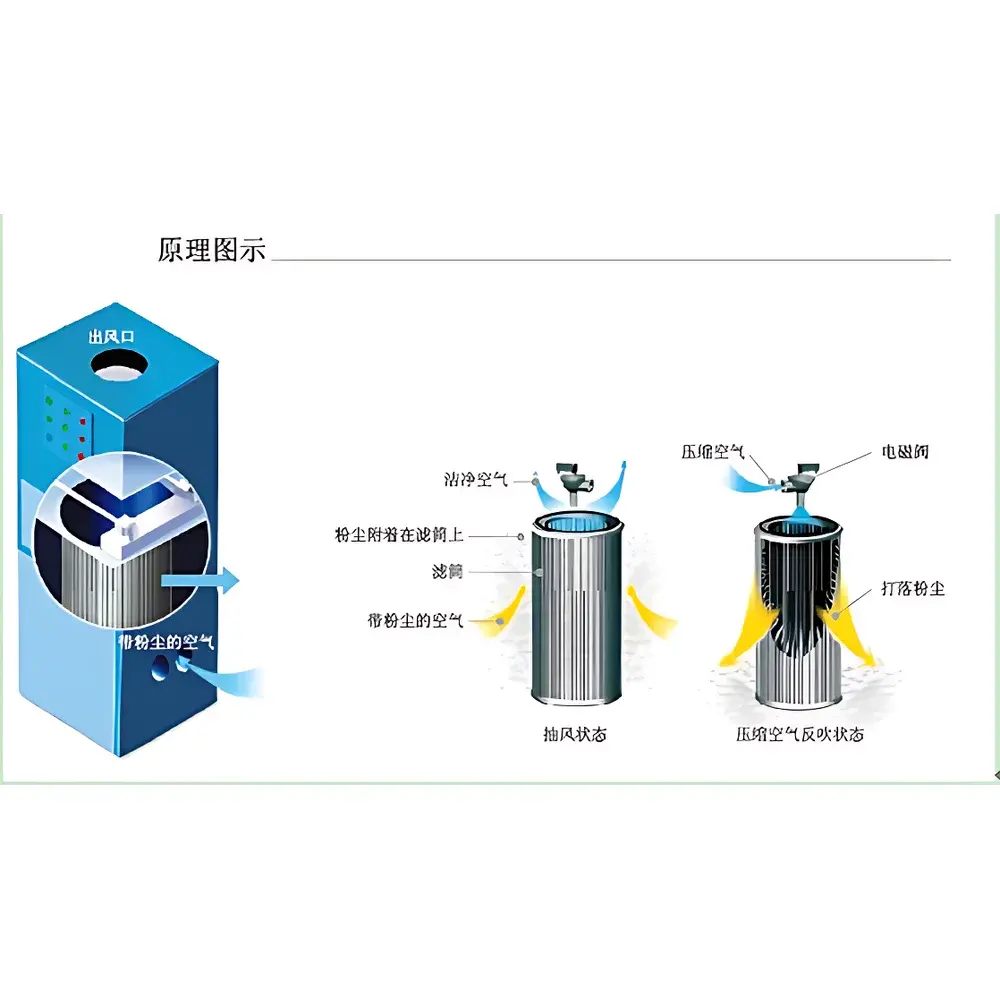
The Sundy SDED Industrial Dust Extraction System is an engineered solution for continuous ambient air purification in sample preparation environments across high-dust industrial sectors—including thermal power generation, coal handling and processing, metallurgy, petrochemical refining, and mineral beneficiation. Designed around the principle of pulse-jet reverse-air filtration, the system utilizes high-efficiency pleated cartridge filters to capture airborne particulates generated during crushing, grinding, sieving, and homogenization operations. Unlike baghouse systems requiring frequent manual intervention, the SDED integrates a self-cleaning mechanism that triggers timed or differential-pressure-activated compressed-air pulses to dislodge accumulated dust from filter media—restoring filtration capacity without process interruption. This architecture ensures uninterrupted operation over extended cycles while maintaining consistent pressure drop and airflow stability, critical for laboratories and QC facilities where environmental consistency directly impacts sample integrity and analyst safety.
Key Features
- Stable, High-Efficiency Filtration: Achieves ≥99.9% collection efficiency for particles larger than 0.5 µm, verified per ISO 16890:2016 methodology for coarse particulate separation; exhaust concentration remains below 4 mg/m³, compliant with China’s GB 16297–1996 and aligned with EU Directive 2010/75/EU (IED) emission benchmarks for stationary sources.
- Pulse-Jet Self-Cleaning Mechanism: Fully automated cleaning cycle eliminates routine filter replacement or manual tapping; programmable cleaning frequency and pulse duration are adjustable via PLC interface to match real-time dust loading profiles.
- Intelligent Variable-Air-Volume (VAV) Control: Integrated frequency converter dynamically modulates fan speed based on duct static pressure feedback or operator-defined setpoints—reducing energy consumption by up to 35% compared to fixed-speed equivalents under partial-load conditions.
- Human-Centric Operational Design: 7-inch capacitive touchscreen HMI supports multi-level user permissions (operator, technician, administrator), embedded diagnostic logging, alarm history with timestamps, and real-time visualization of airflow, pressure differential, motor current, and cleaning event counters.
- Low-Noise & Low-Vibration Engineering: Acoustically insulated housing, balanced impeller design, and vibration-damped mounting reduce operational noise to <75 dB(A) at 1 m distance and mechanical vibration acceleration to <6.5 mm/s²—meeting ISO 5349-1:2001 hand-arm vibration thresholds for prolonged occupational exposure.
Sample Compatibility & Compliance
The SDED system is purpose-built for integration into analytical sample preparation workflows where airborne dust compromises both personnel health and measurement repeatability. It is routinely deployed upstream of jaw crushers, hammer mills, disc grinders, and rotary splitters used in coal proximate analysis (ASTM D3172), ore grade determination (ISO 13909), and cement fineness testing (ASTM C204). All electrical components conform to IEC 60204-1:2018 safety standards; control logic architecture supports audit-ready event logging suitable for GLP-compliant laboratories. While not certified to FDA 21 CFR Part 11, its data retention and user-access controls meet foundational requirements for traceability in regulated industrial QA/QC settings.
Software & Data Management
The embedded PLC controller (Siemens S7-1200 series or equivalent) provides deterministic real-time response for all safety interlocks—including motor overload, filter clogging, and door-open detection. Historical operational data—including cumulative runtime, cleaning cycles, pressure differential trends, and fault codes—is stored locally for ≥30 days and exportable via USB or Modbus TCP to enterprise SCADA or CMMS platforms. Optional OPC UA gateway enables seamless integration with LIMS or MES systems for centralized monitoring of environmental KPIs across multiple sample prep stations.
Applications
- Coal sampling labs requiring compliance with ISO 18283 and ASTM D2234 during primary subsampling and size reduction.
- Metallurgical assay laboratories processing iron ore, bauxite, or copper concentrates prior to XRF or ICP-OES digestion.
- Cement plant QC labs performing Blaine fineness tests (ISO 20920) and loss-on-ignition analysis where airborne fines must be suppressed.
- Petrochemical refineries conducting catalyst activity testing involving abrasive powder handling.
- Independent third-party testing labs accredited to ISO/IEC 17025:2017, where documented air quality control is part of method validation protocols.
FAQ
What particle size range does the SDED system effectively capture?
The system is optimized for particles larger than 0.5 µm, with performance validated against ISO Coarse Dust Test Dust (ISO A2 Fine) and Arizona Road Dust (ISO 12103-1, A4). Sub-micron aerosols require supplementary HEPA-stage filtration.
Can the SDED be integrated with existing laboratory ventilation infrastructure?
Yes—the unit supports both standalone operation and ducted connection via standard 600 mm or 800 mm flanged inlets/outlets. Static pressure compatibility is configurable between –1500 Pa and +500 Pa.
Is remote monitoring supported out of the box?
Basic remote status monitoring (run/stop, alarms, filter delta-P) is enabled via Ethernet; full telemetry and control require optional IoT module installation and configuration.
How often does the filter require replacement under typical lab use?
Under continuous operation with moderate dust loading (e.g., coal pulverization at 2–5 kg/h), pleated cartridges typically exceed 12 months service life before scheduled replacement—validated by trending of cleaning cycle frequency and pressure recovery rate.
Does the system comply with explosion protection requirements for combustible dust environments?
Standard configuration meets IP54 ingress protection; ATEX/IECEx-certified variants (Zone 22, IIIB) are available upon request with conductive filter media, grounding kits, and spark-resistant fan impellers.





