
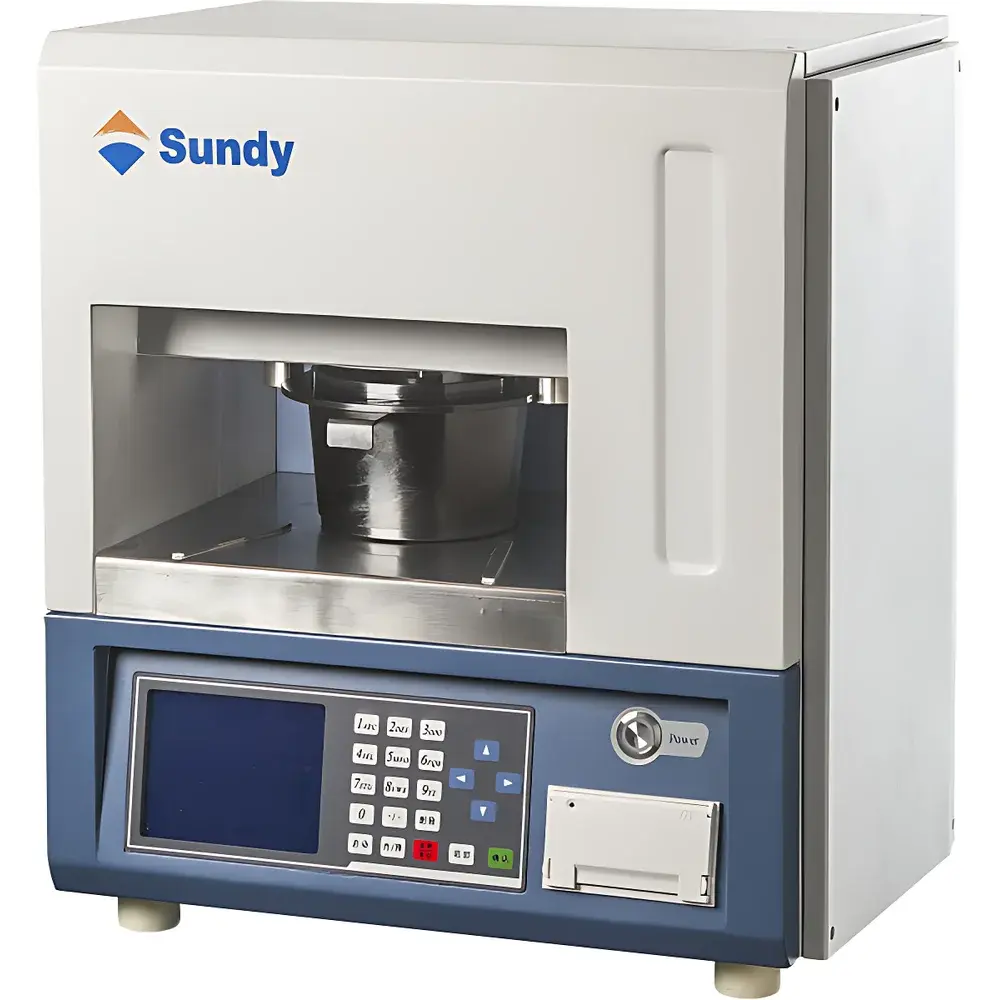
Sundy SDHG60a Hardgrove Grindability Index Tester
| Brand | Sundy |
|---|---|
| Origin | Hunan, China |
| Manufacturer Type | Authorized Distributor |
| Regional Classification | Domestic (China) |
| Model | SDHG60 |
| Instrument Type | Ball Mill (Hardgrove-Specific) |
| Sample Applicability | Hard, Brittle Materials (e.g., Coal, Biomass Pellets) |
| Output Particle Size | 0.01–0.5 mm |
| Feed Particle Size | ≤6.0 mm (per GB/T 2565–2014) |
| Batch Grinding Capacity | 50 g |
| Main Shaft Speed | (20 ± 1) rpm |
| Steel Ball Diameter | 25.4 mm |
| Maximum Power Consumption | 0.17 kW |
| Total Rotations per Test | 60 ± 0.5 rev |
| Applied Load on Balls | (284 ± 2) N |
| Supply Voltage | AC 220 V ± 10 %, 50 Hz ± 1 Hz |
| Grinding Bowl Capacity | 50 g |
| Net Weight | ~88 kg |
Overview
The Sundy SDHG60a Hardgrove Grindability Index Tester is a precision-engineered laboratory instrument designed specifically for the quantitative determination of the relative ease with which coal and other brittle solid fuels resist grinding — a critical parameter known as the Hardgrove Grindability Index (HGI). Based on the standardized Couette-type ball-mill principle, the device subjects a precisely prepared 50 g sample to controlled mechanical attrition using eight 25.4 mm steel balls rotating at (20 ± 1) rpm under a constant axial load of (284 ± 2) N for exactly 60 revolutions. This replicates the empirical conditions defined in ASTM D409, ISO 5074, and the Chinese national standards GB/T 2565–2014 and MT/T 230–2005. The resulting ground product is sieved through a 74 µm (200-mesh) screen, and the HGI value is calculated from the mass percentage passing, using a certified reference calibration curve. The SDHG60a delivers high inter-laboratory reproducibility and traceable results essential for coal procurement, boiler design optimization, pulverizer selection, and fuel blending strategies.
Key Features
- Fully automated grinding cycle: motorized bowl lifting, pneumatic or electromechanical loading, precise rotation counting, and automatic shutdown after 60 revolutions — eliminating operator-dependent variability.
- Microprocessor-based control system with real-time status display (remaining revolutions, elapsed time, load confirmation) via backlit LCD interface with bilingual (English/Chinese) soft-key labeling.
- Integrated linear regression correction algorithm that applies user-loaded or factory-calibrated reference curves to normalize raw sieve data against certified HGI standards — ensuring compliance with ISO/IEC 17025 data validation requirements.
- Emergency stop circuit with non-volatile rotation counter memory: interrupted tests resume from the last recorded revolution upon restart, preserving test integrity and audit trail continuity.
- Digital I/O interface supporting direct integration with analytical balances (RS-232 or USB-serial) for auto-capture of tare, gross, and retained mass values — minimizing transcription errors.
- Onboard thermal-printer module (optional) and internal flash memory for GLP-compliant storage of up to 1,000 test records, including timestamp, operator ID, sample ID, raw sieve data, and final HGI result.
Sample Compatibility & Compliance
The SDHG60a is validated for use with bituminous coals, anthracites, lignites, and densified biomass feedstocks meeting the dimensional and moisture specifications outlined in GB/T 2565–2014 (max. 6 mm top size; air-dried basis, <2% moisture). It is not suitable for ductile, fibrous, or highly abrasive non-coal materials (e.g., slag, ores, polymers). All mechanical and electrical subsystems conform to IEC 61000-6-2 (immunity) and IEC 61000-6-4 (emissions). The instrument’s measurement procedure satisfies the metrological traceability chain required by CNAS-CL01:2018 (equivalent to ISO/IEC 17025), and its software architecture supports 21 CFR Part 11–compliant audit trails when paired with validated LIMS or ELN platforms.
Software & Data Management
While the SDHG60a operates as a standalone unit, its embedded firmware supports bidirectional ASCII protocol communication over RS-232. Exported datasets include full metadata (test ID, date/time, operator code, ambient temperature/humidity if sensor-equipped, raw sieve mass fractions, interpolated HGI, and pass/fail flag against method-defined repeatability limits ±2 HGI units). Data files are structured in CSV format for seamless import into statistical process control (SPC) tools or enterprise QA databases. Optional PC software provides trend analysis, multi-instrument fleet monitoring, calibration log management, and PDF report generation with digital signature fields — fully aligned with GMP Annex 11 and ISO 13485 documentation requirements.
Applications
- Coal quality assurance in power generation plants and cement kiln operations.
- HGI correlation studies for coal blending models in thermal power station fuel management systems.
- Research-grade grindability profiling of low-rank coals and torrefied biomass under controlled humidity conditions.
- Third-party testing laboratories performing accredited coal characterization per ISO 19551 and ASTM D5373.
- Educational laboratories teaching fuel science, mineral processing, and standard methods validation protocols.
FAQ
What standards does the SDHG60a comply with?
It meets GB/T 2565–2014, MT/T 230–2005, ASTM D409, and ISO 5074 for Hardgrove grindability testing procedures and performance verification.
Is the instrument compatible with LIMS or ELN systems?
Yes — via configurable RS-232 ASCII output with programmable delimiters and header formats; optional USB-to-serial adapters support modern Windows/macOS environments.
Can the SDHG60a be used for non-coal samples such as limestone or clinker?
No — it is calibrated and validated exclusively for coal and coal-like brittle solids per international standard scope definitions; alternative comminution indices (e.g., Bond Work Index) require different apparatus geometries and force profiles.
Does the device include built-in calibration verification routines?
Yes — it supports daily verification using certified reference coal standards (e.g., NIST SRM 2682c), with automated pass/fail evaluation based on ±2 HGI tolerance per GB/T 2565–2014 Section 8.3.
What maintenance is required to ensure long-term accuracy?
Annual verification of load cell linearity, bowl concentricity, and rotational timing accuracy by an accredited service provider; routine cleaning of the grinding bowl and sieve assembly with non-abrasive solvents between samples.
Related Products



