
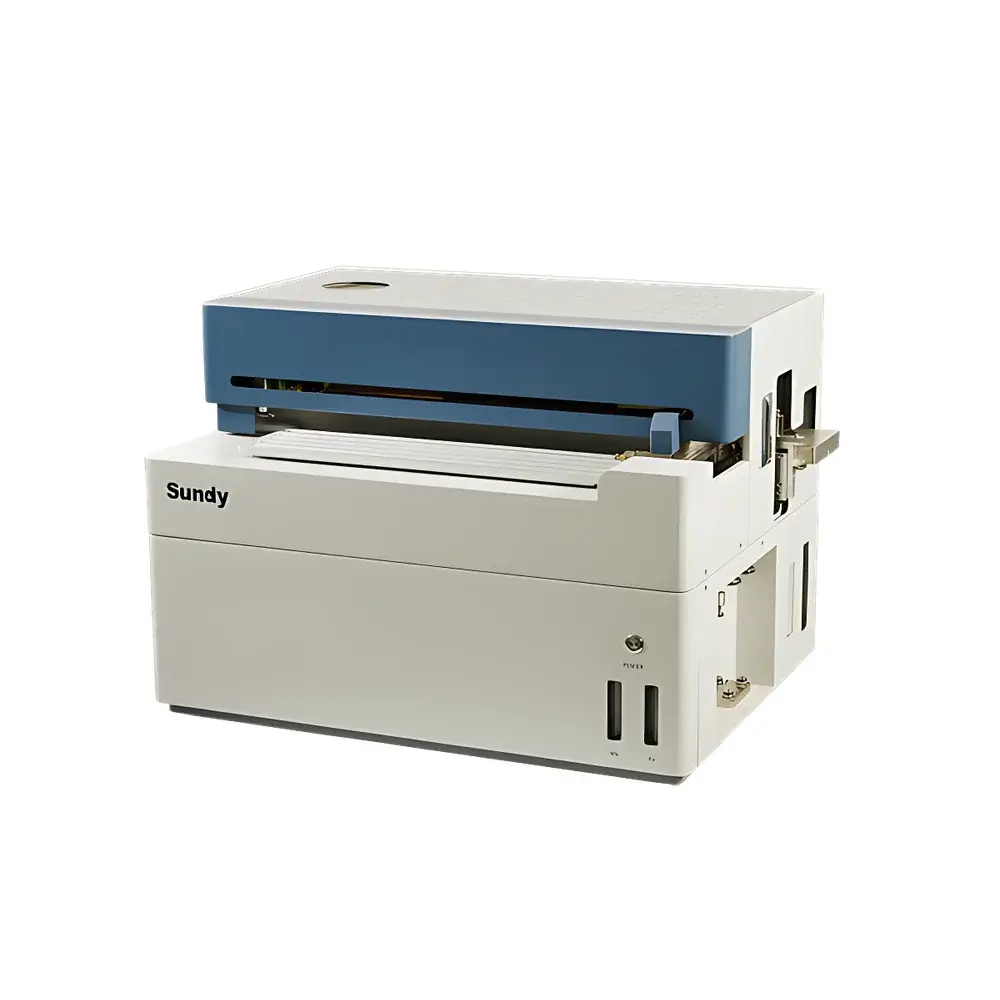
Sundy SDICS450 Infrared Carbon-Sulfur Analyzer / SDIS450 Infrared Sulfur Analyzer
| Brand | Sundy |
|---|---|
| Origin | Hunan, China |
| Manufacturer Type | Authorized Distributor |
| Country of Origin | China |
| Model | SDICS450 Infrared Carbon-Sulfur Analyzer / SDIS450 Infrared Sulfur Analyzer |
| Measurement Principle | Non-Dispersive Infrared (NDIR) Absorption |
| Heating System | High-Temperature Resistance Furnace |
| Carbon Range | 0.1–100 wt% |
| Sulfur Range | 0.01–50 wt% (extendable to 100 wt%) |
| Sensitivity | 0.01 wt% |
| Accuracy | ±0.01 wt% |
| Analysis Time | ≤110 s per sample (typical full-cycle time ≤180 s depending on sample matrix) |
| Combustion Furnace Power Output | 4 kW |
| Operating Temperature | 1250–1350 °C (recommended: 1300 °C) |
| Sample Mass | 200 mg (standard) |
| Max. Batch Capacity | 50 samples per auto-loading cycle |
| Dimensions (W×D×H) | 670 × 890 × 650 mm |
| Weight | ~135 kg |
| Power Supply | AC 220 V ±10%, 50 Hz ±1 Hz |
Overview
The Sundy SDICS450 Infrared Carbon-Sulfur Analyzer and its dedicated variant, the SDIS450 Infrared Sulfur Analyzer, are high-throughput, dual-channel elemental analyzers engineered for precise quantification of total carbon (C) and total sulfur (S) in solid and liquid matrices using non-dispersive infrared (NDIR) absorption spectroscopy. These instruments operate on the principle that CO2 and SO2 gases—generated by high-temperature combustion of samples in a controlled oxygen-rich atmosphere—exhibit characteristic absorption bands in the mid-infrared region (e.g., 4.26 µm for CO2, 7.35 µm for SO2). The analyzers employ thermally stabilized, low-drift NDIR detectors with integrated reference channels to deliver reproducible, interference-resistant measurements. Designed for routine laboratory environments in coal, cement, metallurgy, petrochemical, and environmental testing labs, the system integrates a 1300 °C resistance-heated combustion furnace, proprietary dual-stage combustion tube architecture, and real-time gas conditioning to ensure complete oxidation and clean spectral signal acquisition.
Key Features
- High-capacity automated sample handling: 50-position ceramic crucible carousel enables unattended batch analysis; supports both continuous loading and manual single-sample insertion without interrupting ongoing runs.
- Dual-combustion zone design: Patented reflux cavity within the quartz combustion tube facilitates secondary oxidation, minimizing incomplete combustion residues—critical for heterogeneous samples such as coal, coke, and slag.
- Gas purification system: Integrated high-efficiency desiccant (anhydrous magnesium perchlorate) and particulate filters remove moisture and ash aerosols prior to IR cell entry, ensuring long-term detector stability and eliminating baseline drift.
- Thermal protection architecture: Motorized sample rod retracts automatically after delivery to prevent thermal deformation; patented “gas curtain” assist flow isolates combustion chamber from ambient air, enhancing safety and analytical consistency.
- Intelligent hardware interface: Auto-recognition of crucible position and type eliminates manual sample indexing; open-platform sample tray with boat-shaped crucibles simplifies loading and reduces operator error.
- Stable optical core: Ultra-low-drift infrared absorption cells require only one daily zero calibration—reducing maintenance overhead while maintaining traceable measurement integrity across multi-shift operations.
Sample Compatibility & Compliance
The SDICS450/SDIS450 is validated for use with coal, coke, petroleum coke, cement clinker, fly ash, soil, rubber, polymers, catalysts, and residual fuels. It accommodates both solid powders (200 mg nominal mass) and viscous liquids via specialized crucible configurations. The analyzer complies with internationally recognized standards including GB/T 25214–2010 (coal total sulfur, IR method), ISO 19579:2006 (solid mineral fuels – sulfur determination), ASTM D4239–2018 (sulfur in coal and coke), GB/T 30733–2014 (carbon/hydrogen/nitrogen in coal), and ASTM D5373–08 (instrumental CHN analysis). Its design supports GLP-aligned workflows, with hardware-level audit trail readiness and optional integration into LIMS environments compliant with FDA 21 CFR Part 11 requirements when paired with validated software modules.
Software & Data Management
Built-in Windows-based control software provides real-time monitoring of furnace temperature, gas flow rates, detector signals, and combustion status. All analytical parameters—including integration time, peak width, baseline correction, and calibration coefficients—are fully configurable and stored with timestamped metadata per run. Raw spectral data and processed results are exportable in CSV, XML, or PDF formats. Calibration curves support multi-point linear and quadratic regression with R² validation. Software logs include operator ID, method version, instrument state, and alarm history—enabling full traceability for internal QA audits or regulatory inspections. Optional network deployment allows centralized method management and remote diagnostics across multi-instrument lab networks.
Applications
- Quality control of fossil fuels: Rapid determination of total sulfur content in compliance with emission trading and fuel specification limits (e.g., ISO 8754, ASTM D129).
- Metallurgical process monitoring: Quantification of residual carbon and sulfur in ferroalloys, pig iron, and steelmaking slags to optimize desulfurization efficiency.
- Cement and construction materials: Verification of raw mix homogeneity and clinker quality control per ASTM C114 and EN 196-2.
- Environmental testing laboratories: Analysis of soil, sediment, and waste incineration residues for regulatory reporting under EPA Method 5050 and EU Directive 2000/60/EC.
- R&D in polymer and rubber formulation: Precise sulfur quantification in vulcanized compounds where over- or under-curing impacts mechanical performance.
FAQ
What is the difference between the SDICS450 and SDIS450 models?
The SDICS450 is a dual-element analyzer capable of simultaneous carbon and sulfur measurement in a single run. The SDIS450 is a dedicated sulfur-only configuration optimized for high-volume sulfur screening—offering simplified calibration, reduced gas consumption, and faster throughput for labs with focused sulfur testing needs.
Can the instrument analyze liquid samples?
Yes—when used with sealed quartz crucibles and appropriate sample dilution protocols (e.g., mixing with tungsten trioxide or vanadium pentoxide), the system supports viscous oils, bitumen, and refinery streams per ASTM D4294 guidelines.
Is the combustion furnace temperature programmable?
The furnace operates at a fixed optimal setpoint of 1300 °C, with thermal stability maintained within ±5 °C across the full 50-sample sequence. Temperature ramping profiles are not implemented, as consistent high-temperature oxidation is required for complete conversion of refractory sulfur species (e.g., sulfates, thiophenes).
How often must the IR detector be recalibrated?
Under standard operating conditions, the low-drift NDIR cell requires only one zero-point calibration per working day. Span calibration is recommended weekly or after major maintenance events, using certified CO2/SO2 standard gases traceable to NIST SRM 1632e.
Does the system support LIMS integration?
Yes—the analyzer communicates via TCP/IP or RS-232 using ASTM E1384-compliant messaging. With optional middleware, it supports direct result push to LabVantage, Thermo Fisher SampleManager, and STARLIMS platforms, including electronic signature and audit trail synchronization.






