
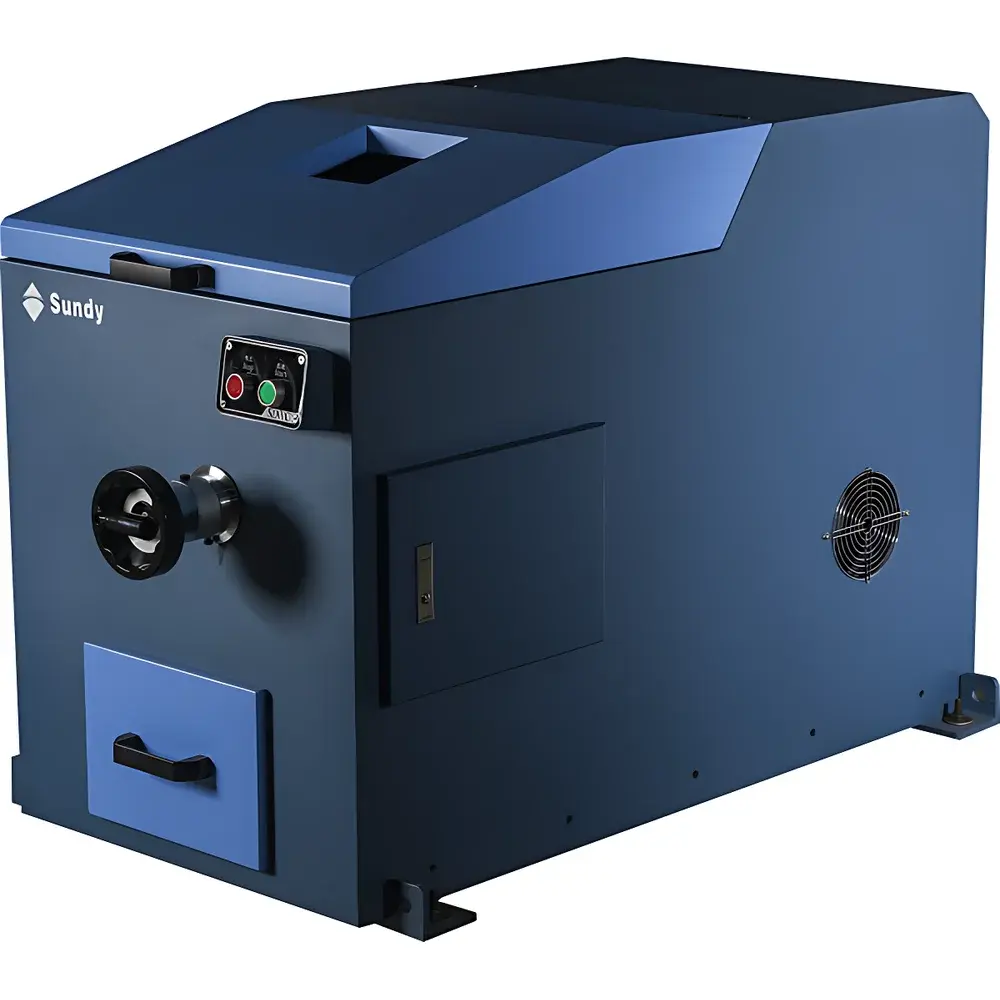
Sundy SDRC Dual-Roll Crusher
| Brand | Sundy |
|---|---|
| Model | SDRC |
| Type | Laboratory Dual-Roll Crusher |
| Compliance | GB/T 474–2008 |
| Feed Size | ≤13 mm |
| Output Size | 0.5–3 mm (adjustable) |
| Moisture Tolerance | ≤12% (total moisture) |
| Throughput | 250–500 kg/h (model-dependent) |
| Dimensions | 1250 × 700 × 820 mm |
| Weight | 300–330 kg |
| Motor Power | 2.2–3 kW |
| Voltage | AC 380 V ±10%, 50 Hz ±1 Hz |
| Dust Interface | Yes |
| Safety Design | Sealed crushing chamber, splash-proof feed hopper |
Overview
The Sundy SDRC Dual-Roll Crusher is a precision-engineered laboratory-scale sample preparation instrument designed for controlled size reduction of brittle, medium-hard materials—primarily coal and mineral samples—in accordance with standardized analytical workflows. Operating on the principle of compressive crushing between two counter-rotating rolls, the SDRC delivers reproducible particle size distribution within the 0.5–3 mm range, fully compliant with GB/T 474–2008 “Methods for Preparation of Coal Samples”. Its robust mechanical architecture ensures consistent throughput (250–500 kg/h depending on model variant), minimal sample loss, and high operational reliability without requiring anchoring to structural foundations—making it suitable for dedicated sample prep rooms in power plants, coal testing laboratories, geological survey institutes, and metallurgical R&D facilities.
Key Features
- Sealed crushing chamber and splash-resistant feed hopper minimize airborne particulate generation and prevent cross-contamination during operation.
- Hardened alloy steel roll surfaces provide exceptional wear resistance and dimensional stability over extended service life, accommodating variable feed hardness and moisture content (≤12% total moisture).
- No foundation mounting required: stable operation achieved on level concrete flooring due to optimized mass distribution and low-vibration drive train.
- Adjustable roll gap mechanism enables precise control of output particle size across the 0.5–3 mm range, supporting method-specific requirements for subsequent analysis (e.g., proximate/ultimate analysis, calorimetry, XRF).
- Standardized dust extraction port (DN60) allows direct integration with centralized or portable dust collection systems, facilitating compliance with occupational health and safety regulations (e.g., OSHA PELs, ISO 45001).
- Motor-driven dual-roll configuration with thermal overload protection and emergency stop circuitry meets IEC 60204-1 safety standards for industrial machinery.
Sample Compatibility & Compliance
The SDRC is validated for use with coal, limestone, shale, bauxite, and other non-fibrous, non-sticky minerals exhibiting compressive strength below 150 MPa. It is not recommended for highly abrasive (e.g., quartz-rich ores >30% SiO₂), ductile (e.g., soft metals), or high-moisture (>12%) feed materials that may cause roll slippage or clogging. All models conform to GB/T 474–2008 for coal sample preparation and support traceability in accredited laboratories operating under ISO/IEC 17025:2017. The sealed design and low-dust operation further align with GLP principles for sample integrity and analyst exposure control.
Software & Data Management
The SDRC is a standalone electromechanical device with no embedded digital control system or data logging capability. Operation is manual via local start/stop controls and mechanical gap adjustment. For laboratories implementing LIMS or electronic record-keeping, usage logs—including batch ID, operator, feed weight, crush duration, and observed output consistency—must be recorded externally. Optional integration with industrial IoT gateways (via dry-contact relay outputs) permits basic run-status monitoring in facility-wide automation platforms, though no native firmware or API is provided.
Applications
- Routine coal sample size reduction prior to pulverization for proximate analysis (ASTM D3172), ultimate analysis (ASTM D3176), and calorific value determination (ASTM D5865).
- Preparation of representative sub-samples from bulk geological cores or exploration drill cuttings for geochemical assay (XRF, ICP-OES).
- Controlled comminution of cement clinker and raw meal for fineness testing (Blaine, ASTM C204).
- Feed conditioning for downstream digestion steps in acid leach protocols (e.g., EPA Method 3050B).
- Quality assurance in brick clay and refractory raw material processing lines.
FAQ
Is the SDRC compatible with automated sample handling systems?
No—the SDRC operates manually and lacks motorized feed, programmable gap control, or digital interface; integration requires third-party robotic feeding modules.
What maintenance intervals are recommended for the roll assemblies?
Roll surface inspection and gap recalibration should be performed after every 200 operational hours or prior to critical certification runs; lubrication of gear reducers per ISO 6743-6 Class CKC guidelines is required every 500 hours.
Can the SDRC process samples containing metallic contaminants?
No—ferrous or non-ferrous tramp metal may damage roll surfaces and compromise particle size fidelity; upstream magnetic separation is mandatory.
Does the unit meet CE or UL certification requirements?
The SDRC complies with Chinese GB standards and IEC 60204-1 for electrical safety; CE marking is not applied, and UL listing is not available—users must conduct local regulatory assessment prior to installation.
What is the expected service life under continuous laboratory use?
With proper maintenance and adherence to moisture and feed-size specifications, the core mechanical assembly (rolls, frame, drive) typically exceeds 10 years of service at 4–6 hours/day average duty cycle.



