
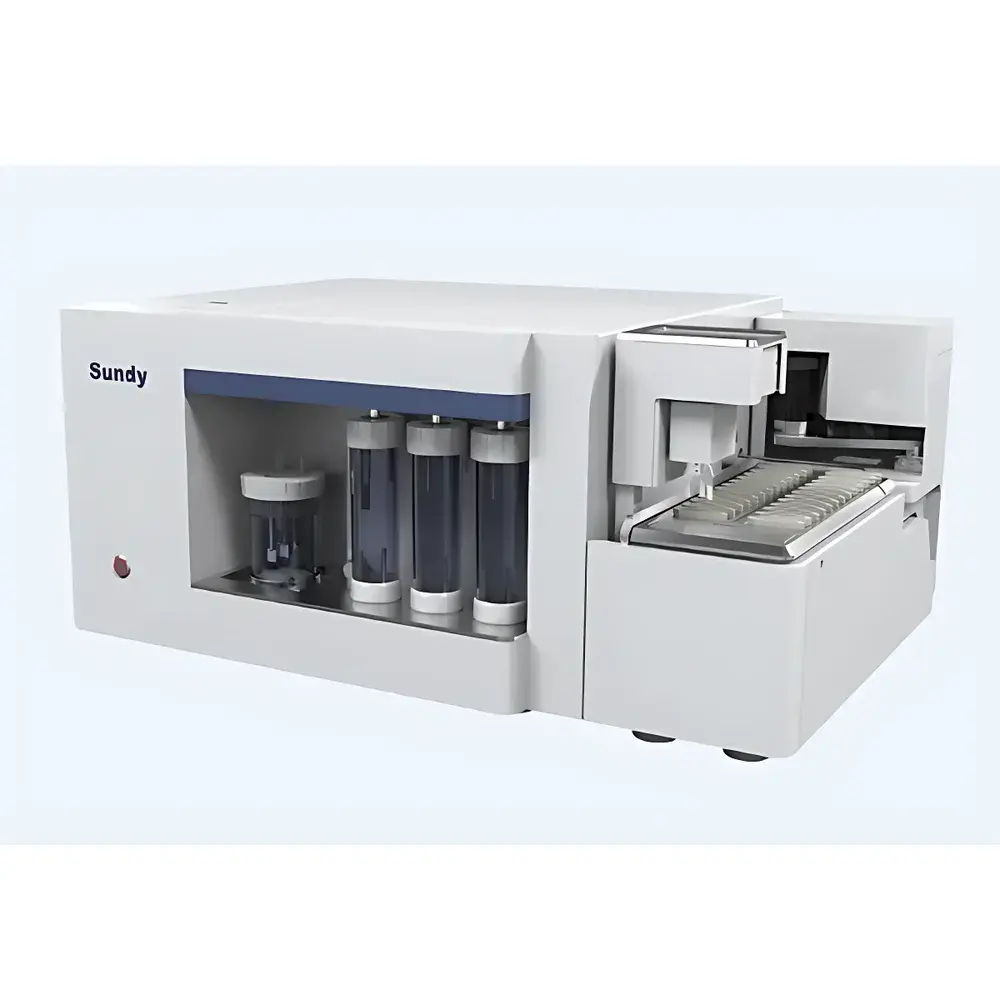
Sundy SDS1600 & SDS1200 Automatic Sulfur Determinators (Coulometric Method)
| Brand | Sundy |
|---|---|
| Origin | Hunan, China |
| Model | SDS1600 / SDS1200 |
| Measurement Principle | Coulometric Titration |
| Sulfur Range | 0.01–40% |
| Resolution | 0.001% |
| Temperature Control Accuracy | ±1°C |
| Sample Mass | ~50 mg (typical) |
| Combustion Zone Temp | (1150±5)°C for coal & coke, (900±5)°C for oil & pyrite, (1150–1200)°C for cement |
| Max. Sample Capacity | 22 positions |
| Avg. Analysis Time | ~200 s per sample |
| Auto WO₃ Addition | SDS1600 only |
| Max. Power | 4 kW |
| Voltage | AC 220 V ±10%, 50 Hz ±1 Hz |
| Dimensions (H×W×D) | 410 × 890 × 610 mm |
| Weight | SDS1600 ≈ 85 kg, SDS1200 ≈ 81 kg |
| Compliance | GB/T 214–2007, JJG 1006–2005 |
Overview
The Sundy SDS1600 and SDS1200 Automatic Sulfur Determinators are precision laboratory instruments engineered for the quantitative determination of total sulfur content in solid and liquid combustible materials—including coal, coke, petroleum coke, sulfide ores, cement clinker, and solid biomass fuels—using the standardized coulometric titration method. Based on controlled high-temperature combustion (up to 1200 °C), the instruments quantitatively oxidize sulfur compounds to sulfur dioxide (SO₂), which is then absorbed in an electrolyte solution and electrochemically titrated via controlled current generation. The integrated charge (coulomb) measurement yields sulfur mass fraction with trace-level resolution (0.001%) across a broad dynamic range (0.01–40% S). Both models comply with GB/T 214–2007 (“Determination of Total Sulfur in Coal”) and JJG 1006–2005 (“Verification Regulation for Total Sulfur Analyzers”), supporting routine quality control, regulatory reporting, and R&D workflows in coal testing laboratories, cement production QA/QC labs, and energy research facilities.
Key Features
- High-throughput batch analysis: 22-sample carousel enables unattended sequential operation with programmable start/stop and real-time status monitoring.
- Optimized combustion architecture: Wide-body ceramic crucibles ensure uniform gas–sample interaction, promoting complete oxidation even for heterogeneous or low-reactivity samples.
- Enhanced electrolytic cell design: Reinforced electrode plates (increased surface area and thickness) improve SO₂ absorption efficiency and coulombic integration fidelity; extended service life reduces maintenance frequency.
- Dual-rod sample introduction mechanism: Delivers superior mechanical stability, positional repeatability, and acoustic dampening—critical for long-duration automated runs.
- SDS1600-exclusive automatic tungsten trioxide (WO₃) dosing: Precisely metered, uniformly dispersed catalyst addition eliminates manual weighing errors and operator variability while reducing reagent consumption by up to 30%.
- Robust thermal management: High-purity refractory furnace lining ensures stable temperature profiles, minimal thermal drift, and >5000-cycle operational endurance under continuous 1150 °C operation.
- Integrated gas conditioning: Dual-stage filtration (particulate + moisture) and closed-loop flow regulation maintain consistent carrier gas (oxygen or air) delivery; optional auto-leak detection validates system integrity prior to each analysis.
Sample Compatibility & Compliance
The SDS1600 and SDS1200 accommodate powdered, granular, and pelletized solid fuels (e.g., pulverized coal, coke breeze, biomass pellets) as well as liquid fuels (e.g., heavy fuel oil, slurry-based samples) when pre-treated per ASTM D4294 or ISO 8754 guidelines. Cement and mineral feedstock analysis is supported per GB/T 176–2017. Instrument validation adheres to JJG 1006–2005 requirements for linearity, repeatability (RSD ≤ 0.05% absolute for 1–5% S reference standards), and recovery accuracy (98.5–101.2%). Data acquisition and instrument control logs meet GLP audit-trail requirements, including timestamped operator actions, calibration events, and error flags—all exportable in CSV or XML formats.
Software & Data Management
Built-in embedded controller (ARM Cortex-M7) manages real-time combustion sequencing, electrolysis current profiling, and hardware-level coulomb integration—eliminating software-based integration latency or sampling gaps. The Windows-based desktop application (Sundy SulfurSuite v3.2) provides intuitive method setup, multi-point calibration (linear and quadratic), QC charting (X-bar/R, trend analysis), and customizable report generation compliant with ISO/IEC 17025 documentation standards. All raw current–time traces, temperature profiles, and calculated sulfur values are stored with metadata (operator ID, sample ID, date/time, method version), supporting full traceability and FDA 21 CFR Part 11–aligned electronic signatures when deployed in regulated environments.
Applications
- Coal trading and blending: Rapid verification of contractual sulfur specifications to prevent penalty clauses or environmental non-compliance.
- Cement kiln feed optimization: Monitoring sulfur input from raw meal and alternative fuels to avoid SO₂ emissions excursions and kiln coating instability.
- Power plant fuel procurement: Batch screening of delivered coal lots for desulfurization system load forecasting.
- Research on low-sulfur alternative fuels: Quantifying sulfur speciation impact on ash fusion behavior and flue gas cleaning efficiency.
- Environmental compliance labs: Supporting EPA Method 19 (for stack testing correlation) and EU Directive 2010/75/EU (IED) reporting requirements.
FAQ
What distinguishes the SDS1600 from the SDS1200?
SDS1600 includes fully automated, gravimetrically controlled tungsten trioxide dosing; SDS1200 requires manual catalyst addition.
Can the instrument analyze liquid samples directly?
Liquids must be pre-absorbed onto inert support material (e.g., diatomaceous earth) and dried prior to combustion to ensure consistent volatilization and avoid electrolyte contamination.
Is external calibration required between analyses?
No—each run includes internal reference checks using certified coal standards (e.g., NIST SRM 1632E); daily single-point verification suffices for routine operation.
How is data integrity ensured during power interruption?
Non-volatile flash memory retains all active method parameters, calibration coefficients, and ongoing analysis state; resumption occurs automatically upon power restoration without data loss.
Does the system support LIMS integration?
Yes—via TCP/IP-based ASCII command protocol and ODBC-compliant database export; supports direct interfacing with Thermo Fisher SampleManager, LabVantage, and STARLIMS platforms.
Related Products




