
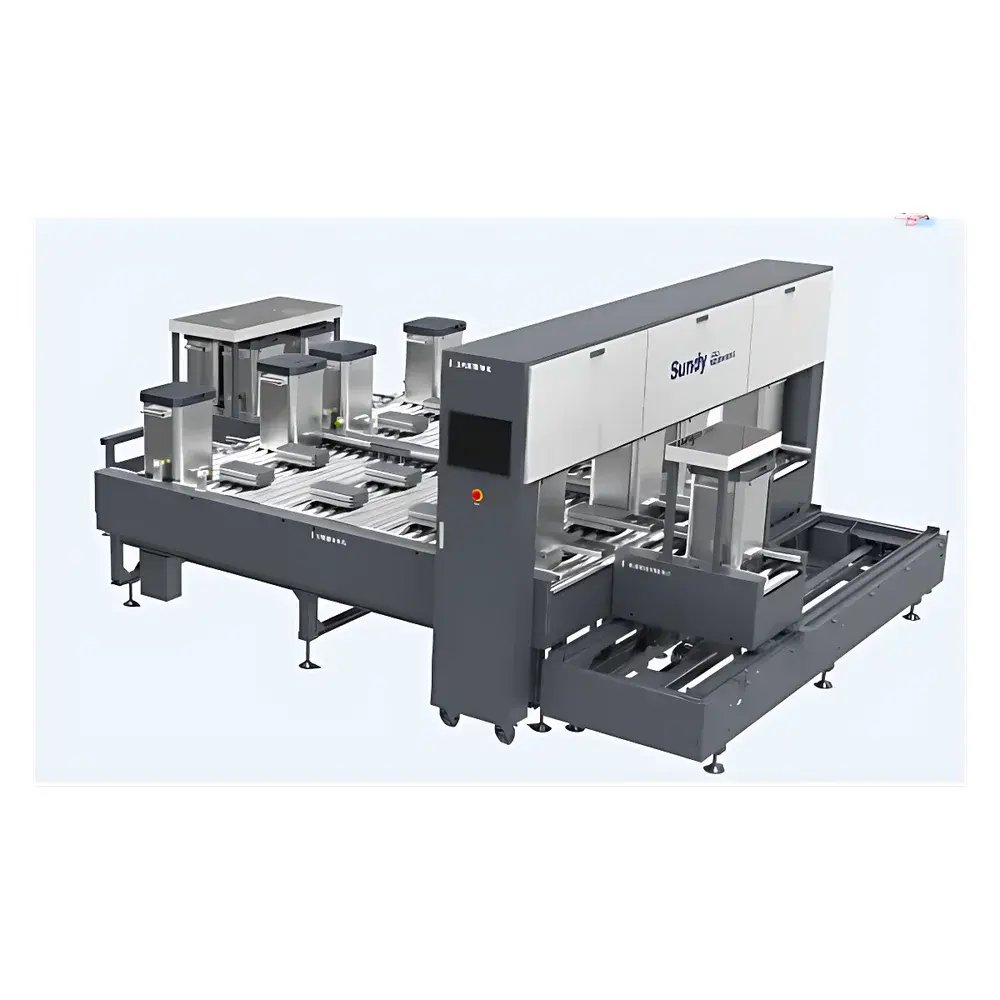
Sundy SDSCB Batch Consolidation and Sample Bucket Sorting System
| Brand | Sundy |
|---|---|
| Origin | Hunan, China |
| Manufacturer Type | Authorized Distributor |
| Country of Origin | China |
| Model | SDSCB Batch Consolidation and Sample Bucket Sorting System |
| Pricing | Available Upon Request |
| Bucket Cache Capacity | ≤32 / 48 / 64 (Configurable) |
| Sorting Cycle Time per Bucket | ≤1 minute |
| Trolley Docking Width | 4-lane configuration |
| Sorting Module Rows | 2 / 3 / 4 rows (Configurable) |
| Sample Bucket Format | RFID-embedded lid |
| Bucket Volume | 25 L |
| Power Supply | 380 V AC |
| Infeed/Outfeed Mode | Fully Automatic or Manual Hybrid |
| Max. Power Consumption | 3.5 kW |
Overview
The Sundy SDSCB Batch Consolidation and Sample Bucket Sorting System is an engineered solution for high-throughput coal sample logistics in automated sampling laboratories and power plant quality control facilities. Designed around a modular roller conveyor architecture with distributed RFID-based identification and dynamic cache allocation logic, the system implements deterministic batch consolidation without fixed-position storage—enabling true blind-in, blind-out (BIBO) operation. Unlike legacy carousel- or loop-based sorting systems that rely on sequential RFID interrogation and mechanical repositioning, the SDSCB employs parallelized lane arbitration and real-time path optimization to assign incoming 25-L coal sample buckets to non-deterministic cache positions within configurable 32/48/64-slot arrays. This architecture eliminates rotational latency and reduces average bucket residence time by over 40% compared to conventional systems—directly supporting throughput alignment with downstream automated sample preparation units (e.g., crushers, dividers, pulverizers) operating under ASTM D2013, ISO 18283, and IEC 62271-1 compliance frameworks.
Key Features
- Full automation with zero manual intervention: All bucket ingress, RFID validation, dynamic cache assignment, batch-triggered sorting, and egress to preparation lines are executed autonomously via integrated PLC and motion controllers.
- Space-optimized footprint: Achieves ≥40% reduction in floor area versus equivalent-capacity loop-type consolidators by eliminating circular transport paths and enabling compact 2–4 row linear module configurations.
- Deterministic sub-60-second sorting latency: Each bucket is dispatched from cache to the designated preparation station within ≤60 seconds of batch release command—guaranteed via priority-lane routing and dedicated egress corridors between sorting rows.
- High-tolerance trolley docking interface: Accommodates inbound sample transport vehicles with lateral alignment variance of ±250 mm (total 500–800 mm operational window), eliminating need for precision-guided AGVs and supporting manual forklift or pallet jack integration.
- RFID-integrated 25-L sample buckets: Sealed lids embed ISO/IEC 18000-6C compliant transponders; read reliability exceeds 99.98% at conveyor speeds up to 0.4 m/s under dust-laden industrial environments.
Sample Compatibility & Compliance
The SDSCB system is purpose-built for standardized 25-L cylindrical coal sample containers conforming to GB/T 19494.1–2023 and ASTM D7508 specifications. Its mechanical handling subsystems—including polyurethane-coated rollers, stainless-steel frame, and IP54-rated control enclosures—are rated for continuous operation in ambient temperatures from 5 °C to 45 °C and relative humidity ≤90% non-condensing. All electrical components comply with IEC 60204-1 safety standards; EMC performance meets EN 61000-6-2 and EN 61000-6-4. The system supports audit-ready operation under GLP and ISO/IEC 17025 quality management systems through timestamped event logging, user-access-controlled configuration changes, and tamper-evident RFID transaction records.
Software & Data Management
The embedded HMI runs on a Linux-based real-time OS with dual-redundant database logging (SQLite + optional OPC UA server). Batch metadata—including origin lot ID, timestamped ingress/egress events, RFID UID history, and operator login trace—is retained for ≥18 months. Integration with LIMS platforms is supported via standard RESTful API endpoints and CSV/JSON export protocols. Audit trails comply with FDA 21 CFR Part 11 requirements when deployed with optional digital signature modules and role-based access control (RBAC) policies. No cloud dependency: all data resides on-board or on local NAS—ensuring full data sovereignty per ISO/IEC 27001 site policies.
Applications
- Coal-fired power plant fuel quality assurance labs requiring synchronized batch dispatch to automated proximate/ultimate analyzers (e.g., LECO, ELTRA, Thermo Fisher instruments).
- Third-party commercial testing laboratories accredited to ISO/IEC 17025 performing contract coal sampling and analysis for trading entities.
- Mining operations implementing ISO 18283-compliant primary sampling systems where multi-point composite samples must be consolidated prior to lab submission.
- Research institutions conducting coal blend optimization studies requiring strict segregation of source batches across multiple preparation lines.
FAQ
What RFID standard does the SDSCB system support?
The system uses ISO/IEC 18000-6C (EPC Gen2) compliant tags embedded in bucket lids, ensuring interoperability with industry-standard readers and long-term tag lifecycle (>10 years under typical coal-handling conditions).
Can the system integrate with existing laboratory information management systems (LIMS)?
Yes—via configurable REST API, OPC UA, or flat-file exchange (CSV/JSON); field-proven integrations include Thermo Fisher SampleManager LIMS, LabWare LIMS, and custom in-house platforms.
Is remote monitoring and diagnostics supported?
Standard Ethernet connectivity enables SNMP-based network monitoring and secure SSH access for firmware updates and log retrieval; optional 4G LTE gateway available for off-site telemetry.
What maintenance intervals are recommended for the roller conveyor subsystem?
Lubrication-free polymer rollers require no scheduled maintenance; annual inspection of motor brakes, belt tension, and RFID reader alignment is advised per ISO 13374 condition monitoring guidelines.






