
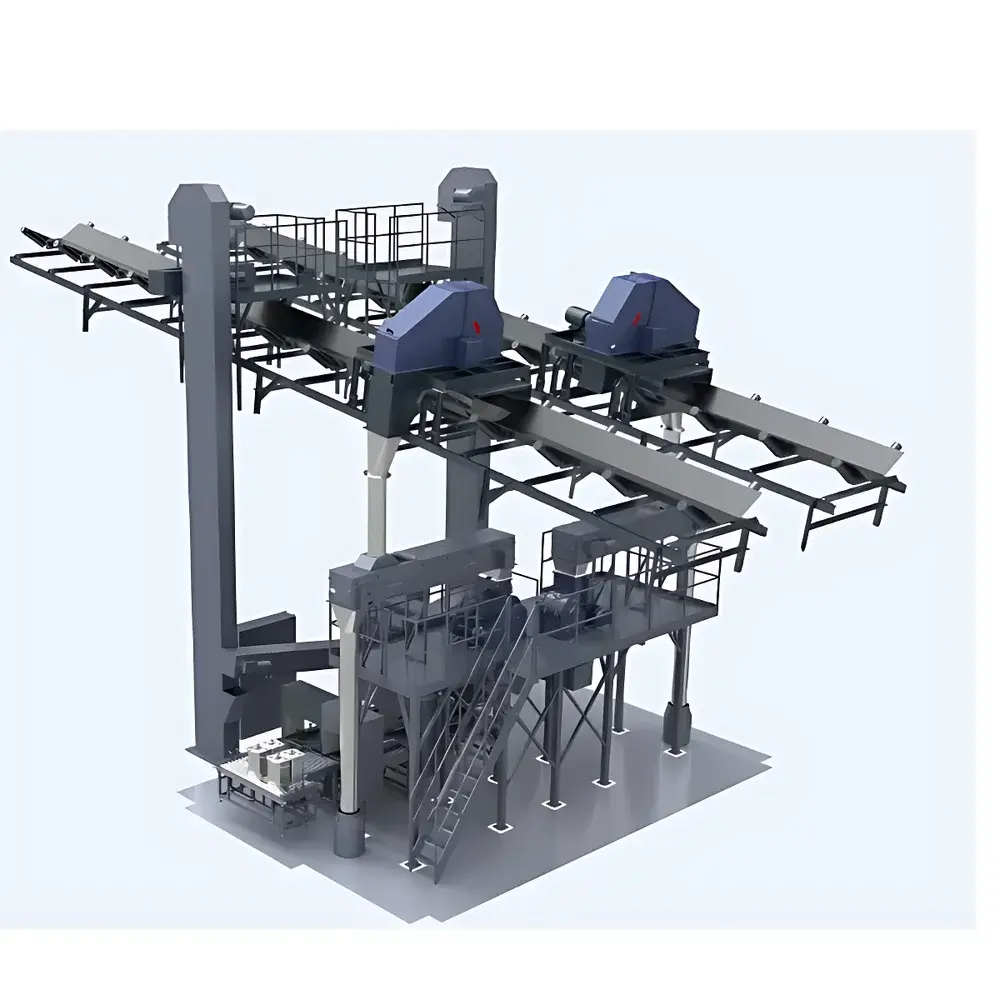
Sundy SDSSC Mid-Belt Automatic Sampling System
| Brand | Sundy |
|---|---|
| Origin | Hunan, China |
| Manufacturer Type | Authorized Distributor |
| Product Category | Domestic |
| Model | SDSSC Mid-Belt Automatic Sampling System |
| Pricing | Available Upon Request |
| Structural Configuration | Mid-belt Sampling |
| Total Weight | ~6,000 kg |
| Control Mode | Fully Automatic / Manual |
| Maximum Feed Particle Size | ≤100 mm |
| Splitting Ratio | 1/4 to 1/32 |
| Reject Disposal | Returned via conveyor belt to main coal conveying belt |
| Sampling Method | Scraper-sweep type |
| Sampling Interval | Adjustable from 2 to 60 minutes |
| Subsample Mass | 5–40 kg (user-configurable) |
| Moisture Tolerance | Anthracite ≤12%, Bituminous Coal ≤20%, Lignite ≤40% |
| Output Particle Size | ≤6 mm or ≤13 mm (max feed ≤20 mm) |
| Crushing Capacity | 3.5 t/h or 7 t/h (optional) |
| Number of Sample Collection Canisters | 6 / 8 / 16 |
| Power Supply | 380 V AC, 30 kW (configurable based on layout and options) |
| Optional Integration | Bottom-discharge divider with direct linkage to adjacent sample preparation system |
Overview
The Sundy SDSSC Mid-Belt Automatic Sampling System is an industrial-grade, ISO-compliant bulk material sampling solution engineered for continuous, representative extraction of heterogeneous particulate solids—primarily coal, ores, coke, limestone, and granular industrial feedstocks—from moving conveyor belts. It operates on the principle of cross-stream mechanical sampling at the midpoint of the belt’s active load zone, ensuring statistically valid sub-sampling in accordance with ASTM D2234, ISO 13909, and GB/T 19494 standards. Unlike side- or top-mounted samplers, the mid-belt configuration minimizes bias from segregation effects, flow asymmetry, and belt edge turbulence. The system integrates seamlessly into automated material handling workflows, serving as the primary sampling node in fully unattended fuel quality monitoring systems used across thermal power plants, integrated steel mills, port terminals, cement kiln feed lines, and coal import/export facilities.
Key Features
- Robust Wet-Coal Handling Architecture: Equipped with a variable-frequency controlled hammer crusher featuring oscillating inlet plates that actively dislodge adhered material, eliminating moisture-induced bridging and cross-contamination—critical for high-moisture lignite and weathered bituminous coal.
- High-Fidelity Sample Integrity: All wetted surfaces—including scraper blades, chutes, crushers, and dividers—are fabricated from 316 stainless steel with electropolished finish to prevent sample adhesion, oxidation, or carryover between subsamples.
- Dynamic Load Matching: Real-time crusher load monitoring enables closed-loop speed adjustment of the feed conveyor, synchronizing throughput with crushing capacity—ensuring consistent particle reduction without overloading or underutilization.
- Intelligent Rejection Management: Reject material is returned directly to the main conveyor via a dedicated return chute with cantilever-mounted vibratory discharge units, preventing accumulation and maintaining uninterrupted belt operation.
- Modular Canister Configuration: Supports 6-, 8-, or 16-position rotary sample collection stations with programmable sequence logic, enabling time-based, mass-based, or event-triggered archiving aligned with QA/QC protocols.
- Fail-Safe Interlocking: Full hardware-level integration with upstream belt motion sensors, emergency stop circuits, and dust suppression systems ensures compliance with IEC 61508 SIL2 functional safety requirements.
Sample Compatibility & Compliance
The SDSSC system is validated for use with free-flowing, non-fibrous, non-sticky bulk solids having bulk densities between 0.6–2.2 g/cm³ and nominal top sizes up to 100 mm. It meets the mechanical and metrological requirements of ISO 13909-3 (Coal and Coke — Sampling — Part 3: Mechanical sampling), ASTM D2234 (Standard Practice for Collection of a Gross Sample of Coal), and GB/T 19494.1–2023 (Coal — Mechanical sampling — Part 1: Sampling methods). All critical sampling components—including cutter geometry, aperture dimensions, and transit time—are traceably calibrated against NIST-traceable reference materials. The system supports GLP-aligned audit trails when integrated with compliant LIMS platforms.
Software & Data Management
An embedded industrial PLC (Siemens S7-1500 series) governs all sequencing, timing, and interlock logic, with HMI access via IP65-rated touchscreen panel. Operational logs—including sampling timestamp, subsample mass, crusher current draw, vibration status, and canister assignment—are stored locally for ≥18 months and exported via OPC UA or Modbus TCP to enterprise MES, SAP QM, or centralized fuel management systems. Optional FDA 21 CFR Part 11-compliant software add-ons provide electronic signatures, role-based access control, and immutable audit history for regulated environments. Data export formats include CSV, XML, and SQL-compatible dumps compatible with Python/Pandas-based statistical analysis pipelines.
Applications
- Continuous quality assurance of inbound coal at coal-fired power stations (ASTM D3172 proximate analysis feedstock verification)
- Grade control and lot acceptance testing for iron ore and coking coal at port transshipment terminals
- Real-time ash and sulfur content trending in cement raw meal homogenization silos
- Automated batch sampling of pulverized fuel prior to boiler injection
- Regulatory compliance sampling for environmental reporting (e.g., mercury, chlorine content per EPA Method 7473)
- Integration with robotic sample preparation cells (e.g., auto-crushing, drying, splitting, pulverizing) for end-to-end unattended lab workflows
FAQ
What standards does the SDSSC system comply with for coal sampling?
It conforms to ISO 13909-3, ASTM D2234, and GB/T 19494.1–2023 for mechanical sampling methodology, cutter design, and statistical representativeness validation.
Can the system handle high-moisture lignite without blockage?
Yes—the oscillating inlet plate, self-cleaning hammer assembly, and high-inclination sieve deck collectively mitigate moisture-related plugging, supporting up to 40% inherent moisture in lignite.
Is remote diagnostics and firmware update supported?
Yes—via secure VPN-enabled Ethernet connection; diagnostic logs and parameter backups are accessible through the web-based engineering interface.
How is sample contamination prevented during multi-material campaigns?
Stainless steel contact surfaces, automated purge cycles between subsamples, and programmable canister rotation minimize carryover; optional nitrogen purging kits are available for oxidative-sensitive samples.
What maintenance intervals are recommended for the crusher and splitter?
Hammer wear inspection every 500 operating hours; splitter blade calibration and alignment verification quarterly; full lubrication service every 2,000 hours per ISO 15243 bearing life guidelines.





