
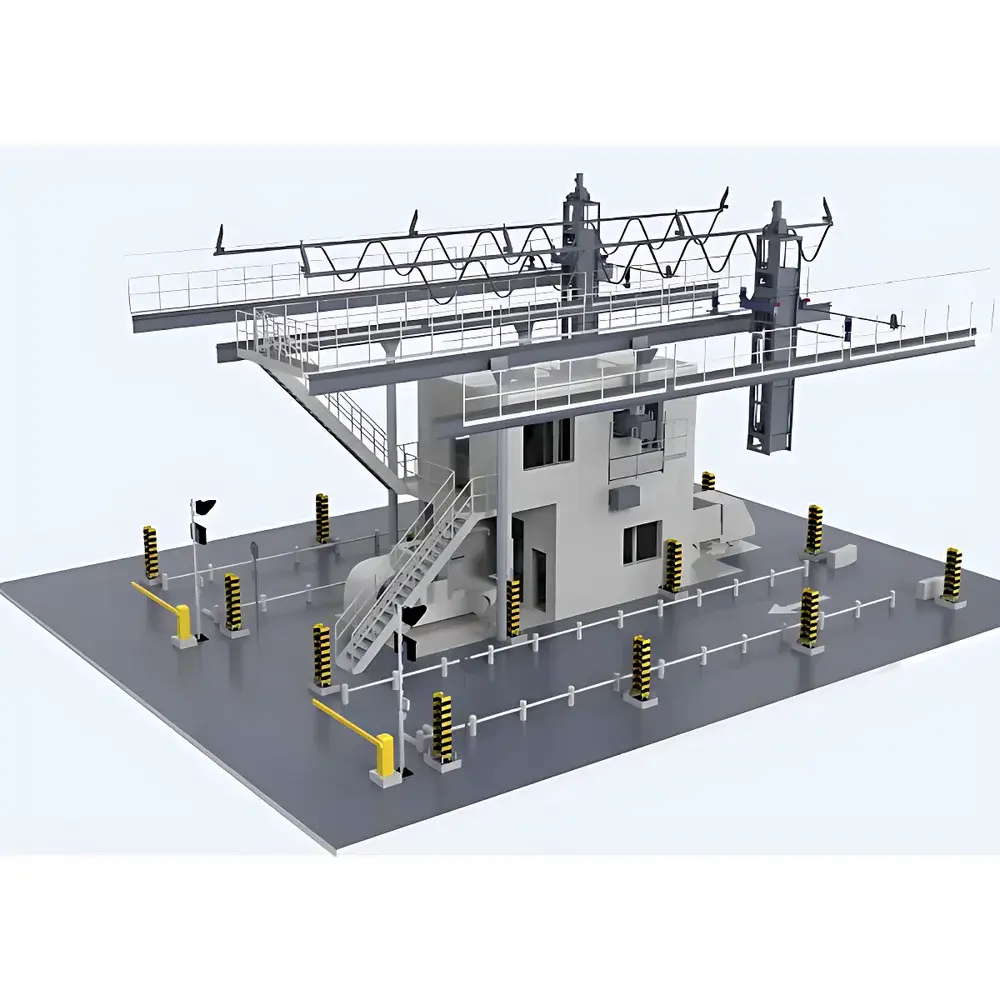
Sundy SDSST Bridge-Mounted Automotive Bulk Material Sampling System
| Brand | Sundy |
|---|---|
| Origin | Hunan, China |
| Model | SDSST Automotive Sampling System |
| Structural Form | Bridge-Type |
| Sampling Method | Helical Auger |
| Sampling Time | ≤60 s per point |
| Sampling Stroke | ≤3200 mm |
| Total Equipment Weight | ~12,000 kg |
| Subsample Mass | 5–40 kg (adjustable) |
| Moisture Tolerance | Anthracite ≤12%, Bituminous Coal ≤20%, Lignite ≤40% |
| Nominal Maximum Particle Size | ≤50 mm (up to 100 mm acceptable) |
| Output Particle Size | ≤6 mm or ≤13 mm (max 20 mm) |
| Crushing Capacity | 3.5 t/h or 7 t/h (optional) |
| Splitting Ratio | 1/4 to 1/32 |
| Sample Canister Count | 6 / 8 / 12 |
| Power Supply | 380 V AC, 50 kW (configurable) |
| Reject Bin Volume | 5 m³ |
| Compliance | Designed for ASTM D2234, ISO 13909, and GB/T 19494 series standards |
Overview
The Sundy SDSST Bridge-Mounted Automotive Bulk Material Sampling System is an industrial-grade, fully automated sampling solution engineered for representative, high-reliability acquisition of bulk solids—including coal, ore, coke, limestone, cement raw materials, and agricultural commodities—delivered by road transport. Deployed as a fixed bridge structure spanning vehicle lanes, the system employs Couette-flow-optimized helical auger sampling combined with integrated wet-coal-tolerant crushing, dynamic splitting, and stainless-steel sample handling pathways. Its core design principle centers on statistical representativeness: achieving ISO 13909-compliant primary sampling according to the theory of stratified random sampling across the full cross-section of a truck bed, while maintaining mechanical integrity under high-moisture, high-adhesion conditions. Unlike conventional grab samplers or pneumatic systems, the SDSST avoids aspiration bias, segregation during transfer, or moisture-induced blockage—making it suitable for continuous operation in thermal power plants, steel mills, port terminals, and integrated mining logistics hubs where regulatory compliance, auditability, and long-term system uptime are mission-critical.
Key Features
- Helical auger sampler (3.2 m stroke) with inward-swept “sickle-blade” geometry ensures full-depth penetration and retention of coarse particles—including lumps up to 100 mm—without ejection or layer skipping.
- Moisture-resilient hammer crusher featuring oscillating inlet clearance plates and dual-mode hammer sets (A/B toothed configurations) enables stable throughput across anthracite (≤12% H₂O), bituminous (≤20%), and lignite (≤40%) without manual intervention or downtime.
- High-open-rate, tapered-angle sieve deck with gradient aperture distribution minimizes residual hold-up and eliminates bridging—critical for maintaining mass balance accuracy in certified sampling protocols.
- Variable-frequency feed control synchronized with real-time crusher load monitoring ensures adaptive material flow matching, preventing overload or starvation under variable feed rates.
- Stainless-steel contact surfaces (304/316 grade) throughout the sampling, crushing, splitting, and canister-filling path prevent cross-contamination and adhesion-related bias.
- Integrated electromagnetic separator removes ferrous contaminants prior to crushing—reducing wear on downstream components and ensuring analytical integrity of final subsamples.
Sample Compatibility & Compliance
The SDSST system is validated for use with heterogeneous particulate materials having nominal top sizes up to 100 mm and moisture content ranging from dry (<5%) to highly plastic (≤40%). It complies with key international sampling standards including ISO 13909-1:2023 (Coal and Coke — Sampling — Part 1: General Principles), ASTM D2234/D2234M (Standard Practice for Collection of a Gross Sample of Coal), and GB/T 19494.1–2023 (Mechanical Sampling of Coal). All critical sampling parameters—including cutter speed, sub-sample mass, split ratio, and positional randomness—are logged with timestamped metadata to support GLP/GMP traceability and 21 CFR Part 11–compliant electronic records when interfaced with validated LIMS or enterprise resource planning (ERP) platforms.
Software & Data Management
The embedded PLC-based control system (Siemens S7-1500 series) supports dual-mode operation—fully automatic cycle sequencing or manual override with parameter lockout. All operational events—including sampling position coordinates, sub-sample weight, crusher current draw, split actuation timing, and reject bin fill level—are stored locally in non-volatile memory and transmitted via OPC UA or Modbus TCP to higher-level SCADA or fuel management systems. Optional SQL-compatible database integration allows direct mapping to SAP PM modules or custom QA/QC dashboards. Audit trails include user login logs, configuration change history, and alarm event timestamps—all exportable in CSV or PDF for internal review or third-party certification audits.
Applications
The SDSST system is deployed in environments requiring legally defensible, repeatable bulk material characterization at receipt points. Typical use cases include: incoming coal quality verification for power generation; iron ore grade assurance at steel plant gates; limestone homogeneity assessment for cement kiln feed control; and grain moisture and impurity screening at port silo inlets. Its modular architecture supports integration with robotic sample preparation lines (e.g., auto-drying, pulverizing, and pelletizing stations), enabling end-to-end unattended workflow from vehicle arrival to analytical subsample dispatch. The system also accommodates optional bottom-discharge divider units for direct coupling to adjacent lab-scale analyzers or archiving vaults.
FAQ
What standards does the SDSST system comply with for sampling accuracy?
It meets ISO 13909-1:2023, ASTM D2234, and GB/T 19494.1–2023 requirements for primary sampling precision, particularly regarding cutter geometry, sampling interval randomness, and mass-based sub-sample definition.
Can the system handle materials other than coal?
Yes—it is routinely deployed for iron ore, bauxite, limestone, phosphate rock, biomass pellets, and cereal grains, provided particle size and moisture fall within specified operating envelopes.
Is remote diagnostics supported?
Yes—via secure VPN-enabled web HMI with live parameter visualization, historical trend charts, and predictive maintenance alerts based on motor current harmonics and thermal profiling.
How is calibration and performance verification performed?
Calibration uses traceable reference weights and certified test sieves; performance verification follows ISO 13909 Annex B procedures involving duplicate sampling trials and variance analysis against certified reference materials.
What maintenance intervals are recommended?
Daily visual inspection of auger flighting and crusher hammers; bi-weekly lubrication of gearmotors; quarterly replacement of wear liners and sieve decks; annual full-system metrological validation.






