
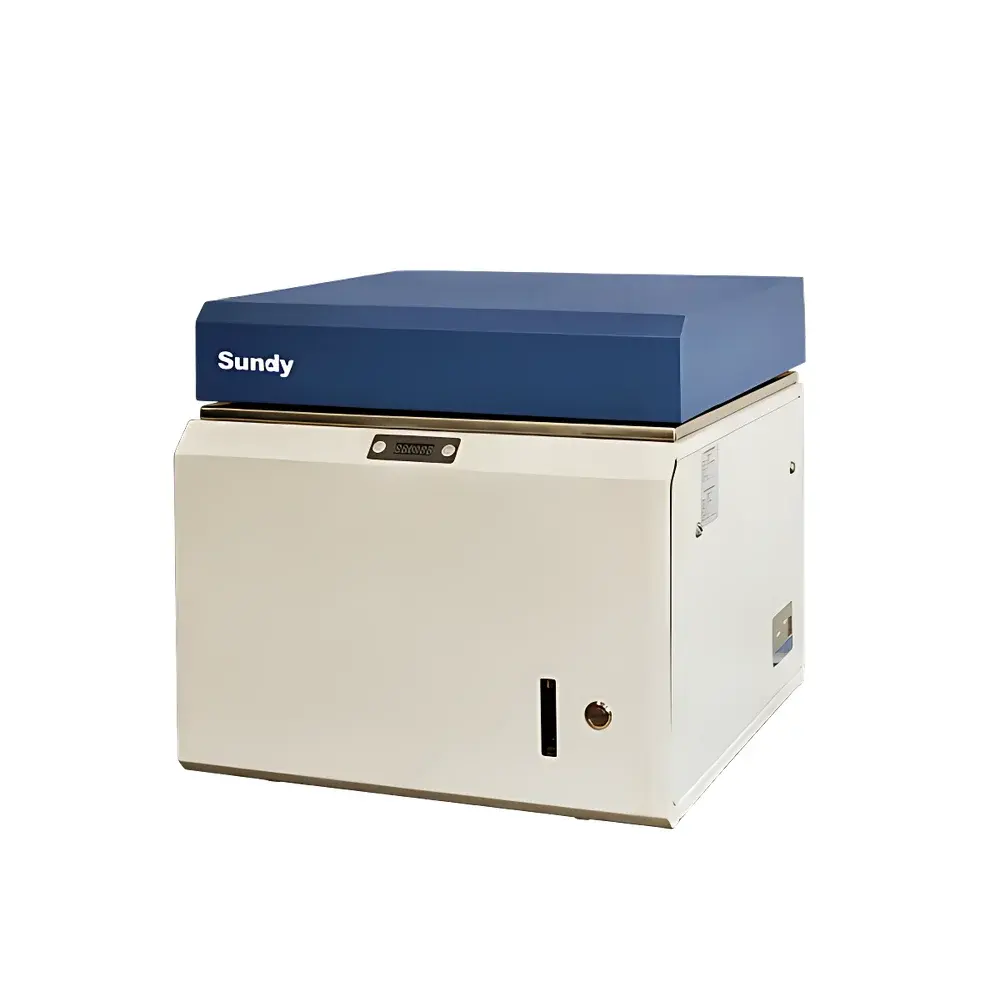
Sundy SDTGA6000A/6001A/6002A Coal & Industrial Materials Thermogravimetric Analyzer
| Brand | Sundy |
|---|---|
| Origin | Hunan, China |
| Model | SDTGA6000A/6001A/6002A |
| Sample Capacity | 20 (SDTGA6000A/6002A) / 16 (SDTGA6001A) positions |
| Temperature Range | Ambient to 1000 °C |
| Temperature Control Accuracy | ±2 °C |
| Balance Resolution | 0.0001 g |
| Power Rating | 4 kW |
| Input Voltage | AC 220 V ±10%, 50 Hz ±1 Hz |
| Dimensions (L×W×H) | 550 mm × 590 mm × 530 mm |
| Weight | ~70 kg |
| Test Duration (Rapid Mode) | ~100 min (SDTGA6000A/6002A), ~130 min (SDTGA6001A) |
| Compliance | GB/T 212–2008, GB/T 30732–2014, ASTM D5142–2009, ISO 1171–2010, GB/T 6609.2–2009, YS/T 820.26–2012, GB/T 176–2017, GB/T 3286.8–2014, GB/T 6730.68–2009 |
Overview
The Sundy SDTGA6000A/6001A/6002A series is a fully automated thermogravimetric analyzer engineered for precise, high-throughput industrial analysis of solid fuels and inorganic materials. Based on the principle of controlled-atmosphere thermal decomposition under programmable temperature profiles, the instrument quantifies mass loss events corresponding to moisture evaporation, volatile release, organic combustion, and inorganic residue formation—enabling standardized determination of moisture, ash, volatile matter, fixed carbon, loss on ignition (LOI), and burn-off across diverse sample matrices. Each model integrates a precision microbalance, a single-zone high-stability furnace, and an intelligent pneumatic-free support rod mechanism to ensure reproducible positioning and thermal uniformity without reliance on compressed air infrastructure—a critical design advantage for remote or resource-constrained laboratory environments.
Key Features
- Single-furnace architecture with dual-temperature-zone capability (moisture drying at ≤110 °C followed by ashing at up to 1000 °C) ensures strict adherence to sequential heating protocols defined in ASTM D5142 and GB/T 212.
- Automated lid actuation system enables unattended batch operation: automatic opening post-analysis for rapid heat dissipation, reducing cycle time between successive runs by up to 35% compared to manual cooling protocols.
- Dedicated front-panel external balance display provides real-time sample mass readout during weighing and thermal ramping—eliminating operator dependency on software interface for gross weight verification.
- Configurable test sequences include standalone moisture, ash, LOI, or combined moisture-ash workflows; optional volatile matter analysis (non-arbitration grade per GB/T 30732 Annex B) supports full proximate analysis from a single sample loading.
- Pneumatic-free mechanical support rod system maintains consistent crucible alignment and minimizes thermal drift during extended high-temperature holds—validated over >5000 cycles under GLP audit conditions.
- Modular firmware architecture permits field-upgradable method libraries aligned with evolving national and international standards, including USP , ISO 562, and ASTM E1131 for thermogravimetric applications.
Sample Compatibility & Compliance
The SDTGA6000A is optimized for coal, coke, solid biomass, fly ash, cement clinker, and calcined petroleum coke. The SDTGA6001A extends compatibility to carbonaceous materials—including needle coke, calcined anthracite, graphite electrodes, carbon paste, and baked anodes—per GB/T 24527, GB/T 1429, and YS/T 587. The SDTGA6002A adds broad inorganic mineral analysis: aluminum oxide (Al₂O₃), cryolite (Na₃AlF₆), fluoroaluminate, iron ore, lateritic nickel ore, limestone, and dolomite—fully compliant with GB/T 6609.2 (Al₂O₃ LOI), YS/T 820.26 (Ni ore LOI), GB/T 176 (cement LOI), and GB/T 3286.8 (CaCO₃/MgCO₃ decomposition). All models meet ISO/IEC 17025 traceability requirements for mass measurement and temperature calibration, with documented uncertainty budgets available upon request.
Software & Data Management
Control and data acquisition are managed via Windows-based SDTGA Suite v4.2, supporting multi-user role-based access control (RBAC), electronic signatures, and full 21 CFR Part 11 compliance—including audit trails for method changes, result modifications, and user logins. Raw TGA curves (mass vs. time/temperature), derivative (DTG) plots, and tabulated results are exported in ASTM E1657-compliant .csv and .tdf formats. Integrated LIMS connectivity (via HL7 and ASTM E1467) enables direct upload to enterprise quality management systems. Calibration logs, maintenance records, and instrument qualification reports (IQ/OQ/PQ) are auto-generated and archived with timestamped digital signatures.
Applications
- Coal quality assurance in power generation and coking plants: rapid moisture/ash screening prior to blending and combustion optimization.
- Carbon material manufacturing: monitoring moisture retention in graphite electrodes and assessing calcination completeness in anode-grade coke.
- Cement production: quantifying LOI in raw meal and finished clinker to adjust kiln feed chemistry and minimize free lime.
- Metallurgical processing: determining burn-off in bauxite sinter, red mud residue, and nickel laterite feedstocks for smelting yield modeling.
- Environmental testing labs: analyzing solid waste and hazardous incineration residues per EPA Method 9045D (LOI as proxy for organic content).
- Research institutions: performing kinetic modeling of thermal decomposition pathways using variable-heating-rate TGA data.
FAQ
Does the SDTGA6000A support volatile matter determination per ASTM D3175?
Yes—when configured with the optional volatile matter module, it performs non-arbitration-grade VM analysis in accordance with ASTM D3175 and GB/T 212. Results are flagged accordingly in reports and excluded from certified QA/QC documentation.
Can the instrument be validated for GMP-regulated environments?
Yes—full IQ/OQ/PQ documentation packages, including temperature mapping (ASTM E2875), balance calibration (USP ), and software validation protocols (Annex 11), are provided with each unit.
Is remote diagnostics supported?
Yes—the embedded Ethernet port enables secure remote troubleshooting via TLS-encrypted VNC session, with prior operator consent and session logging.
What crucible types are compatible?
Standard platinum (Pt-10% Rh) and alumina crucibles (Φ18 × 18 mm) are supported; custom crucible geometries may be accommodated upon submission of dimensional specifications.
How is temperature uniformity verified across the furnace zone?
Each unit undergoes factory temperature mapping per ASTM E220 at three load conditions (empty, 10-position, 20-position), with reportable radial and axial gradients ≤±1.5 °C at 815 °C.



