
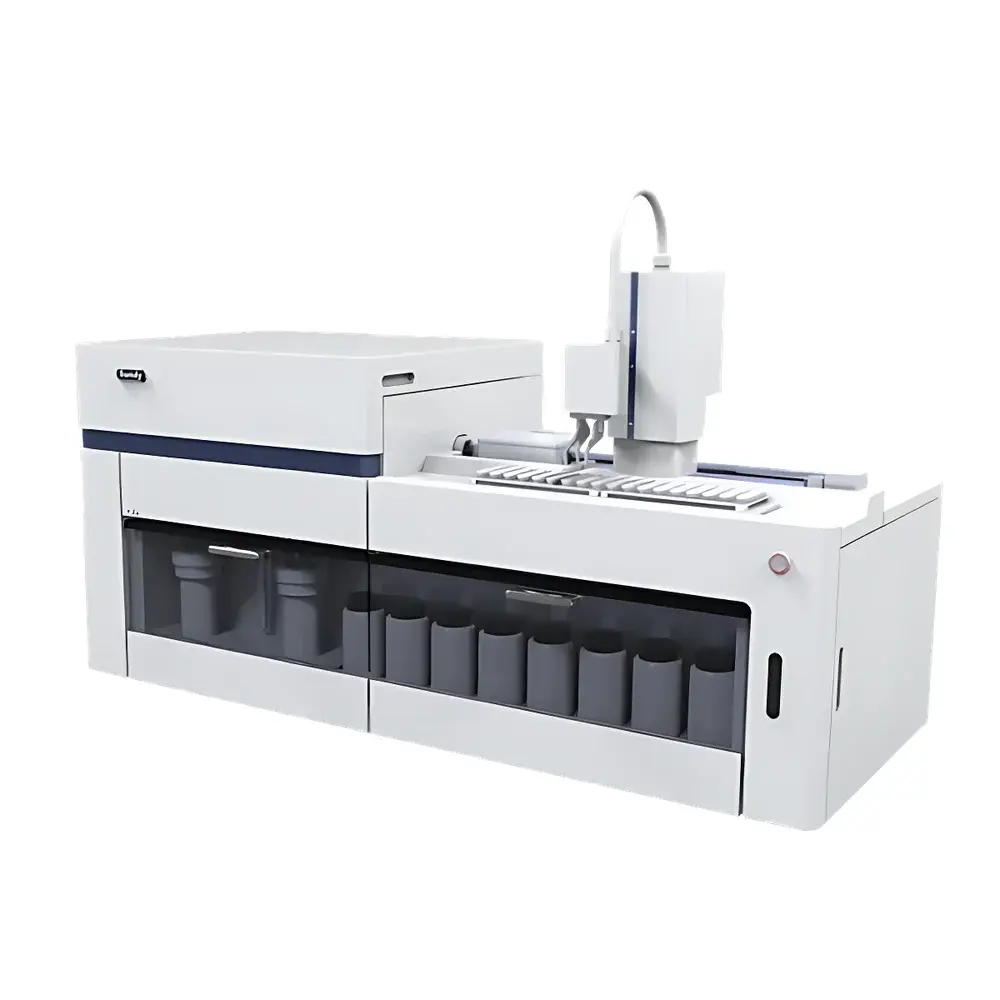
Sundyl SDFCl4200 Fluorine and Chlorine Analyzer
| Brand | Sundyl |
|---|---|
| Origin | Hunan, China |
| Model | SDFCl4200 |
| Dimensions (Analyzer) | 1266 mm × 560 mm × 570 mm (L×W×H) |
| Weight (Analyzer) | ~80 kg |
| Cooling Water Tank Dimensions | 310 mm × 606 mm × 420 mm |
| Water Tank Weight | ~17 kg |
| Fluorine Range | 10–2000 ppm |
| Chlorine Range | 30–4000 ppm |
| Single-Sample Analysis Time (F + Cl) | 35 min |
| Full Cycle Time (including digestion & analysis) | 59 min |
| Furnace Ramp Time | 25–30 min |
| Operating Temperature | 1100 ± 5 °C |
| Temperature Control Accuracy | ±5 °C |
| Power Supply | AC 220 ± 22 V, 50/60 Hz |
| Max. Power Consumption | 3.5 kW |
| Sample Particle Size | ≤0.2 mm |
| Compliant Standards | GB/T 3558, GB/T 4633 |
Overview
The Sundyl SDFCl4200 Fluorine and Chlorine Analyzer is a high-temperature pyrohydrolytic combustion system engineered for precise, simultaneous quantification of fluorine and chlorine in solid heterogeneous matrices—primarily coal, coke, fly ash, geological samples, and industrial by-products. It operates on the principle of high-efficiency pyrohydrolysis at controlled furnace temperatures (1100 ± 5 °C), where halogen-bearing compounds are thermally decomposed in a stream of oxygen and water vapor, converting fluorine and chlorine into volatile hydrogen halides (HF and HCl). These gaseous species are swept through a quartz reaction tube, absorbed quantitatively into dilute NaOH solution, and subsequently determined via ion chromatography (IC) or potentiometric titration using standardized electrodes—a methodology fully aligned with the gravimetric and instrumental validation frameworks of GB/T 3558 (for chlorine) and GB/T 4633 (for fluorine). The system integrates thermal, fluidic, and electrochemical measurement domains into a single automated platform, minimizing operator intervention while maintaining analytical traceability under routine laboratory conditions.
Key Features
- Stable high-temperature furnace with PID-controlled heating zone, achieving and sustaining 1100 °C ±5 °C with <30 min ramp time—optimized for complete halogen release without matrix interference or volatilization loss.
- Dual-channel absorption manifold enabling parallel capture of HF and HCl into separate alkaline traps, eliminating cross-contamination and supporting independent calibration curves for each analyte.
- Integrated cooling water recirculation system (310 × 606 × 420 mm tank, ~17 kg) with temperature monitoring to ensure consistent condensation efficiency and prevent back-diffusion of acidic vapors.
- Modular sample introduction design accommodating ≤0.2 mm pulverized solids—compatible with standard coal sample preparation workflows per ISO 13909 and ASTM D2013.
- Rugged stainless-steel and quartz construction throughout gas pathways, resistant to corrosion from HF/HCl under repeated thermal cycling.
- Compliance-ready architecture: All operational parameters—including furnace setpoint, dwell time, gas flow rates, and absorption duration—are logged with timestamped audit trails, supporting GLP documentation and internal QA review.
Sample Compatibility & Compliance
The SDFCl4200 is validated for use with carbonaceous and mineralogical solids exhibiting wide-ranging ash content (5–45 wt%), sulfur concentration (<5 wt%), and inherent halogen heterogeneity. It meets the methodological requirements of GB/T 3558–2014 (“Determination of chlorine in coal”) and GB/T 4633–2014 (“Determination of fluorine in coal”), including mandatory procedural controls for blank correction, spike recovery (≥95% for both F and Cl across 100–2000 ppm range), and replicate precision (RSD ≤5% at 500 ppm level). While not certified to ISO/IEC 17025 out-of-the-box, its output data structure and parameter logging capability enable straightforward integration into accredited laboratories’ documented quality systems. No modifications are required to satisfy routine regulatory reporting for power generation, coking plant emissions monitoring, or geological survey applications.
Software & Data Management
The analyzer interfaces with a dedicated Windows-based control application that manages furnace sequencing, gas flow regulation, and real-time temperature profiling. All instrument states—including thermocouple readings, solenoid valve actuation logs, and water-cooling status—are recorded at 1-second intervals and stored in encrypted binary files (.sdflog) with SHA-256 checksum integrity verification. Export options include CSV (for LIMS ingestion) and PDF analytical reports compliant with internal QA templates. Audit trail functionality satisfies basic FDA 21 CFR Part 11 readiness when deployed with domain-authenticated user accounts and electronic signature protocols—though full Part 11 compliance requires site-specific validation and IT infrastructure alignment.
Applications
- Coal quality assurance in thermal power plants and coal trading laboratories, where F and Cl concentrations directly impact boiler corrosion risk and flue gas desulfurization efficiency.
- Metallurgical coke evaluation for blast furnace feedstock, where chlorine-induced refractory degradation is a critical operational concern.
- Environmental monitoring of fly ash, bottom ash, and scrubber residues for landfill disposal classification per China’s HJ/T 300 leaching protocols.
- Geochemical exploration of sedimentary basins and hydrothermal deposits, supporting halogen geochemistry studies in academic and survey institutions.
- R&D support for low-halogen fuel formulation and halogen capture additive testing in clean combustion research programs.
FAQ
What sample preparation is required prior to analysis?
Samples must be air-dried, homogenized, and ground to ≤0.2 mm particle size using agate or tungsten carbide mills to ensure representative subsampling and complete combustion. Moisture content should be determined separately per GB/T 211.
Can the instrument analyze liquid or gaseous samples?
No—the SDFCl4200 is designed exclusively for solid matrices. Liquid or slurry samples require pre-concentration and drying; gases are outside its operational scope.
Is ion chromatography included with the system?
No. The SDFCl4200 delivers aqueous absorption solutions ready for downstream IC or titration. Users must supply compatible IC instrumentation or potentiometric titrators with fluoride- and chloride-selective electrodes.
How often does the quartz reaction tube require replacement?
Under normal operation (≤10 samples/day), the quartz tube maintains structural integrity for ≥12 months. Visual inspection for etching or microfractures is recommended every 200 runs.
Does the system support unattended overnight operation?
Yes—full cycle automation includes auto-start, thermal stabilization, sample drop, absorption, and shutdown. However, absorption solution replenishment and electrode calibration must be performed manually before each batch.







