
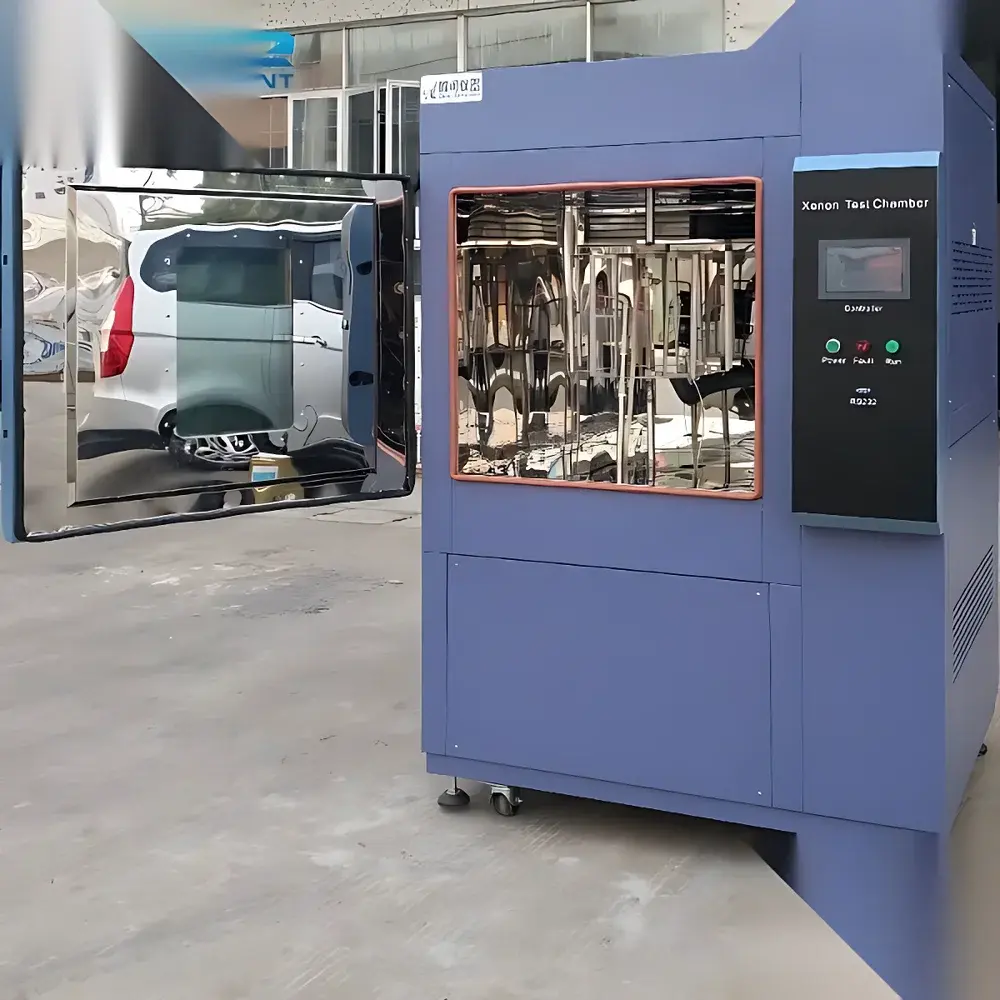
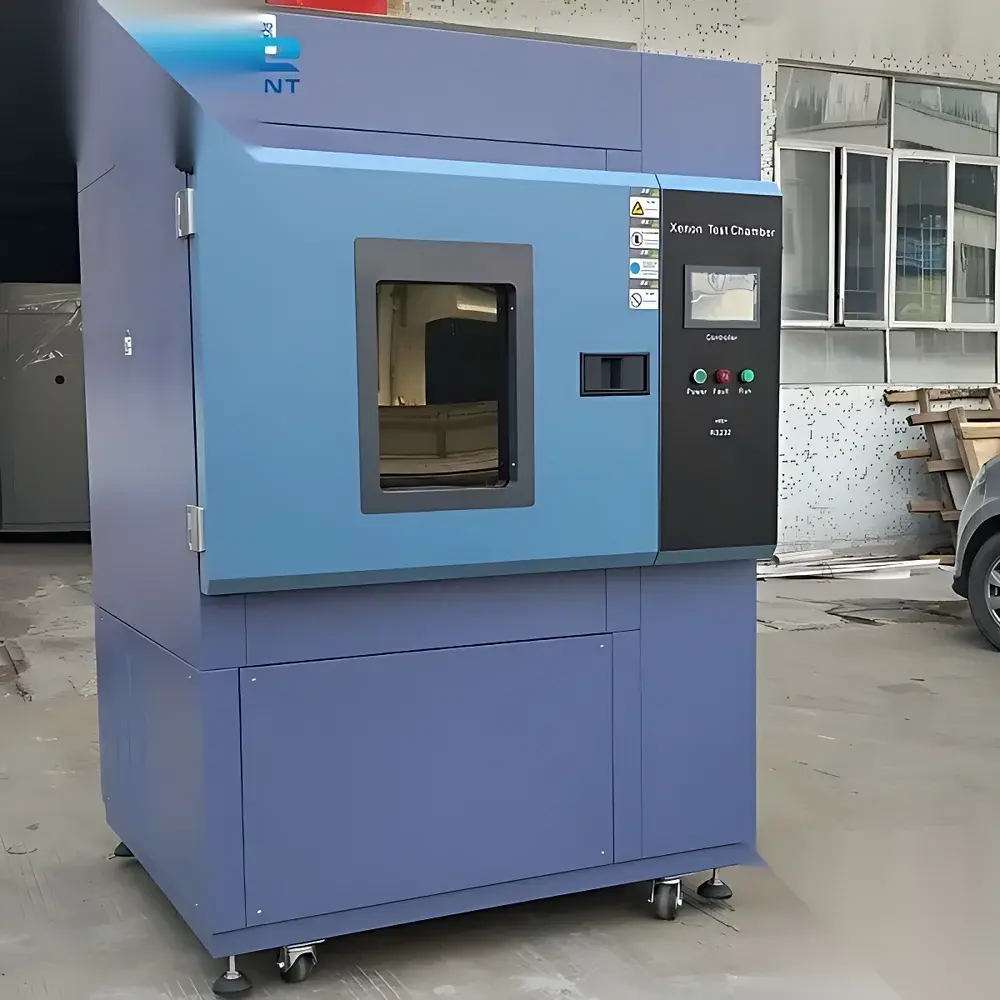
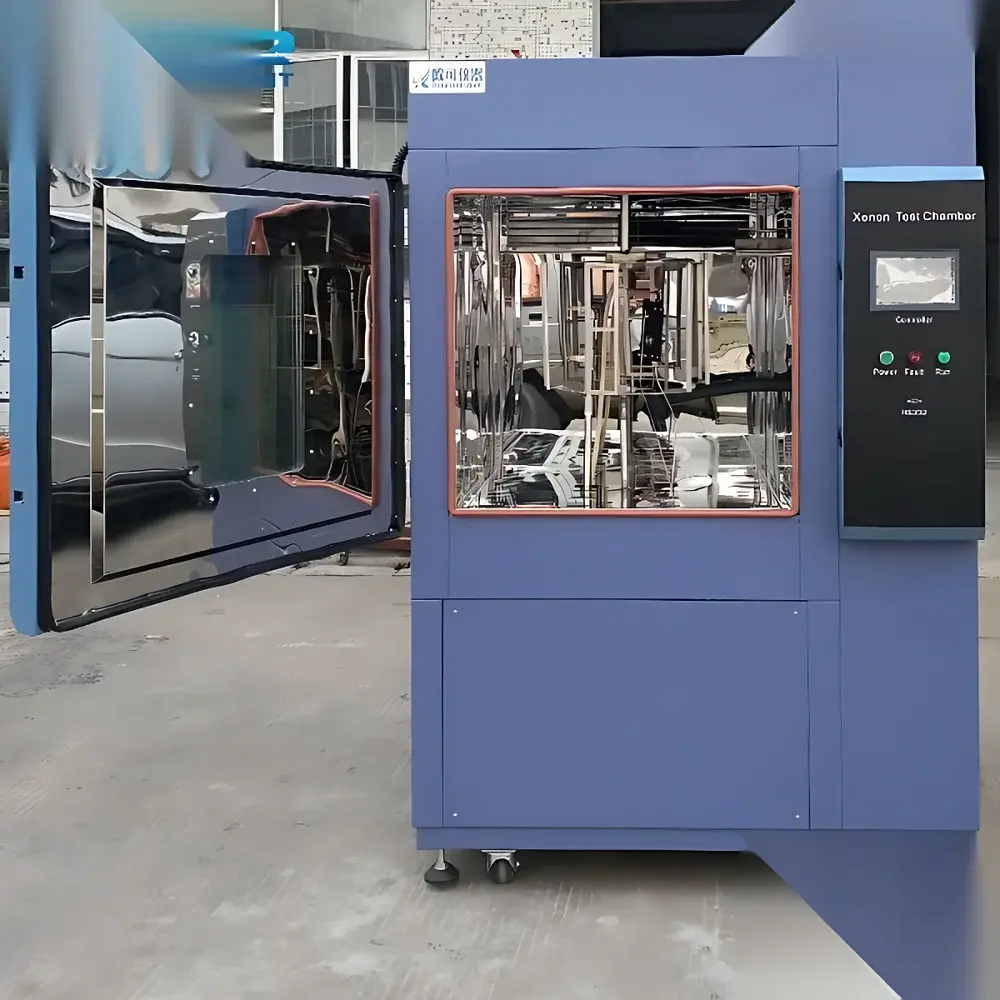
Sunlight Accelerated Weathering Test Chamber
| Brand | Other Brands |
|---|---|
| Origin | Imported |
| Manufacturer Type | Authorized Distributor |
| Price | USD 5,300 (Reference Only) |
| Humidity Range | 30–80% RH (Light Cycle), up to 90% RH (Dark Cycle) |
| Temperature Range | Ambient to 80°C |
| Temperature Uniformity | ±2.5°C |
| Temperature Fluctuation | ±1°C |
| Black Panel Temperature | 53°C (±3°C) |
| Humidification Method | Steam Generation via SUS304 Stainless Steel Heater |
| Humidity Sensor | Dry-Wet Bulb Type |
| Temperature Sensor | PT100 Platinum Resistance Thermometer |
| Heating System | Nickel-Chromium Alloy Heaters |
| Construction | SUS304 Stainless Steel Humidification Reservoir with Auto Water-Level Control |
Overview
The Sunlight Accelerated Weathering Test Chamber is an engineered environmental simulation system designed to replicate and intensify key terrestrial solar exposure conditions—including broadband UV-Vis-NIR irradiance, thermal cycling, controlled humidity, condensation, and simulated rainfall—in a reproducible laboratory setting. Based on the fundamental principles of photochemical degradation and thermally activated oxidation, the chamber enables accelerated assessment of material durability under realistic outdoor service conditions. Unlike generic UV-only or thermal-only test chambers, this system integrates spectral fidelity (approximating the AM1.5 global solar spectrum), dynamic thermal-hygrometric control, and programmable dark/light cycles—making it suitable for evaluating photostability, color fade resistance, gloss retention, chalking, cracking, and embrittlement in non-metallic and organic materials.
Key Features
- Optimized solar-spectrum irradiance simulation using calibrated xenon-arc or metal-halide lamp systems (configuration-dependent), with optional optical filters to match terrestrial solar energy distribution (ASTM G155, ISO 4892-2).
- Integrated black panel temperature control (53°C ±3°C) ensures surface temperature compliance with IEC 61215 and ASTM D4329 standards for polymer and coating evaluation.
- Dual-mode humidification: steam-based generation from a SUS304 stainless steel reservoir with automatic water-level regulation and dry-wet bulb humidity sensing for high accuracy across light (30–80% RH) and dark (up to 90% RH) phases.
- Precision temperature management: ambient-to-80°C operating range, ±1°C fluctuation, and ±2.5°C uniformity across test space—achieved via nickel-chromium alloy heating elements and PT100 platinum resistance sensors.
- Robust chamber construction using corrosion-resistant SUS304 stainless steel for interior walls, reservoirs, and critical fluid-contact components, ensuring long-term reliability in aggressive hygrothermal environments.
- Intuitive touchscreen controller with real-time parameter monitoring, multi-segment programmability, and event logging—supporting traceable test execution per GLP and internal quality protocols.
Sample Compatibility & Compliance
This chamber accommodates flat-panel specimens (standard sizes: 100 × 150 mm, 75 × 150 mm), molded parts, coated substrates, and flexible films mounted on sample racks or holders. It supports standardized specimen orientation (e.g., 5° south-facing tilt per ASTM G155) and optional spray/no-spray configurations for rain simulation. The system aligns with major international test standards including ASTM G155 (xenon-arc exposure), ISO 4892-2 (plastics—xenon arc methods), IEC 61215 (photovoltaic module qualification), and GB/T 16422.2 (Chinese national standard for solar radiation testing). While not inherently 21 CFR Part 11 compliant, audit trails and password-protected parameter locking can be configured to support GMP-aligned validation workflows.
Software & Data Management
The embedded controller provides local data logging at user-defined intervals (minimum 1-minute resolution) for irradiance (W/m²), black panel temperature, chamber air temperature, and relative humidity. Export options include CSV and PDF reports via USB interface. Optional PC-based software enables remote monitoring, advanced scheduling, comparative analysis across test runs, and automated report generation—including pass/fail flagging against pre-set thresholds. All logged parameters are time-stamped and associated with operator ID and test batch information, facilitating traceability during regulatory audits or internal QA reviews.
Applications
- Automotive OEMs and Tier-1 suppliers evaluating paint chip resistance, headlamp lens yellowing, and interior trim UV stability.
- Coating manufacturers validating weatherability claims for architectural paints, marine coatings, and industrial finishes per ISO 11341 and ASTM D4587.
- Photovoltaic component developers conducting pre-qualification testing of encapsulants, backsheets, and front glasses per IEC 61215 and UL 1703.
- Rubber and elastomer producers assessing ozone resistance, tensile retention, and compression set degradation under cyclic solar-thermal stress.
- Plastics compounders performing comparative aging studies on polyolefins, PVC, and engineering thermoplastics exposed to tropical or desert climatic profiles.
FAQ
What spectral output does this chamber deliver, and how closely does it match natural sunlight?
The chamber employs a broadband light source (typically xenon-arc) with optical filtering to approximate the AM1.5G solar spectrum (290–2500 nm), meeting the spectral irradiance requirements of ASTM G155 and ISO 4892-2. Spectral match is verified annually using a calibrated spectroradiometer.
Is condensation simulation supported?
Yes—the system achieves dew-point-controlled condensation through rapid cooling of specimen surfaces during dark cycles, replicating nocturnal moisture accumulation as specified in ASTM D4329 and ISO 4892-3.
Can the chamber perform cyclic tests with alternating UV, heat, and moisture phases?
Absolutely—multi-segment programming allows fully customizable sequences combining irradiance intensity, temperature ramping, humidity levels, and spray intervals, enabling complex weathering profiles such as “QUV + Condensation + Spray” equivalents.
Does the system include calibration documentation and traceability?
Each unit ships with factory calibration certificates for temperature, humidity, and irradiance sensors, traceable to NIST or equivalent national metrology institutes. On-site recalibration services are available upon request.
What maintenance is required to ensure long-term measurement stability?
Recommended quarterly maintenance includes lamp replacement (per manufacturer’s rated lifetime), sensor verification, humidifier descaling, and optical filter inspection—detailed in the included maintenance logbook and SOP guide.



