
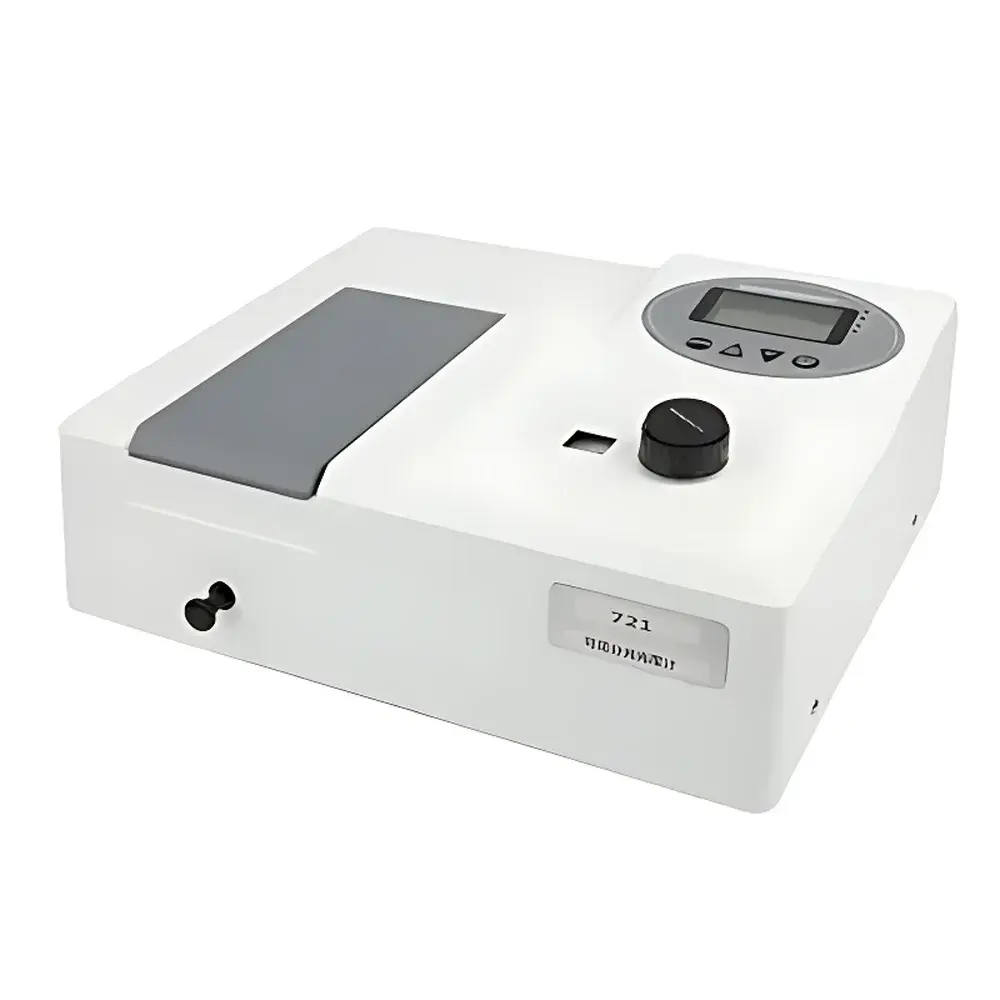
SUNNY HENGPING 721 Visible Spectrophotometer
| Brand | SUNNY HENGPING INSTRUMENT |
|---|---|
| Origin | Shanghai, China |
| Manufacturer Type | Direct Manufacturer |
| Instrument Type | Domestic |
| Model | 721 |
| Price Range | USD 0–720 |
| Optical Design | Single-Beam |
| Detector Type | Photocell (Silicon Photodiode) |
| Wavelength Range | 330–1000 nm |
| Wavelength Accuracy | ±2 nm |
| Wavelength Repeatability | ≤1.0 nm |
| Spectral Bandwidth | 5 nm |
| Stray Light | ≤0.5% T (at 360 nm) |
| Transmittance Accuracy | ±0.5% T |
| Transmittance Repeatability | ≤0.2% T |
| Absorbance Range | 0–1.999 Abs |
| Transmittance Range | 0–199.9% T |
| Concentration Readout | Yes (with user-defined factor) |
| Display | Backlit LCD |
| Auto Zero & Auto 100% T | Yes |
| Power Supply | 220 V ±10%, 50 Hz |
| Dimensions | 470 × 350 × 200 mm |
| Weight | 8 kg |
Overview
The SUNNY HENGPING 721 Visible Spectrophotometer is a precision single-beam optical instrument engineered for quantitative analysis of analytes within the visible spectrum (330–1000 nm). Based on the principle of Beer–Lambert law absorption spectroscopy, it measures transmittance (T%) and absorbance (A) of liquid or transparent solid samples to determine concentration via calibration curves. Its robust mechanical architecture—featuring a self-collimating monochromator with a 1200-line/mm holographic grating and a stable 20 W/12 V tungsten-halogen lamp—ensures consistent spectral output across routine laboratory use. Designed for reliability in non-regulated and education-focused environments, the 721 delivers repeatable photometric performance without requiring complex alignment procedures or external calibration references.
Key Features
- Single-beam optical path optimized for cost-effective, high-stability visible-range measurements
- Backlit LCD display with intuitive interface for real-time monitoring of T%, A, and concentration values
- Integrated auto-zero (0% T) and auto-100% T functions to minimize operator-induced baseline drift
- User-configurable concentration factor input enabling direct C-mode readout without manual calculation
- Fixed 5 nm spectral bandwidth—sufficient for most colorimetric assays including iron (1,10-phenanthroline), phosphate (molybdenum blue), and nitrate (cadmium reduction)
- Photocell-based detection using silicon photodiode with low dark current and thermal drift compensation
- Compact footprint (470 × 350 × 200 mm) and lightweight design (8 kg) suitable for benchtop deployment in teaching labs, QC rooms, and field-deployable units
Sample Compatibility & Compliance
The 721 accepts standard 10 mm pathlength cuvettes (glass or plastic) and supports aqueous, organic, and mildly corrosive solutions common in environmental, agricultural, food, and biochemical applications. While not designed for GLP/GMP-regulated production environments, its performance aligns with foundational requirements outlined in ISO 6425 (spectrophotometer verification), ASTM E275 (describing spectrophotometric measurement practices), and USP (UV-Vis instrumentation guidelines) for educational and screening-level analyses. It meets basic electrical safety standards per GB/T 28290 (Chinese national standard equivalent to IEC 61010-1) and includes overvoltage protection for 220 V ±10% AC supply.
Software & Data Management
The 721 operates as a standalone instrument with no PC connectivity or embedded data logging. All measurements are displayed and retained only on the LCD during active operation; no internal memory or export capability is provided. This architecture intentionally prioritizes simplicity, operational transparency, and maintenance-free longevity—making it ideal for student laboratories where instrument familiarity and fundamental spectroscopic principles take precedence over digital traceability. For users requiring audit trails or electronic records, external documentation (e.g., lab notebooks, manually recorded calibration logs) remains the recommended practice in accordance with general good laboratory practice (GLP).
Applications
- Quantitative determination of metal ions (e.g., Cu²⁺, Fe²⁺/Fe³⁺, Cr⁶⁺) via colorimetric reagents in water quality testing
- Enzyme kinetics assays (e.g., NADH/NADPH oxidation at 340 nm) in biochemistry teaching labs
- Protein concentration estimation using Bradford or Lowry methods (595 nm or 750 nm endpoints)
- Food additive analysis (e.g., nitrite in cured meats, sulfite in wines)
- Pigment concentration assessment in agricultural extracts (e.g., chlorophyll a/b, anthocyanins)
- Routine QC checks in pharmaceutical excipient manufacturing (e.g., color index of lactose or microcrystalline cellulose)
- Environmental monitoring of turbidity-corrected absorbance in wastewater effluent screening
FAQ
Is the 721 compliant with FDA 21 CFR Part 11?
No—the instrument lacks electronic recordkeeping, user authentication, or audit trail functionality required for Part 11 compliance.
Can it measure below 330 nm?
No—the optical design and detector sensitivity are limited to 330–1000 nm; UV measurements require a dedicated UV-Vis model.
What cuvette materials are supported?
Standard 10 mm square glass or UV-grade quartz cuvettes are compatible; plastic cuvettes may be used for non-critical teaching applications.
Does it support wavelength scanning or spectral acquisition?
No—it is a fixed-wavelength or manually stepped instrument; continuous scanning requires a diode array or double-beam spectrophotometer.
How often should wavelength accuracy be verified?
We recommend annual verification using NIST-traceable holmium oxide or didymium filters per ISO/IEC 17025 guidance for routine use.
Related Products




