
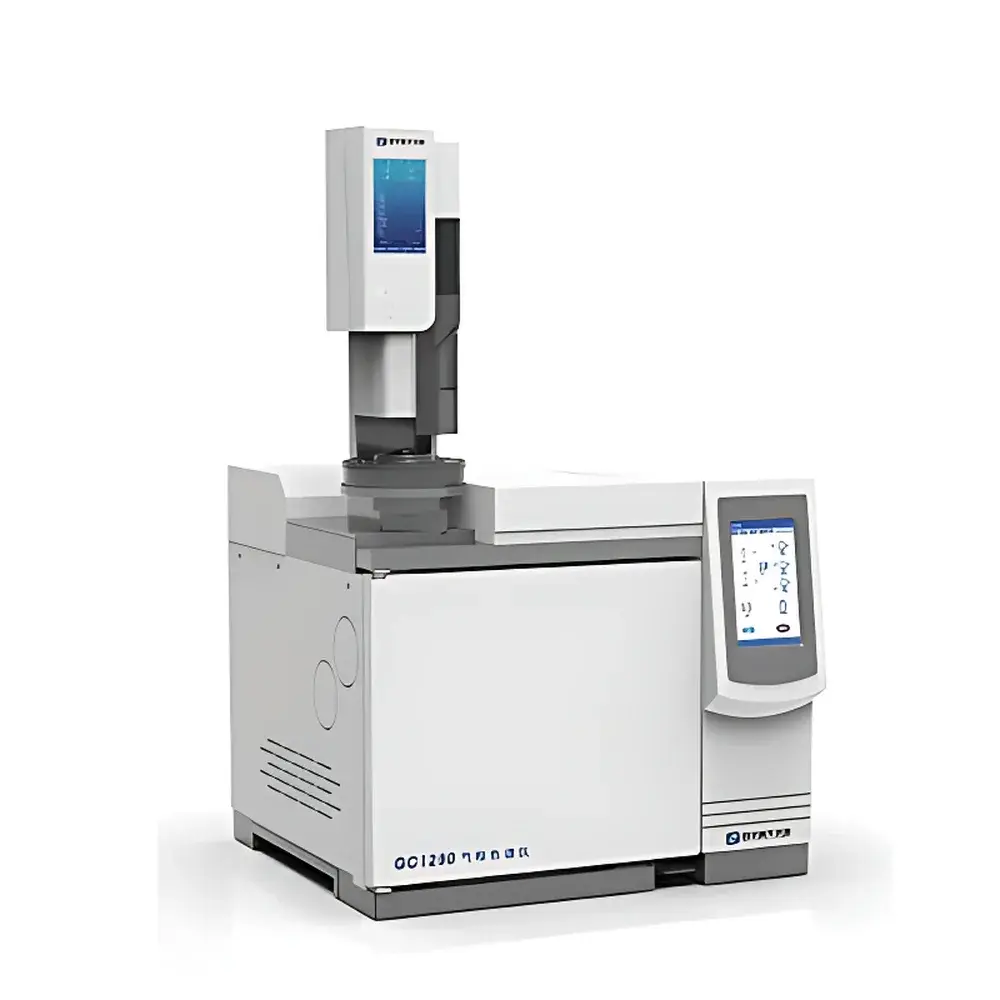
Sunny Hengping GC1290 Gas Chromatograph
| Brand | Sunny Hengping Instrument |
|---|---|
| Origin | Shanghai, China |
| Manufacturer Type | Original Equipment Manufacturer (OEM) |
| Regional Classification | Domestic (China-Made) |
| Model | GC1290 |
| Instrument Category | Laboratory Gas Chromatograph |
| Application Scope | General-Purpose |
| Oven Temperature Range | Ambient + 5°C to 420°C |
| Ramp Rate | 0–80°C/min |
| Cool-Down Time | <2.5 min (from 350°C to 100°C) |
| Carrier Gas Flow Range & Control | 0–200 mL/min |
| Carrier Gas Pressure Range & Control | 0–100 psi |
| Injector Maximum Operating Temperature | 420°C |
| Injector Pressure Setpoint Range | 0–100 psi |
| Injector Total Flow Setpoint Range | 0–250 µL/min |
Overview
The Sunny Hengping GC1290 Gas Chromatograph is a fully automated, laboratory-grade analytical instrument engineered for precision separation and quantification of volatile and semi-volatile organic compounds. Built upon a modular architecture integrating Electronic Pressure Control (EPC) and high-fidelity temperature management, the GC1290 delivers robust retention time reproducibility, consistent peak shape, and reliable baseline stability across extended operational cycles. Its core separation principle relies on differential partitioning of analytes between a mobile phase (inert carrier gas—typically helium, hydrogen, or nitrogen) and a stationary phase coated inside fused-silica capillary columns. The system supports both isothermal and multi-step programmed temperature ramping (up to 20 oven ramps, expandable via software), enabling method flexibility for complex matrices ranging from petrochemical fractions to environmental pollutants and pharmaceutical impurities.
Key Features
- Integrated EPC modules with digital regulation of pressure and flow across up to 12 independent gas channels—enabling simultaneous control of multiple inlets and detectors.
- Carrier gas flow accuracy ±5% and repeatability ±0.35%, compensated for ambient pressure and temperature variations in real time.
- Column oven with dynamic temperature range from ambient + 4°C to 420°C and thermal stability of ±0.02°C; accommodates dual capillary columns or mixed column configurations (e.g., one capillary + two packed columns).
- Modular inlet design supporting split/splitless, packed-column, and large-volume injection (LVI) options—all EPC-controlled with low-dead-volume vaporization chambers and interchangeable glass liners.
- Front-panel 7-inch capacitive touchscreen interface with intuitive navigation, real-time status monitoring, and method parameter validation prior to run initiation.
- Dual-detector capability with standardized EPC-driven gas supply (air: 0–800 mL/min; H₂: 0–100 mL/min; makeup gas: 0–100 mL/min) and full-scale digital signal output.
Sample Compatibility & Compliance
The GC1290 accommodates liquid, gaseous, and thermally stable solid samples following appropriate derivatization or solvent extraction. It supports standard injection volumes (0.1–10 µL) via manual or optional autosampler integration (up to 160-position trays). Inlet configurations are compatible with common capillary column dimensions (ID: 0.1–0.53 mm; length: up to 60 m) and packed columns (ID: 2–4 mm; length: up to 4 m). The instrument complies with foundational regulatory expectations for analytical instrumentation used in quality control laboratories, including design elements aligned with ISO/IEC 17025:2017 clause 5.5.2 (equipment verification), USP (chromatography), and general principles of GLP and GMP environments. Audit trail functionality—including user-level access control (three-tier role hierarchy), electronic signature support, and immutable logs of system events, method changes, and data processing actions—meets baseline requirements for FDA 21 CFR Part 11 compliance when deployed with validated software configurations.
Software & Data Management
The proprietary GC workstation software provides bidirectional communication with the GC1290 hardware, supporting method development, sequence definition, real-time chromatogram visualization, peak integration, calibration curve generation, and report export (PDF, CSV, XML). The interface operates in task-based and method-based modes, allowing analysts to decouple instrument configuration from sample batch logic—a critical workflow efficiency for routine QC labs. All raw data files are stored in vendor-neutral formats with embedded metadata (acquisition parameters, detector settings, column history). Software updates are delivered via secure offline installation packages to maintain integrity in regulated environments. Data archiving follows hierarchical retention policies configurable by administrator, with optional integration into LIMS via ASTM E1384-compliant export protocols.
Applications
The GC1290 serves as a versatile platform for applications requiring high-resolution separation and trace-level detection, including but not limited to: residual solvent analysis per ICH Q3C guidelines; hydrocarbon profiling in fuels and lubricants (ASTM D3606, D5186); pesticide residue screening in food matrices (AOAC 2007.01); volatile organic compound (VOC) monitoring in indoor air (EPA TO-17); fatty acid methyl ester (FAME) analysis in biodiesel (EN 14103); and monomer purity assessment in polymer manufacturing. Its compatibility with FID, TCD, ECD, FPD, NPD, and optional MSQ8100 mass spectrometric detection extends its utility across environmental, clinical, forensic, and industrial R&D settings.
FAQ
Does the GC1290 support method transfer from other GC platforms?
Yes—the instrument accepts standard .cdf and .dx file formats for method import, and its EPC architecture ensures consistent retention time alignment when column geometry and temperature programs are matched.
Is remote monitoring or control possible?
Remote operation is supported via secure LAN/WAN connection using the GC workstation’s client-server mode, provided network infrastructure adheres to organizational cybersecurity policies.
What maintenance intervals are recommended for EPC modules?
EPC modules require no routine recalibration; however, annual verification against NIST-traceable pressure and flow standards is advised as part of preventive maintenance planning.
Can the GC1290 be upgraded to GC-MS?
Yes—the system includes a dedicated transfer line interface and vacuum port pre-installed for seamless integration with the MSQ8100 quadrupole mass spectrometer, with firmware and software updates available for unified control.
Are consumables such as septa and liners supplied with certified lot documentation?
All factory-supplied consumables undergo batch-specific testing for extractables and are shipped with CoA documentation traceable to ISO 9001-certified production lines.
Related Products





