
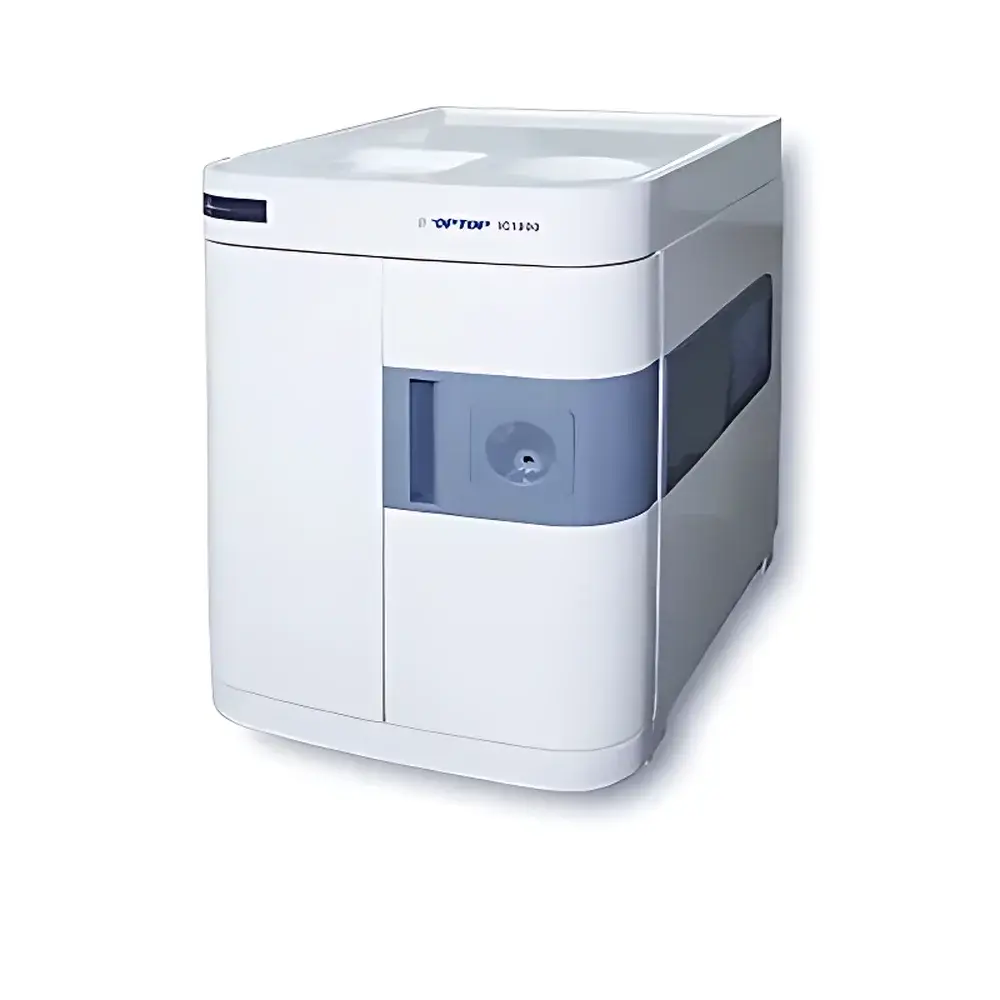
Sunny Hengping IC1800 Ion Chromatograph
| Brand | Sunny Hengping Instrument |
|---|---|
| Origin | Shanghai, China |
| Manufacturer Type | Direct Manufacturer |
| Regional Category | Domestic (China) |
| Model | IC1800 |
| Instrument Type | Laboratory Benchtop System |
| Pump Pressure Range | 0–25 MPa |
| Flow Rate Range | 0.000–9.999 mL/min |
| Eluent Flow Rate Range | 0.000–9.999 mL/min |
| Maximum Operating Pressure | 25 MPa |
| Column Oven Temperature Range | Ambient to 60 °C |
| Temperature Reproducibility | ±0.1 °C within ambient +2 °C to 100 °C |
| Eluent Concentration Range | 0–100 mmol/L (expressed as OH⁻) |
Overview
The Sunny Hengping IC1800 Ion Chromatograph is a fully integrated, laboratory-grade analytical system engineered for high-precision separation and quantitative detection of inorganic anions and cations in complex matrices. Based on suppressed conductivity detection coupled with high-pressure eluent delivery and electrochemical suppression, the IC1800 delivers robust performance across environmental monitoring, potable water testing, pharmaceutical excipient analysis, food safety screening, semiconductor process chemical verification, and industrial effluent compliance. Its modular architecture supports both hydroxide- and methanesulfonic acid–based elution chemistries, enabling flexible method development for multi-ion analysis without hardware modification. The system operates under ISO/IEC 17025-aligned design principles, with digital real-time monitoring of critical parameters—including pump pressure, flow stability, column temperature, and detector baseline integrity—to ensure data traceability and method reproducibility.
Key Features
- High-precision dual-piston series pump delivering ultra-low pulsation (<0.05% RSD) and flow accuracy of ±0.1% over the full 0.000–9.999 mL/min range, optimized for gradient and isocratic elution protocols.
- Digital bipolar pulsed conductivity detector with active temperature compensation; baseline noise ≤0.005 µS·cm⁻¹ and drift ≤0.1 µS·cm⁻¹/30 min, supporting sub-pptr detection limits (e.g., Cl⁻: ≤0.0005 µg/mL; BrO₃⁻: ≤0.005 µg/mL).
- Self-regenerating electrochemical suppressor with continuous inline regeneration, achieving >95% suppression efficiency and background conductivity <0.3 µS·cm⁻¹ for OH⁻-based eluents.
- PEEK-manufactured high-speed six-port injection valve driven by stepper motor actuation—chemically inert fluidic path minimizes metal ion leaching and carryover.
- Full-plastic (PEEK, PTFE, ETFE) flow path compatible with 0–100 mmol/L hydroxide or 0–50 mmol/L methanesulfonic acid eluents, resistant to strong acids, bases, and organic modifiers.
- Integrated column oven with PID-controlled heating (ambient to 60 °C), ±0.1 °C temperature stability, and programmable ramp profiles for retention time optimization.
Sample Compatibility & Compliance
The IC1800 accommodates aqueous samples across pH 2–12, including filtered drinking water, digested soil extracts, pharmaceutical buffers, beverage formulations, and ultrapure rinse solutions from wafer fabrication lines. It complies with key regulatory frameworks for routine QC/QA workflows: ASTM D4327 (anion analysis in water), ISO 10304-1 (determination of dissolved anions), USP (conductivity of purified water), and EPA Method 300.0/317.0 for regulated ion quantification. All hardware and software components support audit trail generation, user access control, and electronic signature capability—aligned with FDA 21 CFR Part 11 requirements when deployed with validated PAStation configuration and networked server logging.
Software & Data Management
PAStation Chromatography Data System (CDS) is a Windows-based platform developed in-house for instrument control, sequence management, peak integration, calibration curve fitting (linear, quadratic, weighted), and report generation. It supports IUPAC-compliant peak identification via retention time matching and spiking validation, integrates with LIMS via ASTM E1384-compliant export formats (.csv, .txt, .cdf), and includes built-in system suitability test (SST) templates per USP . Raw data files are stored with embedded metadata (operator ID, method version, acquisition timestamp, hardware firmware revision), and all processing steps are logged with immutable timestamps to satisfy GLP/GMP documentation standards.
Applications
- Environmental: Quantification of F⁻, Cl⁻, NO₂⁻, Br⁻, NO₃⁻, PO₄³⁻, SO₄²⁻, and AsO₄³⁻ in surface water, groundwater, and wastewater per national standard HJ 84-2016 (China) and EU Directive 2000/60/EC.
- Pharmaceutical: Counterion profiling of APIs (e.g., Na⁺, K⁺, Cl⁻ in lyophilized injectables), residual acetate/sulfate in bioprocess buffers, and nitrate/nitrite impurities per ICH Q5C and Q6A.
- Food & Beverage: Bromate, iodide, and perchlorate screening in bottled water and dairy products; organic acid profiling (acetate, lactate, citrate) using suppressed conductivity with post-column reaction.
- Electronics: Trace chloride, sulfate, and sodium in ultrapure water (UPW) used in photolithography baths, meeting SEMI F63 specifications.
FAQ
What eluent chemistries are supported by the IC1800?
The system is validated for potassium hydroxide (KOH) and methanesulfonic acid (MSA) eluents, with concentration ranges up to 100 mmol/L (OH⁻) and 50 mmol/L (H⁺), respectively.
Is the suppressor cartridge replaceable or fully regenerative?
It employs a membrane-based electrochemical suppressor with continuous electrolytic regeneration—no consumable cartridges required; only periodic electrolyte replenishment is needed.
Can the IC1800 be integrated into an existing LIMS environment?
Yes—PAStation supports ASTM E1384-compliant data export and optional OPC UA server integration for bidirectional communication with enterprise LIMS platforms.
What is the minimum detectable concentration for fluoride under standard operating conditions?
Using a 25-µL loop, AS14 column, and KOH gradient elution, the typical LOD for F⁻ is 0.0003 µg/mL (30 ng/L) at S/N = 3.
Does the system meet ISO/IEC 17025 calibration traceability requirements?
All critical subsystems—including flow meter, temperature sensor, and conductivity cell—are calibrated using NIST-traceable reference standards, with calibration certificates issued per ISO/IEC 17025 Clause 6.5.




