
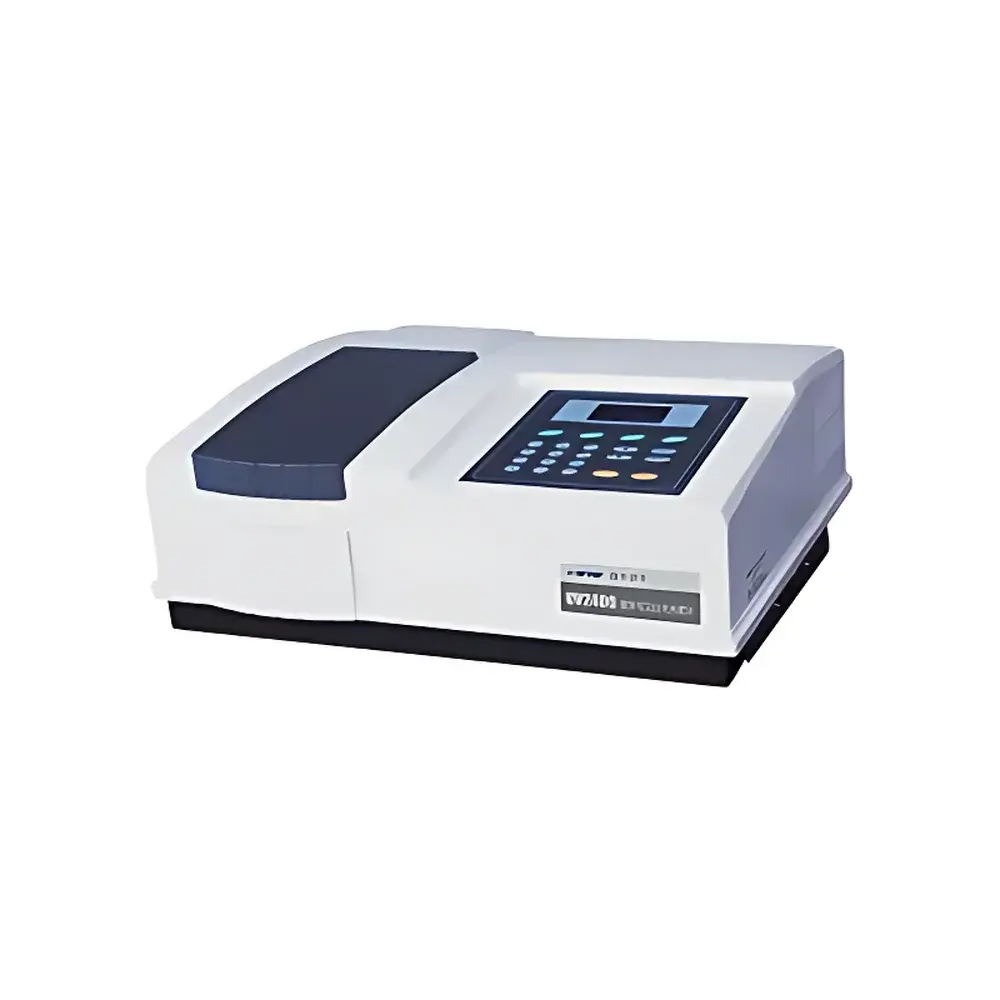
Sunny Hengping UV2400 Proportional-Monitoring Double-Beam Ultraviolet-Visible Spectrophotometer
| Brand | Sunny Hengping Instrument |
|---|---|
| Origin | Shanghai, China |
| Manufacturer Type | Direct Manufacturer |
| Regional Classification | Domestic (China) |
| Model | UV2400 |
| Price Range | USD 1,400 – 2,800 (FOB Shanghai) |
| Optical Design | Proportional-monitoring double-beam |
| Detector Type | Silicon photodiode |
| Wavelength Range | 190–1100 nm |
| Wavelength Accuracy | ±0.5 nm |
| Spectral Bandwidth | 1.8 nm |
| Wavelength Scanning Step | 0.1 nm |
| Display | 128 × 64 dot-matrix LCD |
| Sample Holder | Automated 8-cell rotating cuvette holder (10 mm pathlength) |
| Data Interface | USB 2.0 |
| Power Supply | 220 V ±10%, 50 Hz or 110 V ±10%, 60 Hz |
| Dimensions (L×W×H) | 545 × 450 × 235 mm |
| Net Weight | 17.0 kg |
| Gross Weight | 26.0 kg |
Overview
The Sunny Hengping UV2400 is a precision-engineered proportional-monitoring double-beam ultraviolet-visible (UV-Vis) spectrophotometer designed for routine and research-grade quantitative and qualitative analysis in academic, pharmaceutical, environmental, and industrial laboratories. Based on the Czerny-Turner monochromator optical architecture, the instrument delivers high wavelength accuracy (±0.5 nm), excellent photometric repeatability (<0.002 A at 0.5 A), and low stray light (<0.05% T at 220 nm and 360 nm), ensuring reliable performance across the full spectral range of 190–1100 nm. Its proportional-monitoring double-beam design continuously compensates for source intensity drift and detector response variation, enabling stable baseline behavior over extended measurement sessions—critical for kinetic studies, multi-sample batch analysis, and regulatory-compliant workflows.
Key Features
- Proportional-monitoring double-beam optics with real-time reference beam compensation for enhanced photometric stability and reduced baseline drift.
- Czerny-Turner monochromator with holographic grating ensures high wavelength resolution and reproducibility; spectral bandwidth fixed at 1.8 nm (FWHM).
- Automated 8-position rotating sample holder with standardized 10 mm pathlength cuvettes—enabling rapid sequential analysis without manual intervention.
- Integrated cuvette error correction algorithm automatically subtracts absorbance contributions from matched or unmatched cuvettes, improving quantitation accuracy—especially at low analyte concentrations.
- Direct keyboard entry of wavelength with 0.1 nm increment resolution; supports single-point, multi-wavelength, and full-spectrum scanning modes.
- Front-panel LCD (128 × 64 pixels) displays real-time spectra, numerical results, and system status; intuitive menu navigation requires no external software for basic operation.
- Tool-free deuterium lamp replacement via flanged socket mount—eliminates post-replacement optical alignment, reducing maintenance downtime.
- USB 2.0 interface enables seamless connection to Windows-based PCs for expanded functionality using optional UV-Solution software.
Sample Compatibility & Compliance
The UV2400 accommodates standard 10 mm square quartz, glass, or plastic cuvettes and supports liquid, solution-phase samples compatible with UV-Vis absorption spectroscopy principles. It meets core requirements for ISO/IEC 17025-accredited testing environments when operated under documented procedures. While not pre-certified for FDA 21 CFR Part 11 out-of-the-box, the optional UV-Solution software package includes configurable audit trail logging (user login, method changes, data edits, report generation timestamps), supporting GMP/GLP-aligned data integrity practices. The instrument’s low stray light performance aligns with ASTM E275 and ISO 9001 calibration verification criteria for photometric accuracy in routine QC applications.
Software & Data Management
UV-Solution workstation software (optional, Windows-compatible) extends the UV2400’s analytical capabilities beyond standalone operation. It provides five primary modules: Photometric Measurement (T/A/E at fixed λ), Spectrum Scanning (wavelength scan with smoothing, derivative calculation, peak detection), Kinetic Scanning (time-resolved A/T at user-defined intervals), Quantitative Analysis (linear/nonlinear calibration curves including DNA/protein ratio calculations), and 3D Mapping (wavelength × time × absorbance). All modules support export to CSV and Excel formats; spectral plots can be saved as BMP files. Audit trail functionality records operator actions, parameter modifications, and report outputs—essential for laboratories implementing ALCOA+ data governance frameworks.
Applications
The UV2400 serves diverse analytical needs: determination of nucleic acid (DNA/RNA) and protein concentration using 260/280 nm absorbance ratios; validation of dye-labeled biomolecules in life science workflows; quantification of active pharmaceutical ingredients (APIs) per USP guidelines; monitoring of chemical reaction kinetics in teaching labs; water quality assessment (e.g., nitrate, phosphate, COD estimation); and colorimetric enzyme assays (e.g., ELISA, LDH, glucose oxidase). Its broad 190–1100 nm coverage supports both deep-UV aromatic compound analysis and near-IR solvent characterization.
FAQ
Is the UV2400 compliant with FDA 21 CFR Part 11?
The base instrument does not include electronic signature or audit trail features. However, the optional UV-Solution software offers configurable audit logging and user access control—enabling implementation of Part 11-compliant workflows when validated per organizational SOPs.
What cuvette types are supported?
Standard 10 mm pathlength square cuvettes made of quartz (190–2500 nm), optical glass (340–2500 nm), or polystyrene (300–900 nm) are fully compatible. The 8-cell autosampler accepts all common 12.5 mm × 12.5 mm footprint cuvettes.
Can the instrument perform kinetic measurements?
Yes—when connected to UV-Solution software, the UV2400 supports time-scan mode with adjustable sampling intervals (0.1 s to 600 s), enabling enzyme activity assays, dissolution testing, and redox reaction monitoring.
What is the typical warm-up time before achieving photometric stability?
Deuterium and tungsten lamps require approximately 20 minutes for thermal equilibrium; wavelength and photometric calibration should be performed after this period for optimal accuracy.
Does the UV2400 support GLP documentation standards?
With UV-Solution’s audit trail, electronic signatures, and method versioning, laboratories may configure the system to meet GLP documentation requirements—including traceable calibration logs, raw data archiving, and operator accountability—subject to internal validation.
Related Products




