
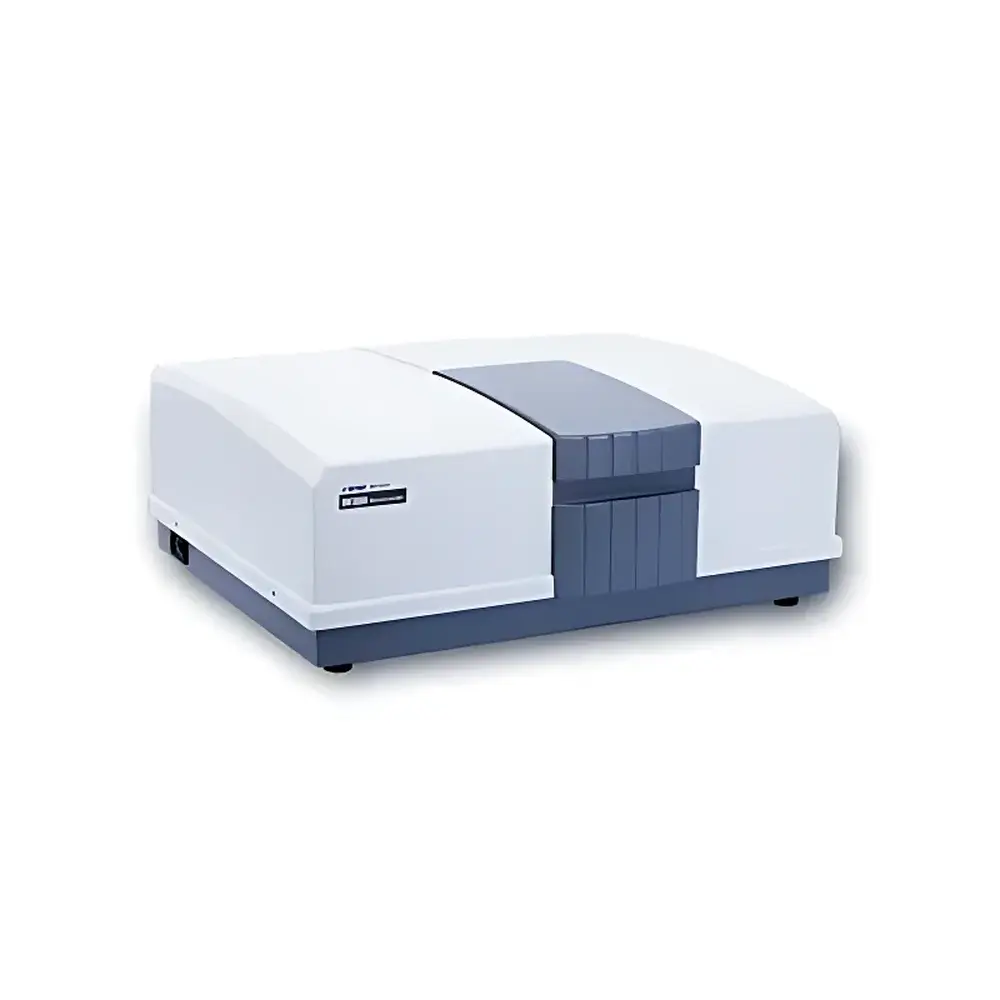
Sunny Hengping UV2900 Dual-Beam Ultraviolet-Visible Spectrophotometer
| Brand | Sunny Hengping Instrument |
|---|---|
| Origin | Shanghai, China |
| Manufacturer Type | Original Equipment Manufacturer (OEM) |
| Regional Classification | Domestic (China-Made) |
| Model | UV2900 |
| Price Range | USD 7,000–10,000 (FOB Shanghai) |
| Optical Design | Dual-Beam |
| Detector | Photomultiplier Tube (PMT) |
| Wavelength Range | 190–900 nm (extendable to 185 nm) |
| Wavelength Drive | Motorized Auto-Scanning |
| Spectral Bandwidth | 0.1–5.0 nm continuously variable |
| Default Discrete Bandwidth Settings | 0.1, 0.2, 0.5, 1.0, 2.0, 3.0, 4.0, 5.0 nm |
| Data Output | Digital via USB 2.0 |
| Power Supply | 220 V ±10%, 50 Hz, 200 W |
| Net Weight | 30.0 kg |
| Dimensions (L×W×H) | 620 × 510 × 245 mm |
| Packaging Dimensions (L×W×H) | 745 × 635 × 400 mm |
Overview
The Sunny Hengping UV2900 is a high-performance, PC-controlled dual-beam ultraviolet-visible (UV-Vis) spectrophotometer engineered for precision quantitative and qualitative analysis across research, quality control, and regulatory environments. Based on the principle of absorbance measurement according to the Beer–Lambert law, the instrument employs a dynamic feedback dual-beam optical architecture that continuously balances reference and sample beam intensities in real time—minimizing drift and enhancing baseline stability over extended acquisition periods. Its core optical system integrates a high-efficiency Czerny–Turner monochromator with a holographic grating, coupled with a low-noise photomultiplier tube (PMT) detector optimized for sensitivity across the full 190–900 nm spectral range (with optional extension to 185 nm for deep-UV applications). The UV2900 delivers exceptional photometric accuracy, low stray light (<0.01% at 220 nm), and high signal-to-noise ratio—critical for trace-level quantitation, kinetic assays, and multi-component spectral deconvolution.
Key Features
- Dual-beam dynamic feedback system ensures long-term baseline stability (<±0.001 A/h at 500 nm), eliminating manual zeroing during prolonged scans.
- Continuously adjustable spectral bandwidth from 0.1 to 5.0 nm, with eight factory-calibrated discrete settings (0.1, 0.2, 0.5, 1.0, 2.0, 3.0, 4.0, 5.0 nm) for method transfer compliance and application-specific resolution tuning.
- Pre-aligned, socket-type deuterium and tungsten-halogen lamps enable tool-free lamp replacement without optical realignment—reducing maintenance downtime and technician dependency.
- Motorized wavelength drive with sub-nanometer positioning repeatability supports high-fidelity spectral scanning at user-defined intervals (0.1–5.0 nm step resolution).
- Integrated thermal management system maintains optical path temperature stability, mitigating thermal drift in absorbance measurements under ambient laboratory conditions.
Sample Compatibility & Compliance
The UV2900 accommodates standard 10-mm square cuvettes (quartz, glass, or plastic), micro-volume adapters (down to 50 µL), and optional fiber-optic probes for remote or in-situ measurements. It supports liquid, solution-based, and transparent solid samples compatible with UV-Vis absorption spectroscopy. The instrument meets essential international performance benchmarks including ASTM E275 (Standard Practice for Describing and Measuring Performance of UV-Vis Spectrophotometers) and ISO 9001-aligned manufacturing controls. When equipped with the optional audit trail module, the UV-Solution3.0 software complies with FDA 21 CFR Part 11 requirements for electronic records and signatures—including user authentication, immutable event logging, and version-controlled method storage—enabling use in GLP and GMP-regulated laboratories.
Software & Data Management
UV-Solution3.0 is a Windows-based workstation software offering full instrument control, data acquisition, and advanced post-processing capabilities. It provides validated workflows for photometric mode, wavelength scanning, kinetic (time-based) assays, quantitative analysis (linear, polynomial, and custom curve fitting), multi-wavelength analysis, and nucleic acid/protein quantification (A260/A280 ratio calculation, extinction coefficient input, and concentration derivation per USP and ISO 13485 guidelines). All spectra and reports are exportable in native .uvd format, as well as CSV, Excel (.xlsx), BMP, and PDF—ensuring interoperability with LIMS, ELN, and statistical analysis platforms. Raw data files retain metadata (date/time stamp, operator ID, instrument serial number, method parameters), supporting full traceability in regulated environments.
Applications
The UV2900 serves diverse analytical needs: routine QC testing of pharmaceutical actives and excipients per USP ; environmental monitoring of nitrate, phosphate, and heavy metal complexes; enzymatic kinetics and protein folding studies; nucleic acid purity assessment (DNA/RNA integrity via A260/A230 and A260/A280 ratios); dye and pigment formulation analysis; and educational spectroscopy instruction. Its broad spectral coverage and tunable resolution make it suitable for both classical single-point assays and advanced spectral fingerprinting—such as identifying degradation products in stressed stability samples or distinguishing structurally similar isomers through fine spectral features.
FAQ
Is the UV2900 compliant with FDA 21 CFR Part 11?
Yes—when configured with the optional audit trail module and operated under UV-Solution3.0’s validated configuration, the system supports electronic signature capture, role-based access control, and immutable activity logs required for regulated biopharmaceutical and clinical testing labs.
Can the instrument perform kinetic measurements with variable time intervals?
Yes—the time-scan function allows programmable sampling intervals from 0.1 s to 600 s, enabling precise monitoring of rapid enzymatic reactions or slow degradation processes.
What is the minimum detectable absorbance change under optimal conditions?
With a 1.0 nm bandwidth and quartz cuvette, the instrument achieves photometric noise ≤±0.0004 A (RMS) at 0.5 A, supporting detection of sub-0.1% concentration changes in stable systems.
Does the software support method validation protocols per ICH Q2(R2)?
UV-Solution3.0 includes built-in tools for linearity assessment, limit of detection/quantitation estimation, and repeatability evaluation—facilitating execution of key validation parameters defined in ICH Q2(R2) for spectrophotometric methods.
Is remote operation possible via network connection?
While the standard interface is USB 2.0, optional Ethernet connectivity and TCP/IP-enabled remote control modules are available for integration into centralized lab networks and automated workflows.




