
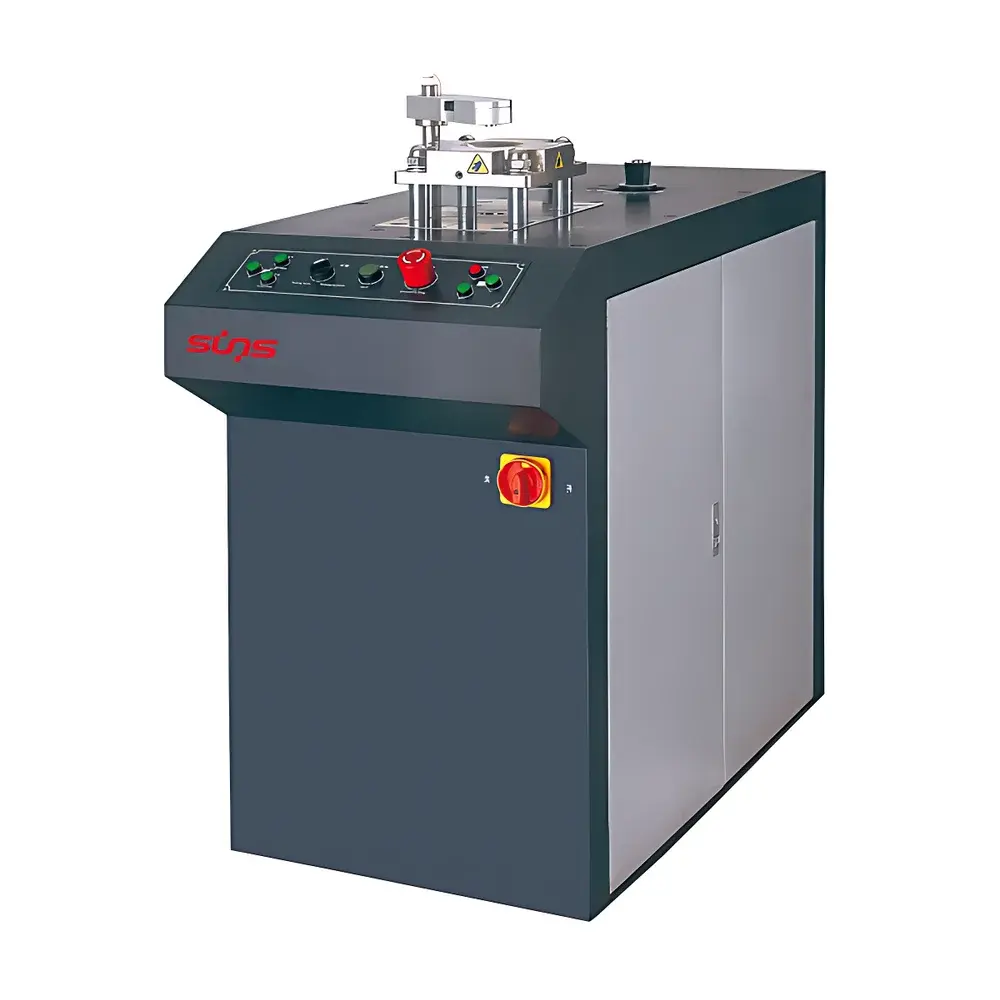
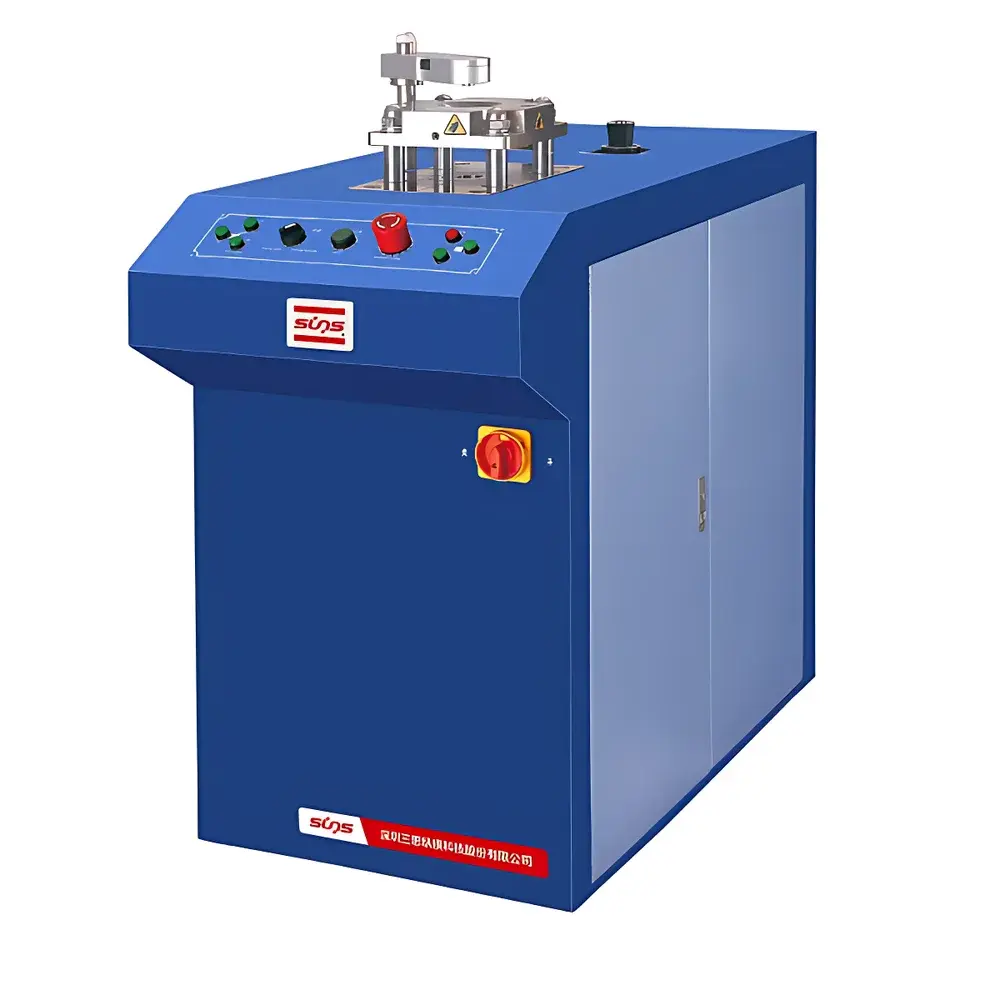
SUNS ETM2604 Erichsen Cupping Tester
| Key | Brand: SUNS |
|---|---|
| Origin | Guangdong, China |
| Manufacturer Type | Direct Manufacturer |
| Instrument Type | Hydraulic |
| Max Test Force | 0.2–60 kN |
| Clamping Force | 25 kN |
| Punch Stroke | 60 mm |
| Clamping Stroke | 50 mm |
| Max Specimen Width | 100 mm |
| Punching Speed | 2–100 mm/min (constant-speed control) |
| Deformation Measurement Accuracy | ±1% |
| Displacement Resolution | 0.001 mm |
Overview
The SUNS ETM2604 Erichsen Cupping Tester is a precision-engineered hydraulic testing system designed to determine the deep-drawing formability of metallic sheets and strips via the standardized Erichsen cupping test. Based on ISO 20482, ASTM E643, GB/T 4156–2007, and GB 5125–2008, this instrument quantifies the cupping index—defined as the vertical displacement of a spherical punch until through-thickness cracking occurs under controlled biaxial strain. Its robust hydraulic architecture ensures stable load application and high repeatability across thin-gauge materials (0.1–3 mm thickness), making it suitable for quality assurance in automotive stamping, appliance manufacturing, and metal packaging supply chains. The system operates under closed-loop servo-hydraulic control, integrating real-time force-displacement synchronization to meet stringent requirements for GLP-compliant mechanical property documentation.
Key Features
- Automated crack-detection logic with immediate test termination upon first visible fracture—enabled by integrated high-resolution digital camera and synchronized video playback for precise cupping depth validation at failure initiation.
- DSP-based real-time control platform delivering superior signal integrity, low-latency feedback response (<1 ms loop time), and deterministic execution of complex ramp-hold profiles.
- Full microcomputer control with dynamic on-screen visualization of clamping load, punching load, cupping depth (E-value), displacement rate, and live L-F-D curves.
- Optical grating displacement sensor with 0.001 mm resolution for direct, non-contact measurement of punch penetration—eliminating mechanical backlash or thermal drift errors inherent in potentiometric transducers.
- Interchangeable hardened steel spherical punches (standard: Ø20.00 ±0.05 mm; optional: Ø15.00 ±0.05 mm and Ø8.00 ±0.02 mm) meeting surface roughness (Ra ≤ 0.4 µm) and hardness (≥60 HRC) specifications per JJG 583–2010.
- Adjustable clamping pressure via calibrated hydraulic regulator—ensuring consistent blank-holder force across varying sheet stiffnesses without manual recalibration.
- Peak load memory function compliant with ASTM E643 Annex A1 for post-test retrieval of maximum applied force during deformation.
Sample Compatibility & Compliance
The ETM2604 accommodates flat metallic specimens up to 100 mm wide and 3 mm thick, including cold-rolled steel, aluminum alloys (e.g., AA5182, AA6016), stainless steels (304, 430), and copper-clad laminates. It supports both standard and non-standard specimen geometries per ISO 20482 Annex B. All mechanical and metrological performance parameters comply with JJG 583–2010 (verification regulation for cupping testers) and JB/T 7408–94 (technical specification). Load cell calibration traceability follows ISO/IEC 17025 guidelines, and displacement sensor certification aligns with ISO 17025-accredited third-party verification protocols.
Software & Data Management
The proprietary TESTMaster™ software provides full test lifecycle management: method setup (including speed ramping, hold duration, and auto-stop thresholds), real-time curve overlay, statistical reporting (mean, SD, CV%), and export to CSV, PDF, or XML formats. Audit trails record operator ID, timestamp, parameter changes, and raw data checksums—fully satisfying FDA 21 CFR Part 11 requirements for electronic records and signatures. Data encryption (AES-256) and role-based access control ensure secure handling in regulated environments. Optional integration with LIMS via ASTM E1384-compliant HL7 messaging enables automated result transfer to enterprise QA databases.
Applications
- Formability assessment of automotive body panels (e.g., door inner panels, hood skins) prior to die tryout.
- Batch release testing of coated steel substrates used in food can manufacturing per ASTM D4145.
- Process validation of continuous annealing line (CAL) output for interstitial-free (IF) steels.
- Comparative evaluation of lubricant efficacy in drawing operations using identical substrate batches.
- Research-grade ductility mapping of additively manufactured thin-walled metal structures (e.g., Ti-6Al-4V foils).
FAQ
What standards does the ETM2604 support for international compliance?
It fully implements ISO 20482, ASTM E643, GB/T 4156–2007, GB 5125–2008, and JJG 583–2010—including verification procedures for force accuracy, displacement linearity, and repeatability.
Can the system be validated for GMP/GLP environments?
Yes—the software includes 21 CFR Part 11-compliant audit trails, electronic signature capability, and IQ/OQ documentation templates aligned with ISO 13485 and ICH Q7 frameworks.
Is remote diagnostics supported?
Standard Ethernet interface enables secure remote firmware updates, parameter backup, and real-time troubleshooting via encrypted VNC session with user permission controls.
How is traceability maintained for sensor calibration?
Each unit ships with NIST-traceable calibration certificates for both load cell and displacement sensor, renewed annually per ISO/IEC 17025 requirements.
What maintenance intervals are recommended?
Hydraulic fluid replacement every 24 months; filter cartridge change every 12 months; annual verification of grating scale alignment and seal integrity per manufacturer’s PM checklist.
Related Products



