
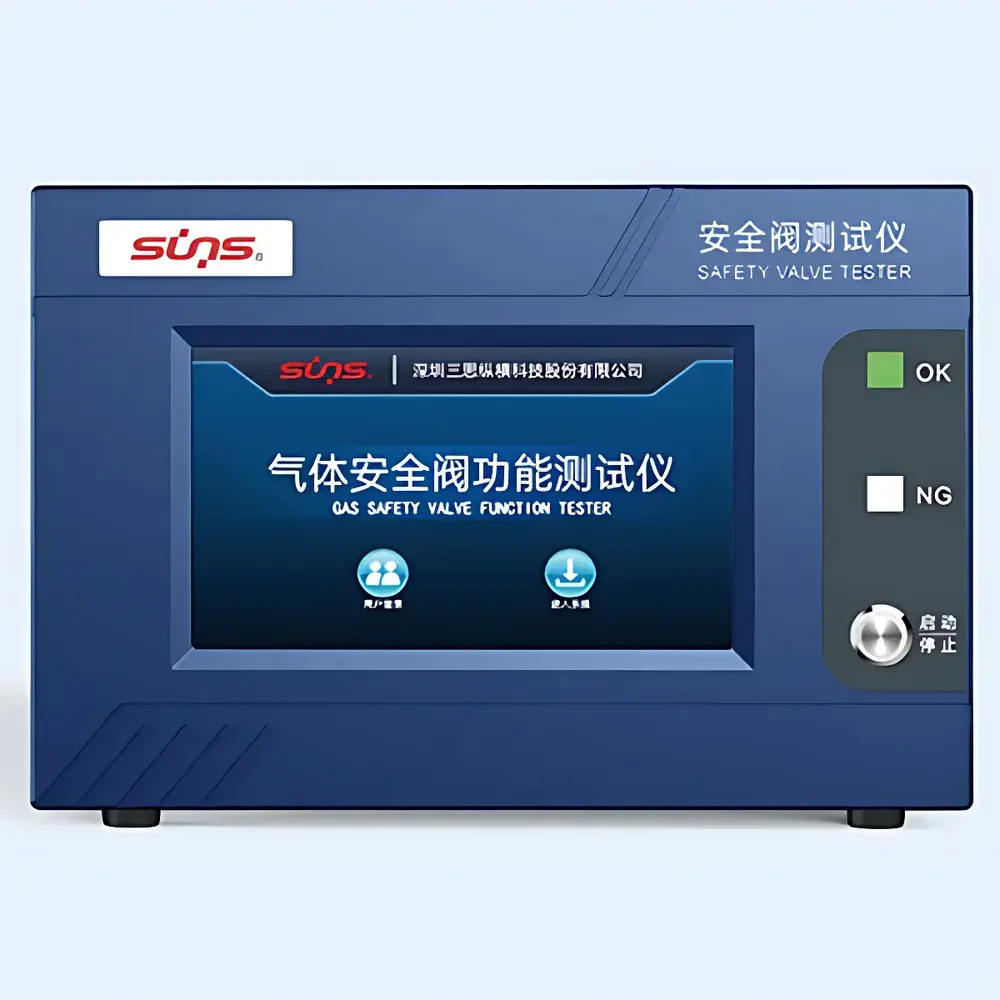
SUNS SAT100 Safety Valve Test System
| Brand | SUNS |
|---|---|
| Origin | Shenzhen, China |
| Manufacturer Type | Direct Manufacturer |
| Country of Origin | China |
| Model | SAT100 |
| Quotation | Upon Request |
| Pressure Range | 2 kPa to 0.8 MPa (customizable) |
| Timing Range | 0–999.9 s |
| Flow Rate Range | 1000 mL/min (customizable) |
| Pressure Resolution | 0.01 kPa / 1 Pa |
| Flow Resolution | 0.1 mL/min or 0.01 mL/min (configurable) |
| Timing Resolution | 0.1 s |
| Accuracy | ±0.1 % FS |
| Pressure Units | kPa, Pa, bar, psi, sccm |
| Pressure Regulation | Mechanical or Electrically Controlled (selectable) |
| Data Export Interface | USB |
| Channel Count | 1 (multi-channel expansion supported) |
| Communication Interfaces | RS-232 / RS-485 (optional), RJ45 Ethernet |
| I/O Ports | 6 digital inputs, 6 digital outputs |
| Display | 7-inch LCD touchscreen |
| Power Supply | AC 110–240 V, 50/60 Hz |
| Required Air Supply Pressure | 0.4–0.8 MPa |
| Operating Environment | 5–45 °C, ≤80 % RH (non-condensing) |
| Net Weight | 9.8–11 kg |
| Dimensions (W×D×H) | 450 × 270 × 190 mm |
Overview
The SUNS SAT100 Safety Valve Test System is a precision-engineered benchtop instrument designed for functional verification, set-pressure calibration, and leakage evaluation of pressure relief devices—including spring-loaded safety valves, pilot-operated safety valves, and rupture discs—across industrial, energy, pharmaceutical, and process engineering applications. It operates on a controlled pneumatic principle: compressed air (0.4–0.8 MPa) is regulated via mechanical or electric actuators to apply precise, repeatable backpressure to the valve under test; real-time pressure, flow, and timing data are acquired synchronously to determine critical performance parameters such as opening pressure, reseating pressure, blowdown, and seat tightness per ISO 4126-1, ASME BPVC Section VIII, and EN 764-7. The system’s modular architecture supports both single-valve qualification and sequential multi-valve testing workflows, with hardware-level synchronization ensuring traceable, audit-ready results.
Key Features
- High-resolution dual-sensor acquisition: Independent pressure transducers (0.01 kPa resolution) and thermal mass flow sensors (0.01 mL/min resolution) enable simultaneous measurement of static pressure, dynamic flow response, and timing events with sub-second temporal fidelity.
- Selectable regulation modes: Mechanical fine-tuning for manual calibration tasks; closed-loop electric control for automated pressure ramping, dwell, and step profiling—compatible with programmable test sequences.
- Integrated I/O subsystem: Six opto-isolated digital inputs and six relay-based outputs support external device triggering (e.g., solenoid actuation, light curtains, PLC handshaking) and real-time status signaling—essential for integration into automated test cells or plant-floor MES environments.
- Rugged industrial design: All-metal chassis, EMI-shielded signal paths, and conformal-coated PCBs ensure stable operation in ambient conditions up to 45 °C and 80 % RH—validated per IEC 60068-2 environmental stress standards.
- Multi-protocol connectivity: Native RS-232/RS-485 serial support enables legacy SCADA interfacing; optional RJ45 Ethernet port allows TCP/IP-based remote monitoring, firmware updates, and centralized fleet management via standard industrial protocols (Modbus TCP, HTTP API).
Sample Compatibility & Compliance
The SAT100 accommodates safety valves with inlet nominal diameters from DN15 to DN100 (½” to 4″) and flanged or threaded connections per ISO 7-1, ASME B16.5, and EN 1092-1. Test fixtures are configurable for vertical or horizontal mounting, with optional temperature-compensated adapters for high-temperature service valves (up to 200 °C with auxiliary cooling). The system complies with calibration traceability requirements under ISO/IEC 17025:2017 (clause 6.5.2), supports documented uncertainty budgets per GUM (JCGM 100), and meets electromagnetic compatibility criteria per EN 61326-1. Its software architecture adheres to ALCOA+ principles for data integrity, enabling full 21 CFR Part 11 compliance when deployed with validated electronic signatures and audit trail modules.
Software & Data Management
The embedded test software provides guided workflow execution—from valve identification and parameter setup to pass/fail logic definition and report generation. All raw sensor data (pressure vs. time, flow vs. time) are stored in timestamped binary archives (.satbin) with embedded metadata (operator ID, calibration certificate ID, environmental logs). USB export yields CSV files compatible with Excel, MATLAB, and LIMS platforms; optional cloud sync (via Ethernet) enables secure, encrypted upload to central repositories. Audit trails record every user action—including parameter changes, test starts/stops, and result approvals—with immutable timestamps and role-based access control (admin/operator/viewer profiles). Report templates conform to ISO 17025 Annex A.2 and include graphical overlays, statistical summaries (mean, SD, Cp/Cpk), and digital signatures.
Applications
- Pre-service commissioning of boiler and pressure vessel safety systems in power plants and refineries.
- Periodic in-situ verification of steam, gas, and chemical process relief valves per API RP 576 and PD 5500.
- Quality assurance during valve manufacturing—validating batch conformity against EN 439 and DIN 3320.
- Research and development of novel overpressure protection mechanisms, including low-differential and vacuum-relief configurations.
- Regulatory submission support for FDA 510(k), CE marking, and PED 2014/68/EU technical documentation packages.
FAQ
What pressure standards does the SAT100 support for calibration traceability?
The system accepts NIST-traceable pressure references via its analog input channel; internal transducers are calibrated annually against primary standards accredited to ISO/IEC 17025.
Can the SAT100 perform seat leakage tests per ISO 5208?
Yes—it measures differential flow rates down to 0.01 mL/min at defined test pressures, supporting Class A through VI leakage classification per ISO 5208 Annex B.
Is multi-valve parallel testing possible?
The base unit supports one test station; multi-channel expansion (up to 8 channels) is available via optional manifold kits and synchronized controller modules.
Does the software support automated pass/fail decision logic?
Yes—users define tolerance bands for opening pressure, reseating pressure, and blowdown; the system applies Boolean logic and generates immediate PASS/FAIL flags with root-cause annotations.
How is cybersecurity addressed for network-connected units?
Ethernet-enabled units feature TLS 1.2 encryption, configurable firewall rules, disabled default credentials, and firmware signing verified at boot—aligned with IEC 62443-3-3 SL2 requirements.




