
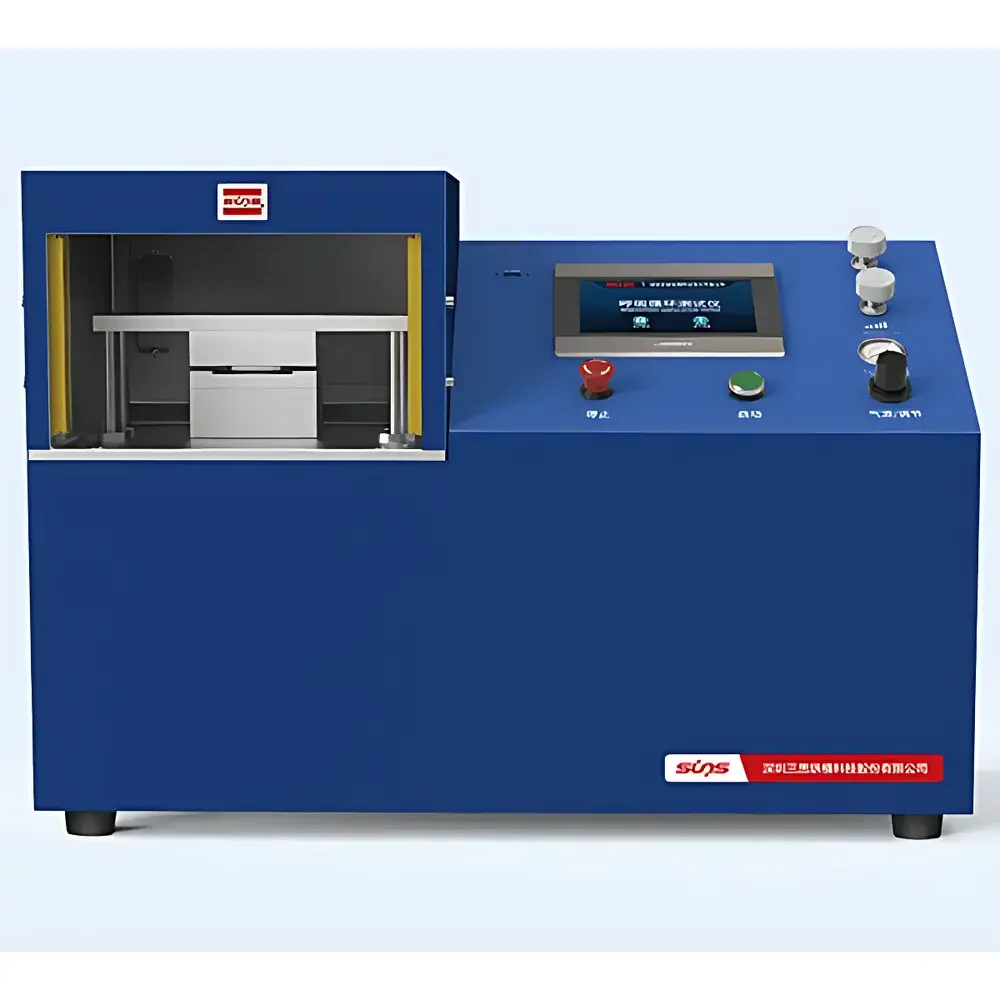
SUNS SF800 Respiratory Cycle Testing System
| Brand | SUNS |
|---|---|
| Origin | Shenzhen, China |
| Manufacturer Type | Direct Manufacturer |
| Model | SF800 |
| Pressure Range | 10–800 kPa |
| Timing Range | 0–999.9 s |
| Pneumatic Supply | 0.4–0.8 MPa (clean, dry air) |
| Pressure Resolution | 0.1 kPa / 1 kPa / 0.0001 MPa |
| Accuracy | ±0.1 % F.S. |
| Units | kPa, bar, psi, MPa |
| Pressure Regulation | Mechanical or Electromechanical (configurable) |
| Data Export | USB |
| Channel Count | 1 (multi-channel expandable) |
| Communication Interfaces | RS485 (RS232/RJ45 Ethernet optional) |
| I/O Ports | 6 digital inputs, 6 digital outputs |
| Display | 7-inch LCD touchscreen |
| Power Supply | AC 110–240 V, 50/60 Hz |
| Test Modes | Air-tightness, Respiratory Cycling |
| Operating Environment | 5–45 °C, ≤80 % RH (non-condensing) |
| Weight | 55–60 kg |
| Dimensions | 700 × 570 × 320 mm |
Overview
The SUNS SF800 Respiratory Cycle Testing System is an engineered platform designed for precise, repeatable evaluation of respiratory device performance under dynamic pneumatic loading conditions. It operates on the principle of controlled pressure cycling—applying and releasing calibrated air pressure to simulate inhalation and exhalation waveforms across medical-grade respiratory components including ventilator circuits, breathing tubes, one-way valves, CPAP masks, and disposable anesthesia circuits. Unlike static leakage testers, the SF800 replicates physiological pressure-time profiles with programmable ramp rates, dwell times, and cycle counts—enabling functional validation per ISO 80601-2-12 (ventilators), ISO 10993-1 (biocompatibility support), and ASTM F2050 (respiratory system integrity). Its architecture integrates a high-stability pressure generation module, real-time closed-loop feedback control, and deterministic timing logic to ensure traceable, GLP-compliant test execution.
Key Features
- Programmable dual-mode operation: configurable air-tightness (static hold) and respiratory cycling (dynamic waveform) protocols
- Dual-resolution pressure sensing: selectable 0.1 kPa resolution for low-pressure diagnostics and 0.0001 MPa resolution for high-precision transducer calibration support
- Electromechanical or mechanical pressure regulation—user-selectable based on required repeatability and maintenance profile
- Real-time monitoring via 7-inch industrial-grade LCD touchscreen with intuitive icon-driven interface and on-screen waveform visualization
- Robust I/O architecture: 6 opto-isolated digital inputs and 6 relay outputs for integration with external actuators, safety interlocks, or PLC-controlled test benches
- Multi-interface connectivity: standard RS485 for Modbus RTU integration; optional RS232 for legacy instrument chaining or RJ45 Ethernet for TCP/IP-based remote supervision and SCADA linkage
Sample Compatibility & Compliance
The SF800 accommodates rigid and semi-rigid respiratory assemblies up to 3 L internal volume, with quick-connect fittings compatible with ISO 5356-1 (anesthesia connectors) and ISO 8536-4 (infusion sets). It supports testing of both single-use and reusable devices under ambient conditions (5–45 °C, ≤80 % RH non-condensing), meeting environmental requirements specified in IEC 60601-1. All pressure measurements are traceable to NIST-calibrated reference standards, and system accuracy (±0.1 % F.S.) satisfies the uncertainty budget stipulated in ISO/IEC 17025 for accredited laboratories. The unit’s firmware and data handling routines support audit-ready operation in FDA-regulated environments—fully compliant with 21 CFR Part 11 requirements for electronic records and signatures when paired with validated software configurations.
Software & Data Management
Data acquisition and test sequencing are managed through SUNS’ proprietary PC-based control suite (Windows 10/11 compatible), which provides full protocol scripting, real-time graphing, and automated pass/fail decision logic. Each test session generates timestamped CSV files containing pressure vs. time vectors, event logs, and system status flags—exportable via USB mass storage mode. Audit trails include operator ID, parameter settings, calibration history, and anomaly alerts (e.g., supply pressure deviation, sensor timeout). Optional network-enabled firmware allows secure HTTP API access for integration into LIMS or MES platforms, enabling centralized test scheduling, result aggregation, and statistical process control (SPC) charting across production lines.
Applications
- Functional verification of pressure relief valves and pop-off mechanisms in anesthesia machines
- Cycle endurance testing of flexible breathing hoses subjected to 10,000+ simulated breaths at defined peak inspiratory pressures (e.g., 30 cmH₂O ≈ 2.94 kPa)
- Leak quantification in CPAP mask interfaces using differential pressure decay methodology (ISO 17510-1)
- Validation of flow resistance and pressure drop characteristics across HEPA filters and bacterial/viral filters used in critical care circuits
- Supporting design verification testing (DVT) for ISO 13485-certified manufacturers seeking CE marking or FDA 510(k) clearance
FAQ
What regulatory standards does the SF800 directly support?
It is configured to execute test sequences aligned with ISO 80601-2-12, ISO 10993-1, ASTM F2050, and IEC 60601-1. Full compliance documentation—including uncertainty budgets and calibration certificates—is provided upon request.
Can the SF800 operate in a cleanroom environment?
Yes—its sealed chassis, non-outgassing materials, and absence of internal lubricants permit use in ISO Class 7 (10,000) cleanrooms; optional stainless-steel enclosure upgrade available for ISO Class 5 compatibility.
Is multi-channel expansion supported out of the box?
The base unit includes one independent pressure channel, but hardware-ready expansion slots enable up to four synchronized channels via field-installable modules—requiring no firmware reflash.
How is traceability maintained during calibration?
Each unit ships with a factory calibration certificate referencing NIST-traceable deadweight testers; annual recalibration intervals follow ISO/IEC 17025 guidelines and may be performed in-house using SUNS-certified reference kits.
Does the system support automated reporting for quality audits?
Yes—customizable PDF report templates can embed company logos, test parameters, raw data plots, and pass/fail conclusions, all generated without manual post-processing.





