
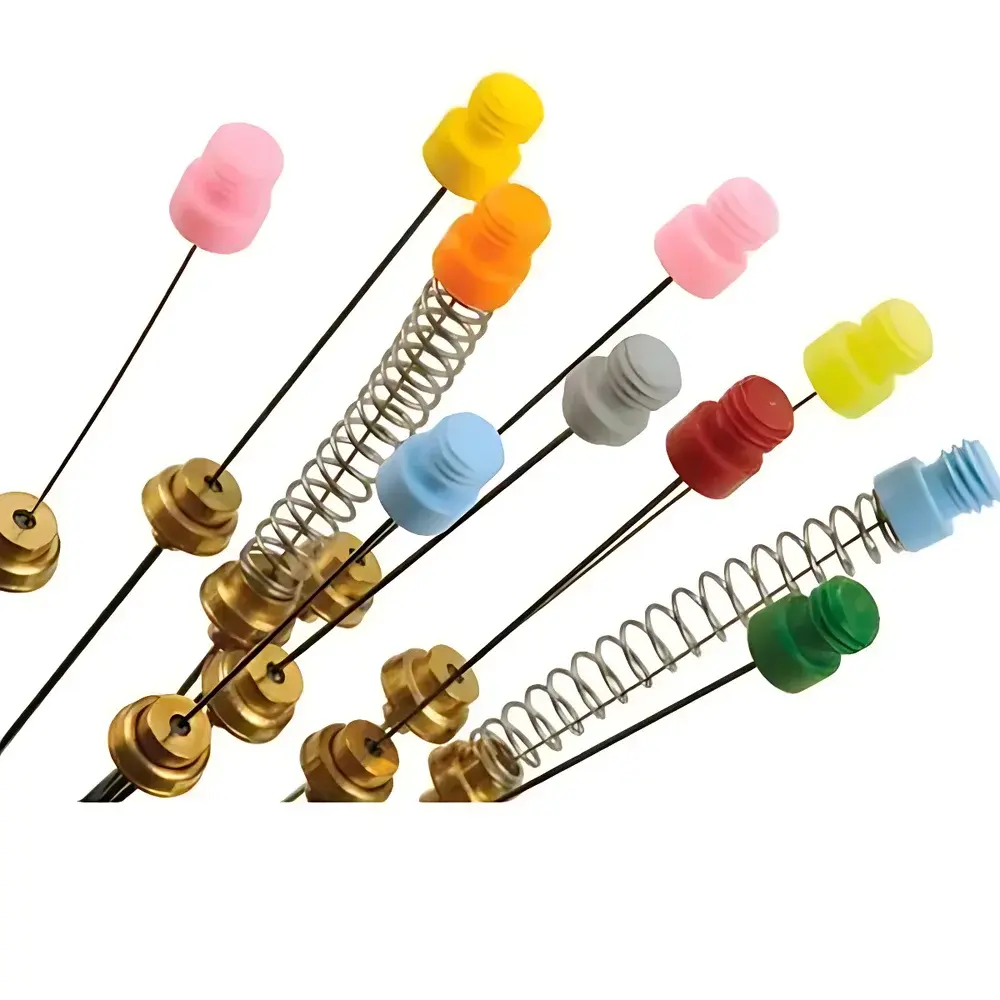
Supelco 57300-U / 57301 PDMS 100 µm Solid Phase Microextraction (SPME) Fiber Assembly for Manual and Automated GC/GC-MS Integration
| Brand | Supelco |
|---|---|
| Origin | USA |
| Product Type | Imported SPME Fiber Assembly |
| Model Numbers | 57300-U (Manual), 57301 (Automated) |
| Packaging | 3 fibers per vial |
| Coating | Polydimethylsiloxane (PDMS), 100 µm thickness |
| Fiber Substrate | Fused silica |
| Needle Gauge | 24 ga |
| Compatibility | Manual SPME holder (e.g., 57330-U) and automated SPME autosamplers (e.g., CTC Analytics PAL, Gerstel MPS) |
| Target Analytes | Volatile and semi-volatile non-polar compounds (MW 60–275) |
Overview
The Supelco 57300-U and 57301 PDMS 100 µm Solid Phase Microextraction (SPME) Fiber Assemblies are precision-engineered consumables designed for quantitative and qualitative analysis of volatile organic compounds (VOCs) in complex matrices. Based on the principle of equilibrium-based partitioning, SPME leverages a fused silica fiber coated with a 100 µm layer of polydimethylsiloxane (PDMS)—a non-polar, thermally stable stationary phase—to selectively adsorb analytes from liquid, solid, or headspace samples. The fiber is housed within a stainless-steel needle (24 gauge) and retracts fully into the protective sheath during insertion and withdrawal, ensuring mechanical robustness and reproducible exposure geometry. Unlike traditional liquid–liquid extraction or solid-phase extraction, SPME integrates sampling, extraction, concentration, and direct thermal desorption into a single, solvent-free step—minimizing sample handling, contamination risk, and analytical variability. These assemblies are validated for seamless integration with gas chromatography (GC) and gas chromatography–mass spectrometry (GC-MS) systems, including Agilent, Thermo Fisher, Shimadzu, and PerkinElmer platforms.
Key Features
- Consistent 100 µm PDMS film thickness applied via proprietary vapor deposition, ensuring batch-to-batch reproducibility and high surface-area-to-volume ratio for efficient VOC enrichment.
- Red-colored blunt-tip fiber end (57300-U/57301) enables rapid visual identification and alignment in manual holders; compatible with both manual (e.g., Supelco 57330-U holder) and automated SPME autosamplers (e.g., CTC PAL RSI, Gerstel MPS).
- Fused silica core provides mechanical flexibility and thermal stability up to 250 °C (short-term), supporting repeated thermal desorption without coating degradation or fiber breakage.
- Non-bonded PDMS coating offers high affinity for non-polar analytes—including BTEX (benzene, toluene, ethylbenzene, xylene), chlorinated solvents, aliphatic hydrocarbons, and terpenes—within the molecular weight range of 60–275 Da.
- Each vial contains three individually sealed, pre-conditioned fibers, packaged under inert atmosphere to prevent ambient contamination and oxidation prior to first use.
Sample Compatibility & Compliance
These PDMS 100 µm fibers are routinely applied in regulatory-compliant workflows aligned with EPA Method 8260D (VOCs in water and soil), ASTM D7715-19 (headspace analysis of residual solvents), and ISO 17025-accredited laboratories performing environmental, forensic, and pharmaceutical testing. They support both direct immersion (DI-SPME) and headspace (HS-SPME) modes—enabling analysis of aqueous samples (e.g., drinking water, wastewater), biological fluids (urine, blood plasma), food volatiles (coffee, wine, dairy), polymer leachates, and air monitoring canisters. For GLP/GMP environments, traceability is maintained through Supelco’s lot-specific QC documentation, including retention time shift validation data and blank fiber chromatograms. The fiber design conforms to ICH Q2(R2) guidelines for method suitability when used in validated SPME-GC procedures.
Software & Data Management
When deployed with automated SPME platforms (e.g., CTC PAL or Gerstel MPS), the 57301 fiber assembly interfaces with instrument control software (e.g., CTC CombiPAL v3.x, Gerstel Maestro) to enable full audit trail generation per FDA 21 CFR Part 11 requirements—including user ID, timestamp, fiber exposure duration, desorption temperature ramp, and GC injection sequence. Method parameters (agitation speed, incubation time, desorption time/temperature) are programmable and exportable as CSV or XML for LIMS integration. Manual workflows using the 57300-U fiber require standardized SOP documentation for exposure timing and thermal desorption settings—consistent with ISO/IEC 17025 clause 7.2.2 on method validation.
Applications
- Environmental monitoring: Quantification of VOCs in groundwater, surface water, and landfill leachate via HS-SPME-GC-MS.
- Pharmaceutical quality control: Residual solvent analysis (e.g., methylene chloride, hexane) in active pharmaceutical ingredients (APIs) per USP <467>.
- Forensic toxicology: Detection of volatile drugs of abuse (e.g., ethanol, acetone, chloroform) in postmortem blood and urine.
- Food & flavor science: Profiling of aroma-active compounds (e.g., limonene, linalool, ethyl acetate) in beverages and dairy products.
- Materials testing: Screening of extractables and leachables from medical device polymers and packaging materials.
FAQ
What is the maximum recommended desorption temperature for the PDMS 100 µm fiber?
The fiber is rated for continuous use up to 230 °C; short-term desorption at 250 °C is permissible but should be limited to ≤5 minutes to preserve coating integrity.
Can the same fiber be reused across multiple analyses?
Yes—under controlled conditions. Supelco recommends ≤100 injections per fiber when analyzing clean matrices; carryover assessment via blank runs is required before reuse in regulated environments.
Is this fiber compatible with Shimadzu GC systems?
Yes, provided the SPME autosampler interface (e.g., AOC-6000 Plus) supports standard 24-gauge fiber geometry and thermal desorption parameters.
How does PDMS 100 µm compare to PDMS 7 µm or 30 µm for VOC analysis?
The 100 µm thickness provides higher capacity and slower equilibration—ideal for low-concentration VOCs in headspace; thinner films (7–30 µm) offer faster kinetics for highly volatile compounds but lower absolute sensitivity.
Do these fibers require preconditioning before first use?
Yes—preconditioning at 250 °C for 30 minutes in the GC inlet (with carrier gas flow) removes residual solvents and stabilizes the coating; this step is documented in Supelco Technical Bulletin TB-1001.



