
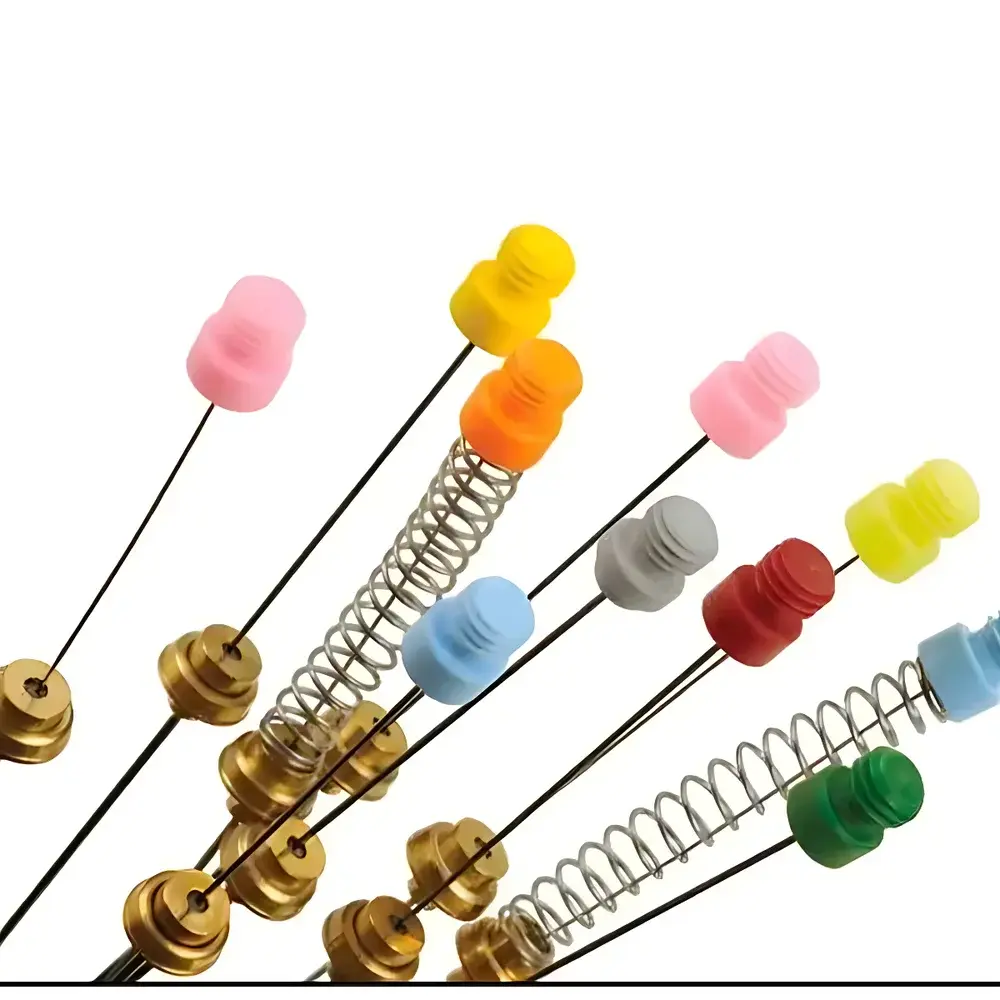
Supelco 57310-U / 57311 PDMS/DVB 65 µm Solid Phase Microextraction (SPME) Fiber Assembly
| Brand | Supelco |
|---|---|
| Origin | USA |
| Type | Manual (57310-U) / Automated (57311) |
| Coating | Polydimethylsiloxane/Divinylbenzene (PDMS/DVB), 65 µm thickness |
| Fiber length | 10 mm |
| Needle gauge | 24 ga |
| Pack size | 3 fibers per vial |
| Compatibility | GC, GC-MS, HPLC-MS (with derivatization or specialized interface) |
| Recommended analyte MW range | 50–300 Da |
| Application focus | Volatile and semi-volatile polar/non-polar compounds including amines, nitroaromatics, and low-MW VOCs |
Overview
The Supelco 57310-U (manual) and 57311 (automated) SPME fiber assemblies are precision-engineered solid-phase microextraction devices designed for solvent-free, in-situ sampling and preconcentration of trace analytes from gaseous, liquid, and solid matrices. Each fiber consists of a 10-mm segment of fused-silica core coated with a partially crosslinked, dual-phase stationary phase comprising polydimethylsiloxane (PDMS) and divinylbenzene (DVB) at a nominal thickness of 65 µm. This hybrid coating leverages the hydrophobicity and thermal stability of PDMS with the enhanced π–π interactions and surface area provided by DVB, enabling efficient extraction of moderately polar to non-polar volatile organic compounds (VOCs), aliphatic and aromatic amines, nitroaromatics (e.g., nitrobenzene, dinitrotoluene), and other mid-polarity analytes within the ~50–300 Da molecular weight range. The fiber is housed within a stainless-steel needle (24 gauge) and mounted on a standard SPME holder compatible with manual insertion or autosampler-driven retraction—ensuring reproducible exposure geometry and controlled desorption kinetics during thermal or solvent-based elution.
Key Features
- Optimized dual-layer PDMS/DVB coating (65 µm) for balanced affinity toward volatile and semi-volatile polar/non-polar analytes
- Fused-silica fiber substrate with high mechanical integrity and thermal resilience up to 270 °C (isothermal) and 300 °C (short-term desorption)
- Partially crosslinked phase architecture ensures long-term coating stability, reduced bleed, and improved resistance to matrix fouling
- Standardized 24-gauge stainless-steel needle housing enables seamless integration with commercial SPME holders (e.g., Supelco 57330-U/57331) and autosamplers (Agilent, Gerstel, CTC Analytics)
- Consistent 10-mm active fiber length and precise coating thickness guarantee inter-batch reproducibility and quantitative method transferability
- Pre-packed in inert glass vials under argon; each package contains three individually tested fibers with lot-specific QC documentation
Sample Compatibility & Compliance
These SPME fibers are validated for direct immersion (DI-SPME) and headspace (HS-SPME) sampling across aqueous, biological, environmental, and industrial matrices—including drinking water, wastewater, plasma, urine, soil headspace, polymer leachates, and pharmaceutical residual solvents. Their performance aligns with established regulatory guidance for trace analysis, supporting compliance with EPA Methods 8260D (VOCs in water), 8270E (semivolatiles), ISO 17931:2018 (determination of VOCs in indoor air), and USP <467> (residual solvents in pharmaceuticals). When used in conjunction with GLP/GMP-compliant instrumentation and documented SOPs—including calibration verification, carryover assessment, and fiber lifetime tracking—the 57310-U/57311 assemblies support auditable workflows meeting FDA 21 CFR Part 11 requirements for electronic records and signatures.
Software & Data Management
While the fiber itself is a passive consumable, its use is fully integrated into chromatographic data systems (CDS) such as OpenLab CDS, Chromeleon, and MassHunter via standardized autosampler method templates. Instrument control software supports automated sequence definition for fiber conditioning, sampling time, agitation parameters (when used with optional magnetic stir plates like PC-420D), desorption temperature ramps, and inlet bake-out cycles. Audit trails capture fiber ID (via manual log or barcode scanning), usage count, thermal history, and associated calibration data—enabling full traceability in regulated environments. Optional accessories—including SPME-specific inlet liners (e.g., Agilent 5190-2299), dedicated injection port inserts (e.g., Supelco 2637505 for Agilent 6890), and certified reference standards—further enhance method robustness and data integrity.
Applications
- Environmental monitoring: Quantification of nitroaromatic explosives (TNT, DNT), chlorinated benzenes, and alkylamines in groundwater and sediment pore water
- Clinical toxicology: Rapid screening of amphetamine analogs, volatile anesthetics, and illicit drug metabolites in whole blood and oral fluid
- Pharmaceutical quality control: Residual solvent profiling (e.g., acetone, dichloromethane, ethyl acetate) in APIs and final dosage forms per ICH Q3C guidelines
- Forensic chemistry: Extraction of accelerants (gasoline, kerosene markers) and designer stimulants from fire debris and clothing substrates
- Food & flavor analysis: Profiling of esters, lactones, and terpenoids in dairy, fruit, and fermented products without solvent interference
- Materials science: Headspace analysis of outgassing volatiles from adhesives, coatings, and packaging polymers per ASTM D7564
FAQ
What is the maximum recommended desorption temperature for the 57310-U/57311 fiber?
The fiber supports isothermal desorption up to 270 °C; brief exposures to 300 °C are permissible during inlet bake-out but should not exceed 5 minutes to preserve coating integrity.
Can this fiber be used for HPLC analysis without derivatization?
Direct HPLC injection is not recommended due to irreversible adsorption and poor elution efficiency; however, thermal desorption-GC/MS remains the primary validated interface. For LC-MS applications, solvent desorption with methanol/acetonitrile followed by large-volume injection may be employed with method optimization.
How many extractions can be performed before fiber replacement?
Under typical DI-SPME conditions with clean aqueous samples, ≥100 reproducible extractions are achievable; lifetime decreases significantly in complex or particulate-laden matrices—monitoring peak area drift and carryover is essential for routine QC.
Is the 65 µm PDMS/DVB coating compatible with acidic or basic sample matrices?
Yes—its partially crosslinked structure provides moderate resistance to pH extremes (pH 2–12); however, prolonged exposure to strong acids/bases or oxidizing agents (e.g., hypochlorite) accelerates degradation and is not advised.
Does Supelco provide certificate of analysis (CoA) with each vial?
Yes—each batch is accompanied by a CoA listing coating thickness verification (FTIR or SEM), blank test results (GC-MS background ≤ 5 pg for target analytes), and thermal stability validation data.



