
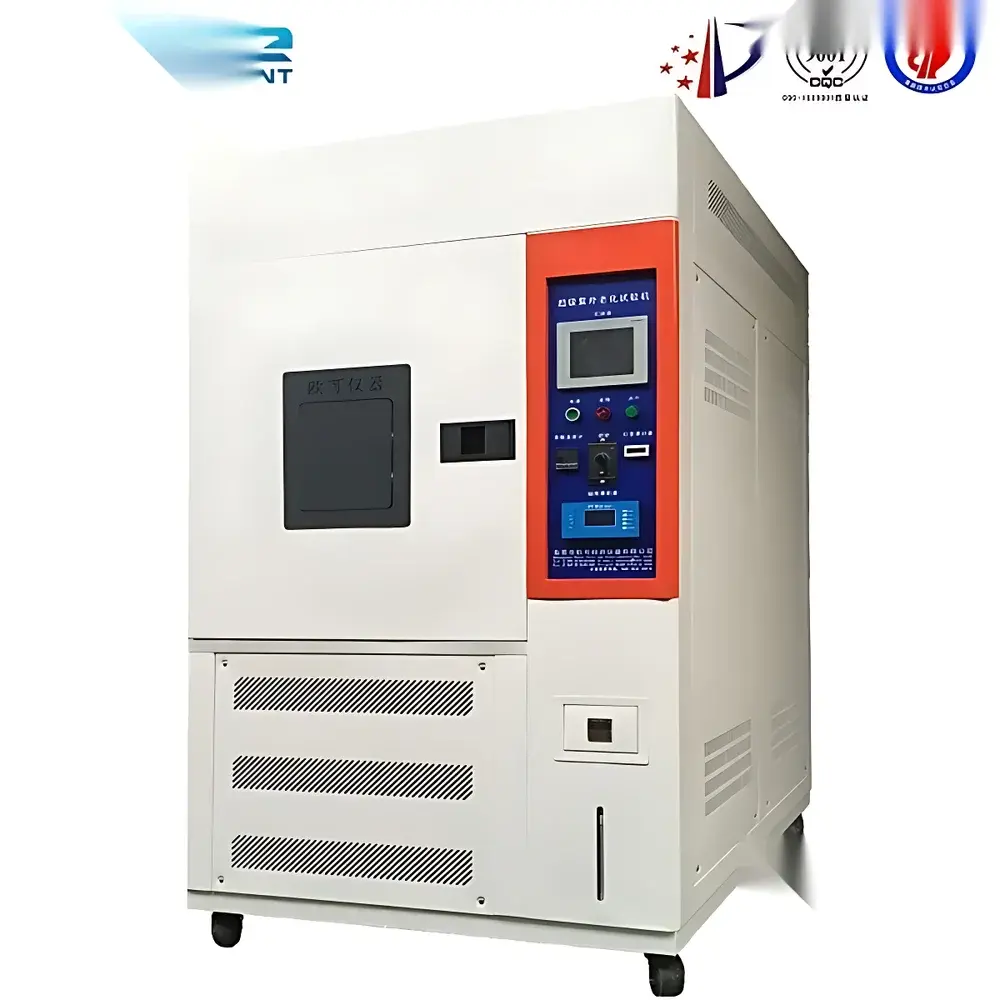
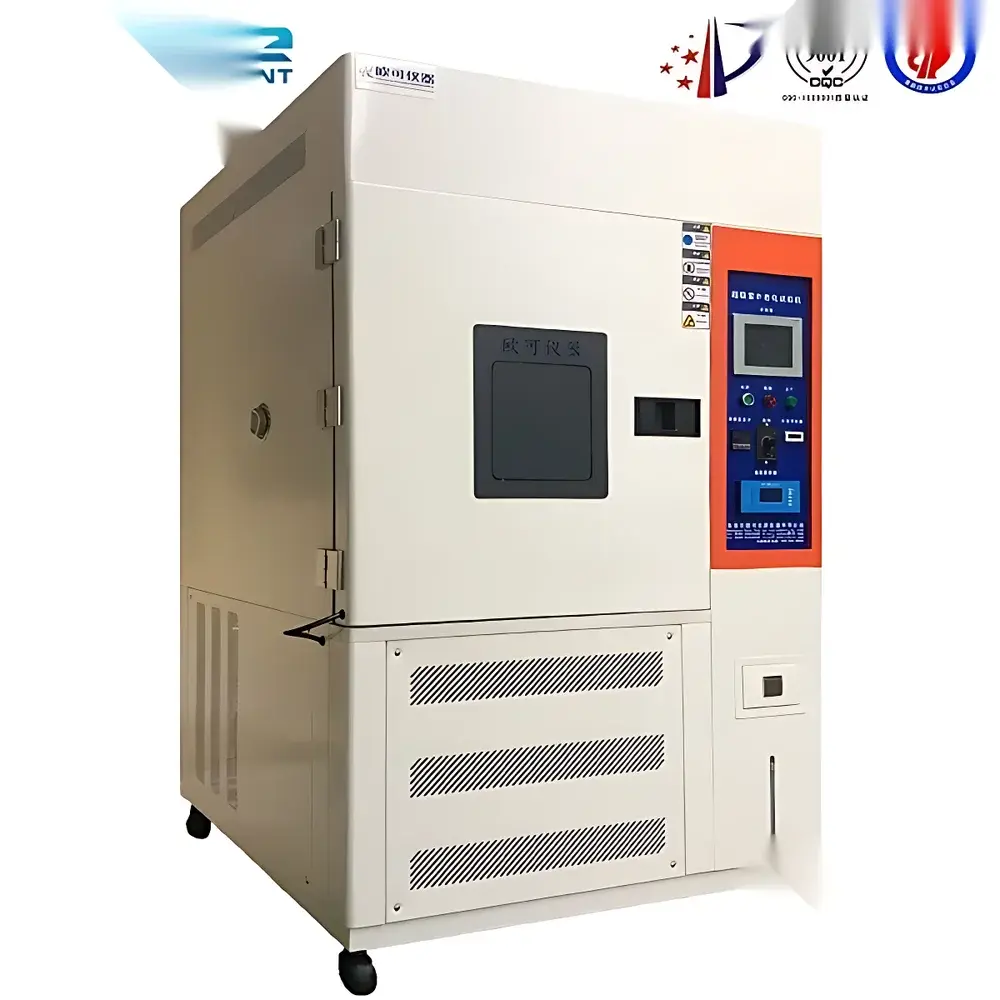
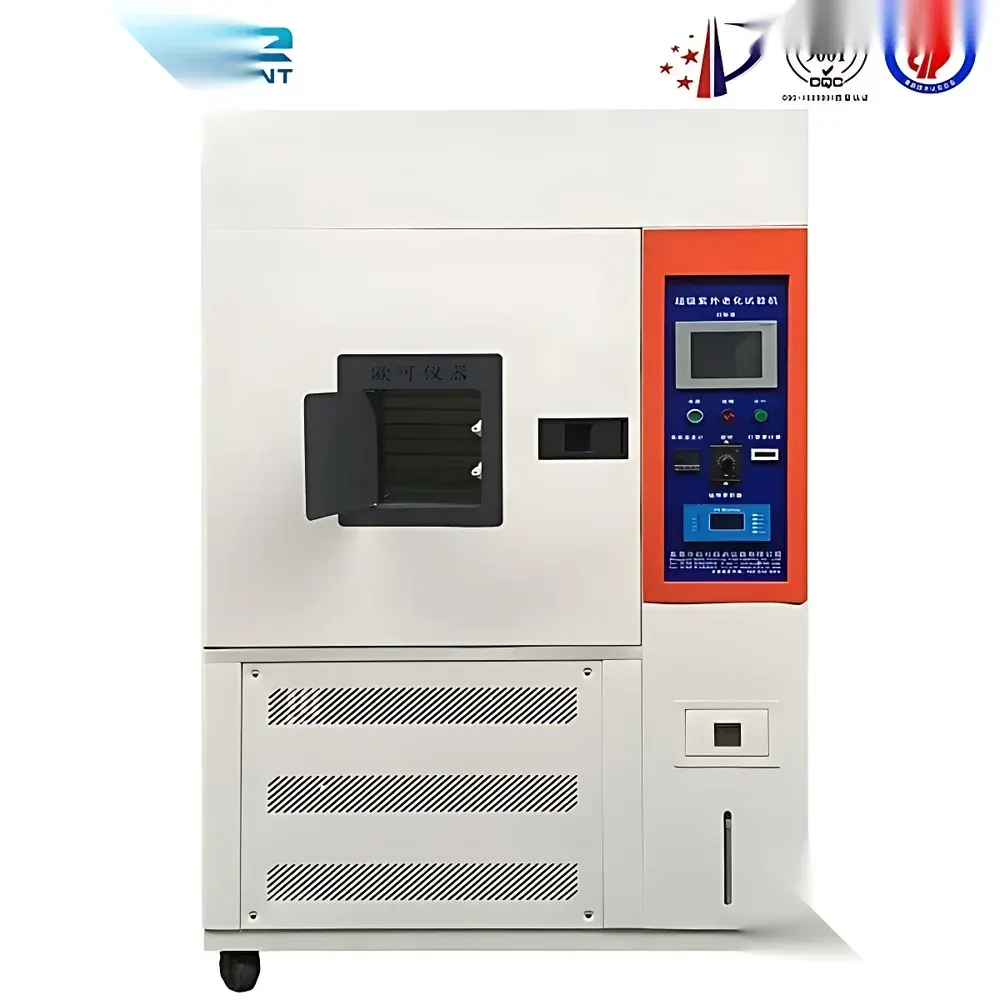
Super QUV Ultraviolet Accelerated Weathering Tester
| Brand | OEM / Private Label |
|---|---|
| Origin | Imported |
| Manufacturer Type | Authorized Distributor |
| Price | USD 21,500 (FOB) |
Overview
The Super QUV Ultraviolet Accelerated Weathering Tester is an engineered environmental test chamber designed to simulate and accelerate the degradation effects of outdoor exposure—primarily solar ultraviolet (UV) radiation, temperature cycling, and moisture—on polymeric materials, coatings, inks, adhesives, and automotive or architectural finishes. Unlike conventional fluorescent UV testers, this system employs air-cooled metal halide lamps as its primary radiation source, delivering a continuous spectral output from 295 nm to 450 nm. After optical filtration, the irradiance distribution across the specimen plane closely matches the relative spectral power distribution (SPD) of terrestrial sunlight filtered through 3 mm of borosilicate glass—a widely accepted proxy for real-world windowed or semi-outdoor exposure conditions per ISO 4892-2 and ASTM G154 Annex A3. The instrument operates on the principle of controlled photodegradation: UV photons induce bond scission and free radical formation in organic matrices, while thermal and hygric stress cycles (condensation, water spray) exacerbate physical failure modes such as microcracking, interfacial delamination, and hydrolytic degradation. This enables laboratory replication of months-to-years of field aging within days or weeks under repeatable, traceable conditions.
Key Features
- Air-cooled metal halide lamp array with spectral output spanning 295–450 nm, optimized for high UV-B and UV-A intensity without excessive near-infrared heating
- Optical filtering system that shapes lamp emission to match the relative SPD of 3-mm borosilicate-filtered solar radiation, ensuring metrological relevance to ISO 4892-2 Cycle 1 and ASTM G154 Method B
- Programmable exposure cycles integrating UV irradiation, condensation (100% RH, 40–60 °C), and water spray (deionized, 25 °C), each independently controllable via touchscreen interface
- Uniform irradiance distribution (±15% across specimen plane) validated per ASTM G154 Section 7.3.2, supported by NIST-traceable UV radiometer calibration ports
- Stainless-steel interior chamber with corrosion-resistant construction, integrated drain system, and sealed lamp housing for long-term operational stability
- Compliance-ready architecture supporting audit trails, user access levels, and electronic signature capability aligned with FDA 21 CFR Part 11 requirements when paired with optional software modules
Sample Compatibility & Compliance
The Super QUV accommodates standard flat-panel specimens up to 75 mm × 150 mm (3″ × 6″) with adjustable rack spacing. It supports rigid substrates (e.g., aluminum panels, glass slides), flexible films, and coated textiles—provided samples meet dimensional and thermal stability limits during condensation and spray phases. Test protocols are fully compatible with international standards including ISO 4892-2 (Methods A and B), ASTM G154 (Cycles 1–6), SAE J2020, and JIS D 0205. The system’s spectral fidelity and irradiance control enable direct correlation to outdoor Florida and Arizona exposure data per ASTM G155 and ISO 11341, facilitating predictive lifetime modeling. All operational parameters—including lamp voltage, chamber temperature, relative humidity, and spray duration—are logged with timestamps and user identifiers to support GLP/GMP-compliant reporting.
Software & Data Management
The embedded controller features a 7-inch capacitive touchscreen with intuitive icon-based navigation and real-time graphing of irradiance (W/m² @ 340 nm), chamber temperature, and condensation cycle status. Optional PC-based software provides expanded functionality: automated method sequencing, multi-user permission management, CSV/Excel export with metadata embedding, and compliance with 21 CFR Part 11 through electronic signatures, audit trail generation, and secure data encryption. Raw sensor logs are stored in binary format with checksum validation; historical data retention exceeds 12 months at default sampling intervals (10-second resolution). Integration with LIMS platforms is supported via Modbus TCP or OPC UA protocols.
Applications
This tester serves quality assurance laboratories in automotive OEMs and Tier-1 suppliers for evaluating paint clearcoat durability, plastic grilles, and headlamp lens yellowing resistance. It is routinely deployed in coating R&D to rank UV stabilizer efficacy (e.g., HALS, benzotriazoles) and assess pigment dispersion stability. Packaging engineers use it to validate barrier film integrity against photooxidative embrittlement. Aerospace composites labs apply it to qualify prepreg resins and surface sealants per MIL-STD-810H Method 505.5. Academic researchers leverage its reproducible irradiance profile for mechanistic studies of polymer photolysis kinetics and crosslink density evolution measured post-test via FTIR, DSC, or tensile testing.
FAQ
What lamp type does the Super QUV use, and how does it differ from fluorescent UV lamps?
It uses air-cooled metal halide lamps, which generate a broad, continuous UV–visible spectrum (295–450 nm) after optical filtering—unlike narrow-band UVA-340 or UVB-313 fluorescent tubes. This improves correlation to full-spectrum solar exposure, especially for materials sensitive to visible-light-initiated degradation.
Is spectral calibration required, and how often should it be performed?
Yes. Irradiance sensors must be calibrated annually using a NIST-traceable reference radiometer. Lamp spectral drift is monitored via periodic spectroradiometric verification every 500 operating hours or per ISO 4892-2 Clause 8.2.
Can the system perform cyclic tests combining UV, condensation, and water spray in a single program?
Yes. Up to 99 programmable steps per cycle allow arbitrary sequencing of UV exposure (with irradiance setpoint), dark condensation (temperature-controlled RH), and deionized water spray—each with independent timing and setpoint parameters.
Does the system meet regulatory requirements for pharmaceutical or medical device packaging validation?
When configured with Part 11-compliant software, audit trail logging, and electronic signature modules, it satisfies ICH Q1B photostability testing prerequisites for packaging components, provided irradiance uniformity and spectral match are verified per USP .



