
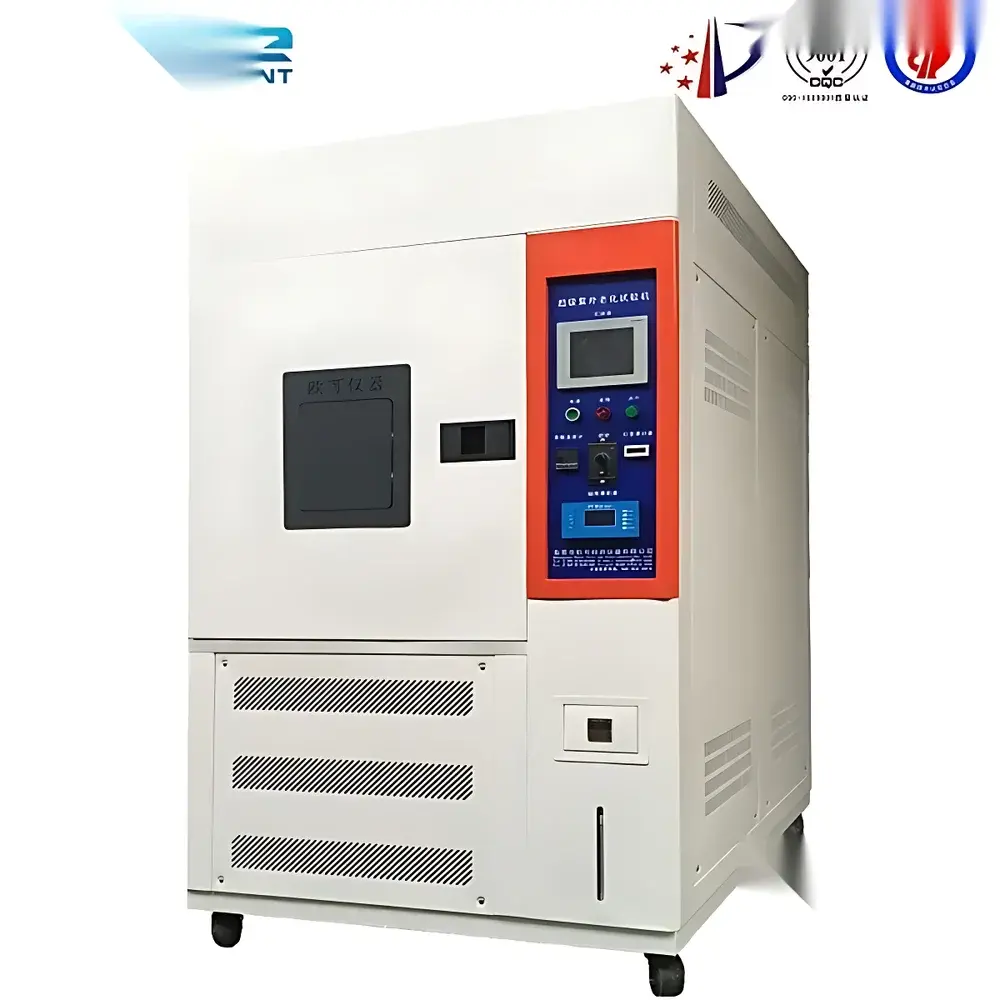
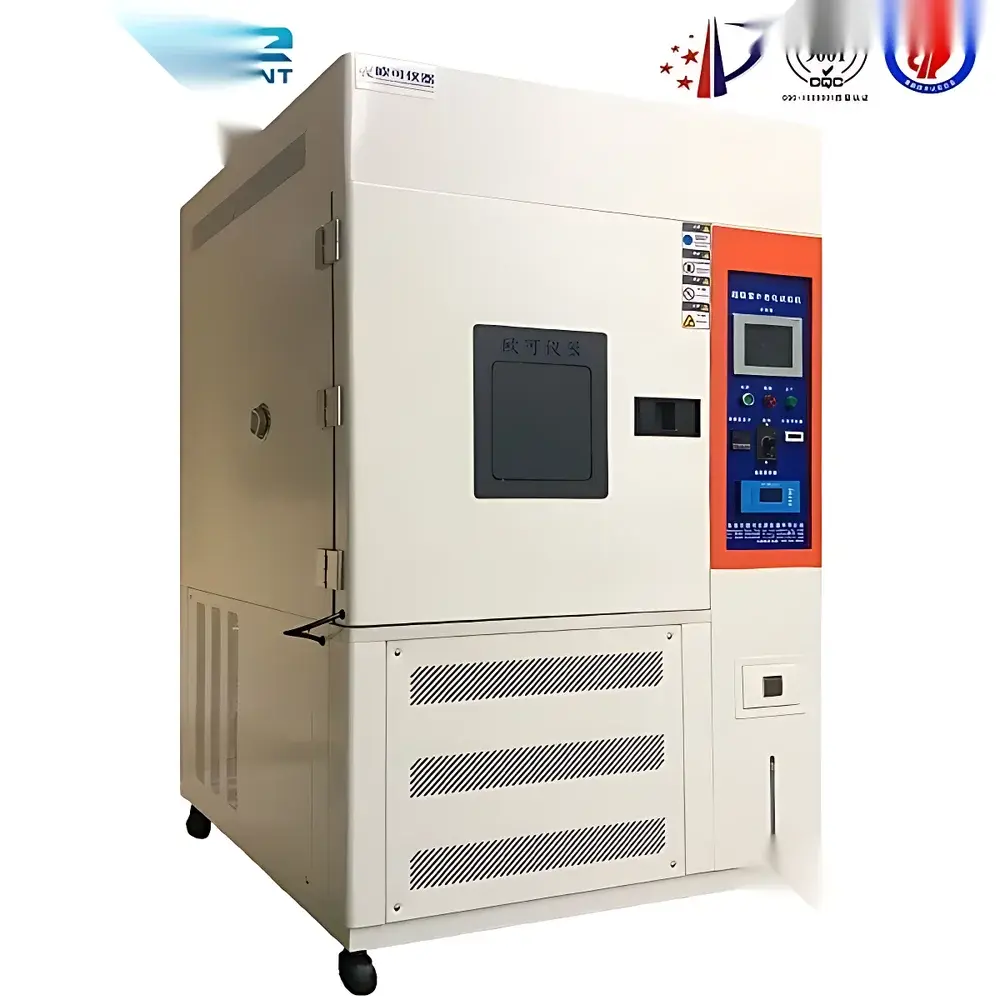
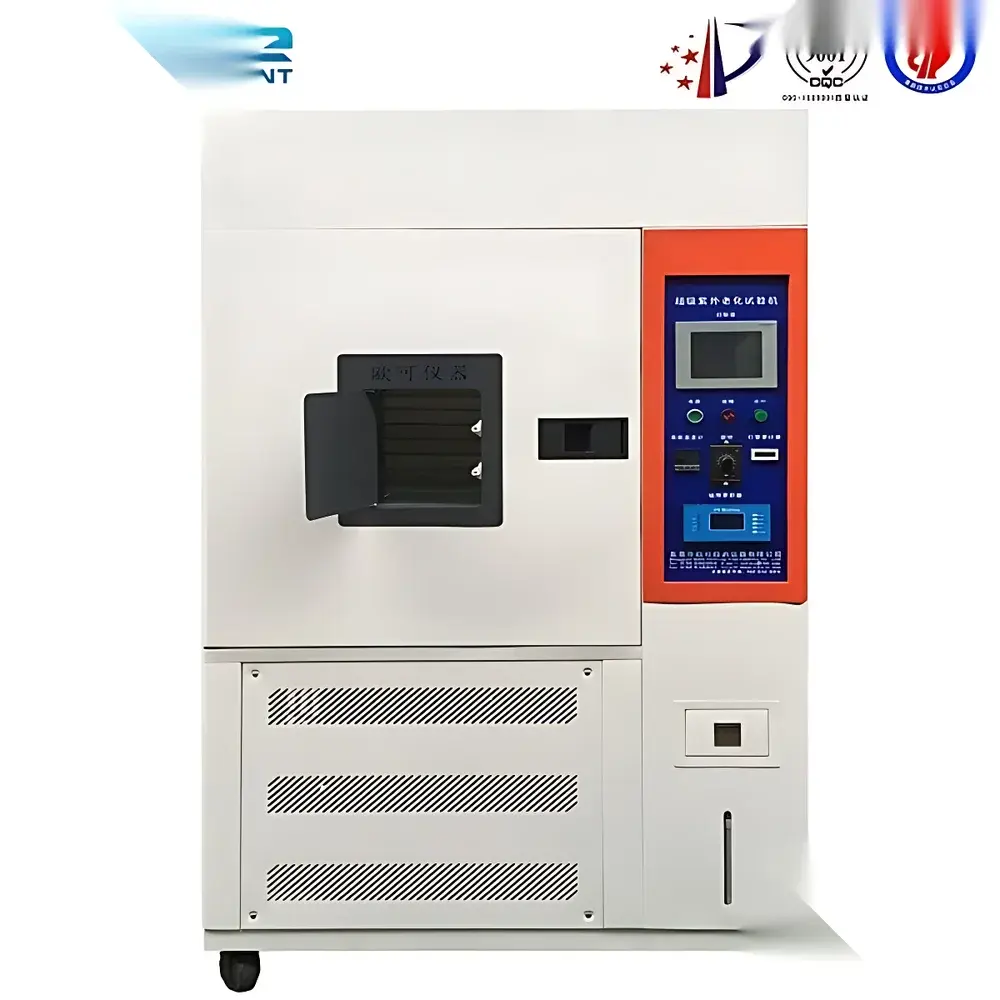
Super UV Accelerated Weathering Test Chamber
| Brand | Other Brands |
|---|---|
| Origin | Imported |
| Manufacturer Type | General Distributor |
| Price | USD 21,500 (FOB) |
Overview
The Super UV Accelerated Weathering Test Chamber is an advanced environmental simulation system engineered for high-fidelity artificial solar radiation exposure testing. It employs air-cooled metal halide lamps as the primary irradiation source, delivering a spectral power distribution (SPD) closely aligned with terrestrial sunlight—specifically within the critical 295–450 nm range encompassing UVA, UVB, and visible wavelengths. Unlike fluorescent UV lamps, metal halide technology replicates both direct and diffuse solar irradiance components, enabling realistic photochemical degradation kinetics in materials exposed to natural outdoor conditions. The chamber integrates controlled thermal cycling, condensation humidity (via saturated vapor cold-wall condensation), and calibrated water spray cycles—mimicking diurnal wet/dry transitions observed in real-world service environments. This multi-stress methodology accelerates failure modes including photolysis-induced polymer chain scission, chromophore degradation, surface oxidation, and interfacial delamination—allowing laboratory-based prediction of long-term durability across months or years of field exposure in days or weeks.
Key Features
- Air-cooled metal halide lamp array with spectral output filtered to match ASTM G155 Cycle 1 (equivalent to ISO 4892-2, Method A) and tailored for automotive and photovoltaic applications
- Programmable irradiance control (0.35–0.85 W/m² @ 340 nm) with real-time feedback via integrated broadband UV sensor and NIST-traceable calibration
- Temperature regulation range: 30–80°C (black panel temperature), with precision ±1.5°C stability under dynamic irradiance load
- Condensation cycle: Saturated humidity maintained at 50–100% RH through chilled cold-wall condensation; programmable duration from 1–12 hours per cycle
- Water spray system compliant with IEC 60068-2-52 (salt mist optional), featuring adjustable nozzle pressure (0.05–0.15 MPa), droplet size distribution < 100 µm, and uniform coverage over test specimen area
- Stainless steel 316L inner chamber with quartz glass viewing window, corrosion-resistant hardware, and IP54-rated electrical enclosure
Sample Compatibility & Compliance
The chamber accommodates specimens up to 1,200 mm × 600 mm × 200 mm (W×D×H), supporting full-size automotive exterior trim panels, PV module frames, architectural cladding samples, and large-format electronic enclosures. It meets functional requirements of multiple international standards including ASTM G155 (Standard Practice for Operating Xenon Arc Lamp Apparatus with and without Water for Exposure of Non-Metallic Materials), ISO 4892-2 (Plastics — Methods of exposure to laboratory light sources — Part 2: Xenon-arc lamps), and SAE J2527 (Surface Vehicle Recommended Practice for Accelerated Exposure of Automotive Exterior Materials Using a Controlled Irradiance Water Cooled Xenon Arc Apparatus). While optimized for metal halide spectral fidelity rather than xenon arc, its irradiance profile and environmental stress sequencing are validated against these protocols for comparative aging studies. The system architecture supports GLP-compliant operation with audit-ready event logging and user access control.
Software & Data Management
Equipped with embedded industrial-grade controller running proprietary firmware (v4.2+), the chamber provides intuitive touchscreen HMI with multilingual interface (English, German, Japanese, Chinese). All test parameters—including irradiance setpoints, temperature ramps, condensation timing, spray intervals, and runtime—are stored in non-volatile memory with timestamped version history. Data export is supported via USB 2.0 and Ethernet (Modbus TCP/IP), enabling integration into LIMS or MES platforms. Optional software package includes automated report generation compliant with ASTM E2042 (Standard Guide for Statistical Analysis of Electrical Insulation Aging Data) and FDA 21 CFR Part 11–ready electronic signatures for regulated laboratories.
Applications
- Automotive OEMs and Tier-1 suppliers validating exterior plastics, paints, elastomers, and adhesives per GMW14124, Ford CETP 00.00-L-467, and VW TL 226
- Photovoltaic manufacturers assessing encapsulant yellowing, backsheet cracking, and junction box housing UV resistance per IEC 61215-2 MQT10 and UL 1703
- Aerospace component developers evaluating composite matrix stability and coating integrity under tropical and desert climatic profiles
- Architectural product certifiers conducting accelerated weathering of sealants, membranes, and curtain wall systems per AAMA 2605 and EN 13523-17
- Academic research groups studying photo-oxidative degradation mechanisms in polymeric nanocomposites and bio-based coatings
FAQ
What spectral range does the metal halide lamp emit, and how is it filtered?
The lamp emits broad-spectrum radiation from 295 nm to 450 nm; a custom interference filter system attenuates wavelengths below 295 nm and above 450 nm to replicate the solar cutoff at atmospheric boundary layer and approximate the transmission through 3-mm borosilicate glass.
Can this chamber replace xenon arc testing for automotive qualification?
It is not intended as a direct replacement for xenon arc per SAE J2412/J2527 but serves as a complementary high-UV-intensity screening tool where UV-driven degradation dominates over visible/IR thermal effects.
Is calibration traceable to national standards?
Yes—UV irradiance sensors are factory-calibrated against NIST SRM 2242 reference materials, with recalibration interval recommended every 1,000 operating hours or annually, whichever occurs first.
Does the system support remote monitoring and alarm notification?
Standard Ethernet connectivity enables SNMP-based network monitoring; optional SMS/email alert module triggers on temperature deviation >±2°C, irradiance drift >±5%, or condensation failure.
What maintenance is required for the metal halide lamps?
Lamp life is rated at 1,500 hours at nominal output; replacement requires re-calibration of irradiance profile due to spectral shift over lifetime—procedure documented in operator manual and supported by field service engineers.



