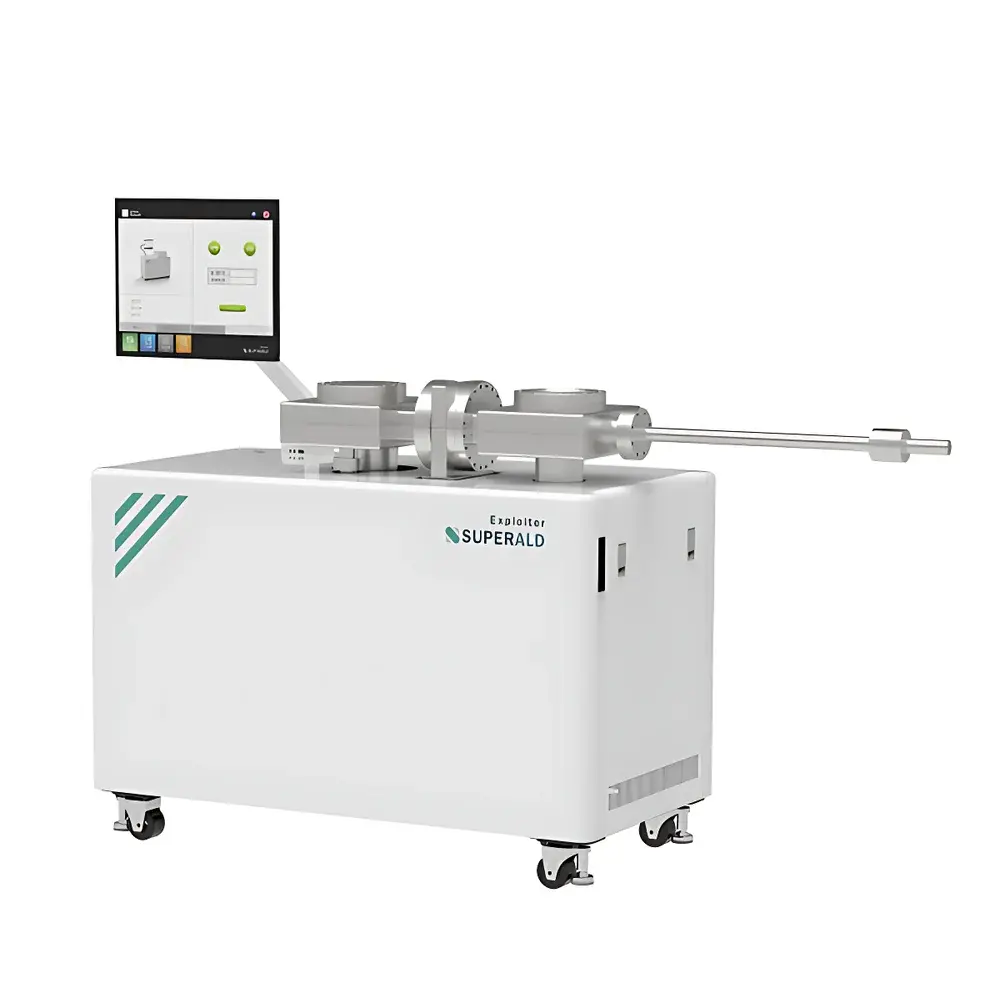
SUPERALD UHV ALD Integrated Atomic Layer Deposition System
| Brand | SUPERALD |
|---|---|
| Origin | Guangdong, China |
| Manufacturer Type | Authorized Distributor |
| Country of Origin | China |
| Model | UHV ALD |
| Quotation | Upon Request |
| Substrate Diameter | 100 mm (4 inch), customizable |
| Process Temperature Range | RT to 400 °C, ±1 °C accuracy (customizable) |
| Precursor Channels | Up to 6 independent, supporting solid and liquid precursors with dedicated heated source bottles |
| Reactant Channels | 2 standard (customizable) |
| Carrier Gas | N₂ with MFC-controlled flow (customizable) |
| Vacuum System | High-performance turbomolecular pump suite for ultra-high vacuum (UHV) base pressure <5×10⁻⁸ mbar |
| Heating Capability | Source bottles and reactor zone heated up to 150 °C |
| Control System | Industrial embedded IPC with 19″ capacitive touchscreen, Windows 7 OS, real-time PLC-based logic control via Ethernet |
| Transfer System | Manual magnetic wand loading with dedicated load-lock chamber, gate valves, and integrated vacuum interlocks |
Overview
The SUPERALD UHV ALD Integrated Atomic Layer Deposition System is an engineered platform for precision thin-film synthesis under ultra-high vacuum (UHV) conditions. It operates on the fundamental principle of self-limiting surface reactions—sequential, saturative chemisorption of gaseous precursors followed by purging and reactive treatment—enabling atomic-scale thickness control, exceptional conformality (>95% step coverage on features >50:1 aspect ratio), and sub-nanometer reproducibility across complex 3D topographies. Designed specifically for semiconductor R&D, advanced packaging, and nanomaterial process development, the system integrates vacuum architecture, thermal management, gas delivery, and deterministic control into a single robust platform compliant with cleanroom-compatible mechanical design standards.
Key Features
- Ultra-High Vacuum Environment: Equipped with a high-capacity turbomolecular pumping station achieving base pressures below 5×10⁻⁸ mbar—essential for minimizing residual hydrocarbon contamination and enabling deposition of highly sensitive oxides (e.g., Al₂O₃, HfO₂) and noble metals (e.g., Ru, Ir) without parasitic CVD pathways.
- Modular Precursor Delivery: Supports up to six independently heated and temperature-stabilized precursor sources (solid or liquid), each with dedicated vaporization zones (RT–150 °C) and mass flow control, ensuring stoichiometric fidelity and long-term repeatability.
- Thermal Precision & Uniformity: Reactor heating stage maintains ±1 °C stability over the full 25–400 °C operating range, validated per ASTM E220 and traceable to NIST standards; uniformity across 100 mm substrates is maintained within ±2 °C.
- Integrated Load-Lock Architecture: Manual magnetic transfer rod operation with dedicated load-lock chamber, pneumatically actuated gate valves, and interlocked pressure monitoring ensures rapid sample exchange without breaking main chamber vacuum—reducing cycle time and contamination risk.
- Dual-Channel Reactant Support: Two independent reactive gas lines (e.g., O₃, H₂O, NH₃, plasma-activated species) enable binary or ternary reaction schemes critical for nitride, oxynitride, and sulfide film synthesis.
- Industrial Control Stack: Real-time deterministic control via IEC 61131-3-compliant PLC, synchronized with Windows 7-based HMI running custom ALD orchestration software; supports audit trails, electronic signatures, and configurable user roles aligned with FDA 21 CFR Part 11 readiness.
Sample Compatibility & Compliance
The system accommodates standard 100 mm (4-inch) wafers with optional adaptability for smaller substrates (e.g., 25 mm chips, MEMS devices, TEM grids) and non-planar geometries including porous scaffolds and microfluidic channels. All wetted materials—including stainless-steel chambers, VCR fittings, and alumina-coated heater elements—comply with SEMI F57 and ISO 14644-1 Class 5 cleanroom requirements. Vacuum components meet ASTM F2781 for outgassing performance, while electrical subsystems conform to UL 61010-1 and CE Machinery Directive 2006/42/EC. Software logs—including recipe execution history, sensor readings, valve actuation timestamps, and alarm events—are timestamped, immutable, and exportable in CSV/PDF for GLP/GMP documentation.
Software & Data Management
The SUPERALD Control Suite provides full-cycle ALD workflow management: recipe definition (pulse/purge/react durations, temperatures, flows), real-time parameter visualization (pressure, temperature, MFC output), automated sequence execution (“One-Touch Deposition”), and post-run analysis tools. All operational data—including vacuum curves, thermocouple traces, and valve status logs—are stored locally with SHA-256 hashing for integrity verification. Role-based access control enforces three-tier permissions (Operator / Engineer / Administrator), while hardware-enforced interlocks prevent unsafe state transitions (e.g., heating under atmospheric pressure). Data export supports .csv, .xlsx, and XML formats compatible with LIMS integration. Optional OPC UA server enables seamless connection to factory MES platforms.
Applications
- Semiconductor Front-End: High-κ gate dielectrics (Al₂O₃, HfO₂, La₂O₃), metal gates (TiN, TaN, Ru), diffusion barriers (WNₓ), and MTJ tunnel barriers (MgO).
- Energy Devices: Cathode surface passivation (LiCoO₂, NMC), SEI stabilization on Si anodes, Li-metal dendrite suppression layers (Li₃PO₄, Al₂O₃), and functionalized separator coatings (Al₂O₃ on PP/PE).
- Catalysis: Single-atom catalysts (Pt₁/CeO₂), core–shell nanoparticles (Pt@SiO₂), bimetallic clusters (PtPd, IrRu), and oxide-overcoated supported metals for selective hydrogenation and CO oxidation.
- Optoelectronics: Hermetic encapsulation for flexible OLEDs (Al₂O₃/HfO₂ nanolaminates), antireflective AR coatings on curved optics, and piezoelectric ZnO/AlN stacks for MEMS resonators.
- Biofunctional Surfaces: TiN/ZrN antimicrobial coatings on orthopedic implants, ALD-modified mesoporous silica for controlled drug release, and biocompatible TiO₂ layers for neural electrode interfaces.
FAQ
What vacuum level does the system achieve, and how is it measured?
The system achieves a base pressure of ≤5×10⁻⁸ mbar using a dual-stage turbomolecular pump backed by a dry scroll pump; pressure is monitored continuously via Bayard–Alpert ionization gauge calibrated to NIST-traceable standards.
Can the system be upgraded to support plasma-enhanced ALD (PE-ALD)?
Yes—optional RF or microwave plasma sources (13.56 MHz or 2.45 GHz) can be integrated with existing gas lines and chamber ports, maintaining UHV compatibility and enabling low-temperature nitridation and radical-assisted oxidation.
Is remote monitoring and diagnostics supported?
Standard Ethernet connectivity enables secure remote access via VPN; optional SNMP integration allows real-time health telemetry (pump status, temperature deviations, interlock faults) to centralized facility SCADA systems.
How is process repeatability verified between runs?
Each run records full sensor time-series data; thickness calibration is performed using in-situ ellipsometry (optional) or ex-situ XRR/XPS cross-validation; CV values for 100-mm Al₂O₃ films are typically <1.2% (n=20, 5-point mapping).
Does the system comply with semiconductor fab safety protocols?
Yes—integrated gas detection (NH₃, O₃, H₂), emergency venting, purge interlocks, and fail-safe valve logic meet SEMI S2-0215 and NFPA 55 requirements for hazardous gas handling in Class 100 environments.