
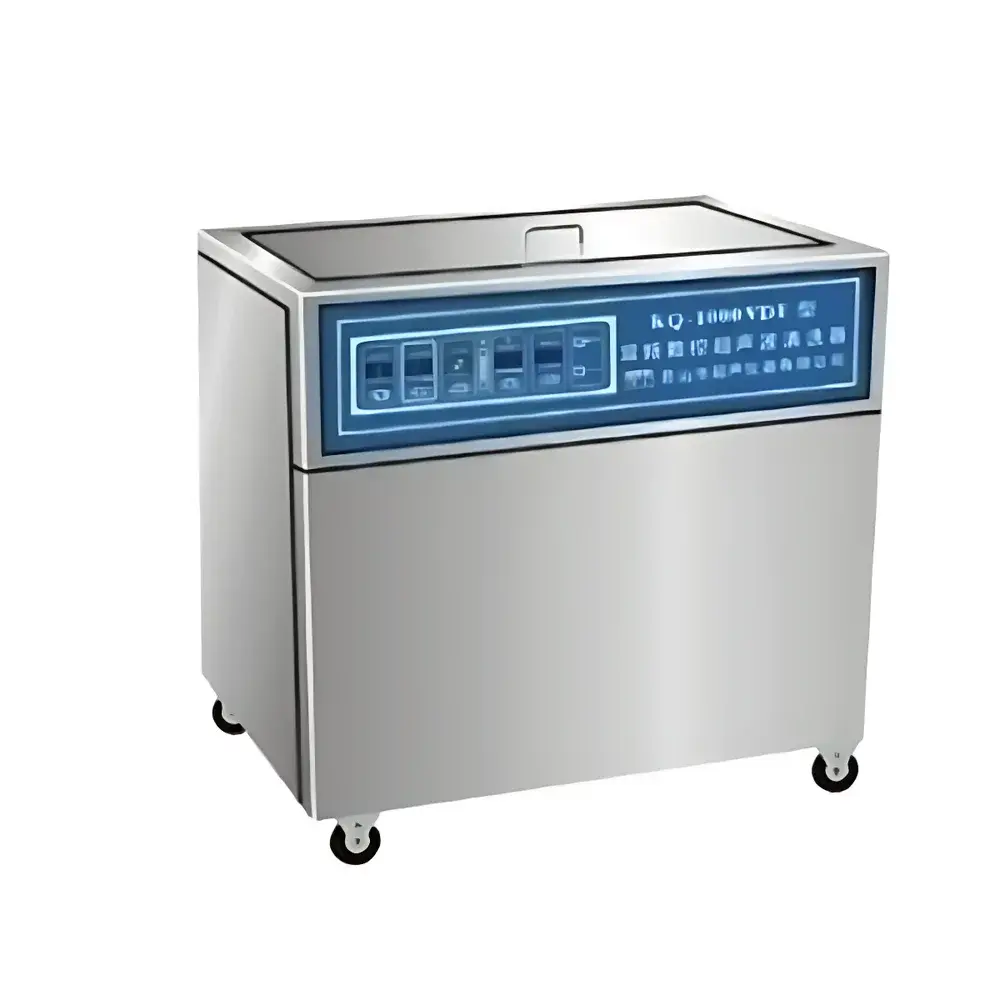
Supmile KQ-1000VDB Floor-Standing Triple-Frequency Digital Ultrasonic Cleaner
| Brand | Supmile |
|---|---|
| Origin | Jiangsu, China |
| Model | KQ-1000VDB |
| Capacity | 72 L |
| Ultrasonic Frequencies | 45 / 80 / 100 kHz |
| Ultrasonic Power | 1000 W (adjustable 40–100%) |
| Heating Range | 10–80 °C |
| Timer Range | 1–480 min |
Overview
The Supmile KQ-1000VDB is a floor-standing, triple-frequency digital ultrasonic cleaner engineered for high-reproducibility cleaning across diverse laboratory, quality control, and industrial maintenance applications. It operates on the principle of cavitation—generating controlled micro-bubbles in liquid media via high-frequency acoustic energy—which collapse to produce localized shockwaves and microstreaming that dislodge particulate, organic, and oily contaminants from surfaces. Unlike single-frequency systems, the KQ-1000VDB dynamically cycles among three discrete frequencies (45 kHz, 80 kHz, and 100 kHz), enabling sequential optimization for coarse removal, intermediate decontamination, and fine particle detachment. This multi-frequency strategy mitigates standing-wave dead zones and improves cleaning uniformity across complex geometries—including blind holes, threaded components, porous ceramics, and delicate optical or semiconductor substrates. Designed as a VDE-series unit, it features a fully welded 304 stainless steel tank (600 × 300 × 400 mm internal dimensions), reinforced chassis, and integrated thermal insulation—ensuring mechanical stability during extended operation and minimizing ambient heat transfer.
Key Features
- Triple-Frequency Programmable Operation: Independent selection and timed alternation between 45 kHz (high energy, ideal for heavy particulates), 80 kHz (balanced penetration and resolution), and 100 kHz (fine-cavitation, suited for micro-scale residues and sensitive surfaces).
- Digital Precision Control: Microprocessor-based interface with real-time display of frequency mode, power level (%), temperature setpoint, and remaining time; retains last-used parameters upon power cycle.
- Adjustable Ultrasonic Power Output: Linear 40–100% power modulation (400–1000 W) allows optimization for sample fragility, solvent volatility, or contamination load without altering frequency.
- Programmable Temperature & Timing: Heated cleaning support from 10 °C to 80 °C (3000 W heater) with ±1 °C stability; timer configurable in 1-minute increments up to 480 minutes (8 hours) for unattended batch processing.
- VDE-Series Robust Architecture: All-welded 304 stainless steel tank and frame; corrosion-resistant hardware; reinforced base for floor-mounted stability; manual fill/drain valve positioned for ergonomic access.
- No-Sound-Dampening Design: Intended for installation in dedicated utility rooms or ventilated equipment bays where acoustic isolation is managed at the facility level—not integrated into the unit.
Sample Compatibility & Compliance
The KQ-1000VDB accommodates a broad range of sample types—including metal parts, glassware, ceramic filters, printed circuit boards, surgical instruments, and analytical labware—without requiring dedicated fixtures beyond standard stainless steel mesh baskets. Its non-contact cleaning mechanism avoids mechanical abrasion, making it suitable for coated optics, MEMS devices, and thin-film substrates when operated at higher frequencies and lower power settings. While not certified to ISO 13485 or FDA 21 CFR Part 11 out-of-the-box, the system supports GLP/GMP-aligned workflows through documented parameter logging (via external data loggers), traceable calibration of temperature and timer functions, and compatibility with validated cleaning solvents compliant with ASTM D4306 (standard practice for cleaning aerospace components) and USP (cleaning validation for pharmaceutical equipment). Users are advised to validate cleaning efficacy per ISO 15883-1 and IEC 61000-4-3 for electromagnetic compatibility in shared lab environments.
Software & Data Management
The KQ-1000VDB operates via an embedded digital controller with no proprietary software dependency. All operational parameters are set and monitored directly on the front-panel LCD interface. For audit-trail requirements, optional RS-232 or USB-to-serial adapters enable connection to external PCs running third-party SCADA or LabVantage-compatible data acquisition platforms. Time-stamped logs of temperature, power setting, frequency mode, and elapsed duration can be exported for inclusion in SOP documentation or regulatory submissions. The unit does not feature built-in electronic signatures, password protection, or 21 CFR Part 11-compliant user access controls; such functionality must be implemented at the enterprise software layer.
Applications
- Pre-analytical sample preparation in clinical and environmental labs (e.g., filter membrane cleaning prior to gravimetric analysis)
- Removal of polishing compounds and machining oils from precision metrology components
- Decontamination of reusable surgical tools in hospital central sterile supply departments (CSSD)
- Extraction support for botanical and forensic samples in conjunction with solvent-based protocols
- Dispersion of nanomaterials and catalyst precursors in R&D synthesis workflows
- Ultrasonic-assisted degassing of HPLC mobile phases and coating solutions
FAQ
Is the KQ-1000VDB suitable for use with flammable solvents?
Yes, provided the unit is operated in a ventilated fume hood or explosion-proof environment; the heater and transducers are electrically isolated, but no ATEX or UL Class I Division 1 certification is included.
Can frequency switching be automated during a single cycle?
Yes—the controller supports programmable sequence timing for automatic transitions between 45 kHz, 80 kHz, and 100 kHz within one run, with user-defined dwell times per frequency.
What is the maximum recommended liquid depth for optimal cavitation?
For consistent performance, maintain liquid level between 100 mm and 350 mm above the tank bottom; excessive depth attenuates ultrasonic energy transmission.
Does the unit include a degas function?
No dedicated degas mode is present, but initiating operation at 45 kHz for 5–10 minutes prior to introducing samples effectively removes dissolved air from aqueous and polar solvent baths.
Is calibration documentation available for temperature and timer accuracy?
Factory calibration certificates are supplied; users may perform periodic verification using NIST-traceable thermistors and stopwatch standards per ISO/IEC 17025 guidelines.



