
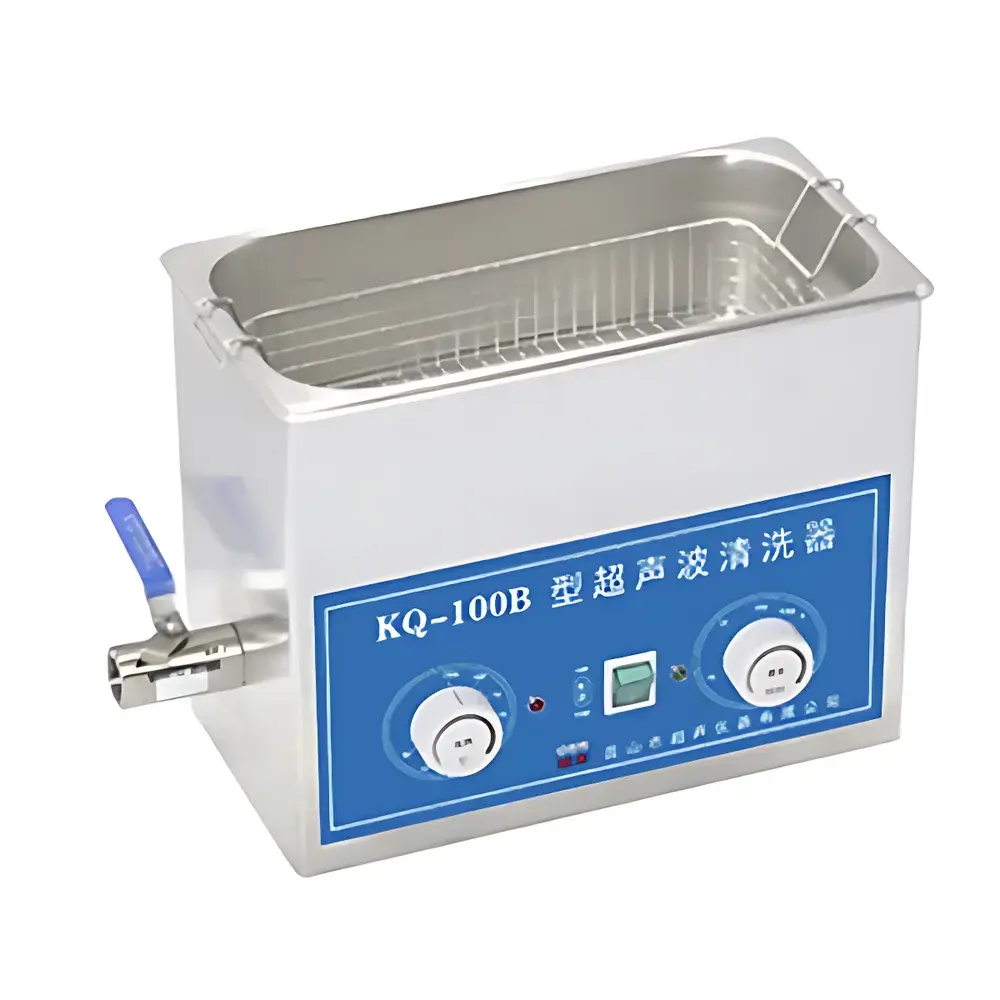
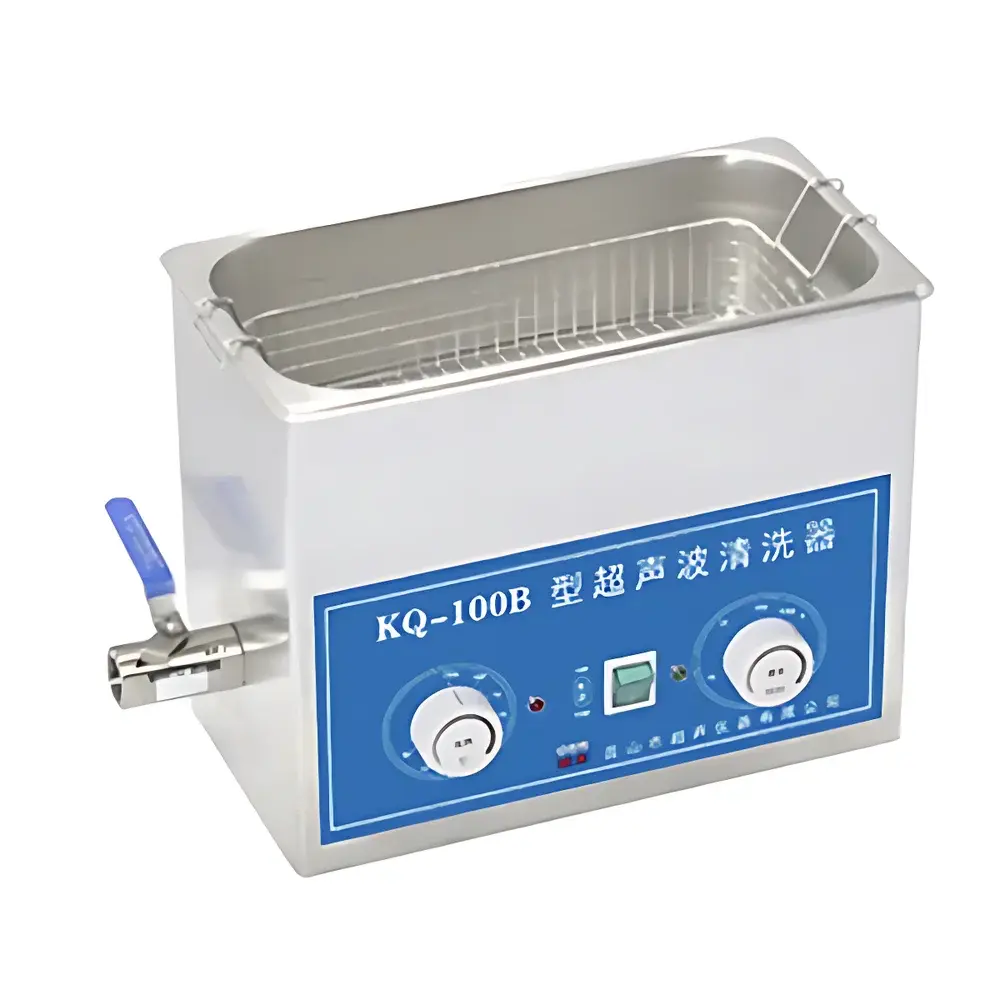
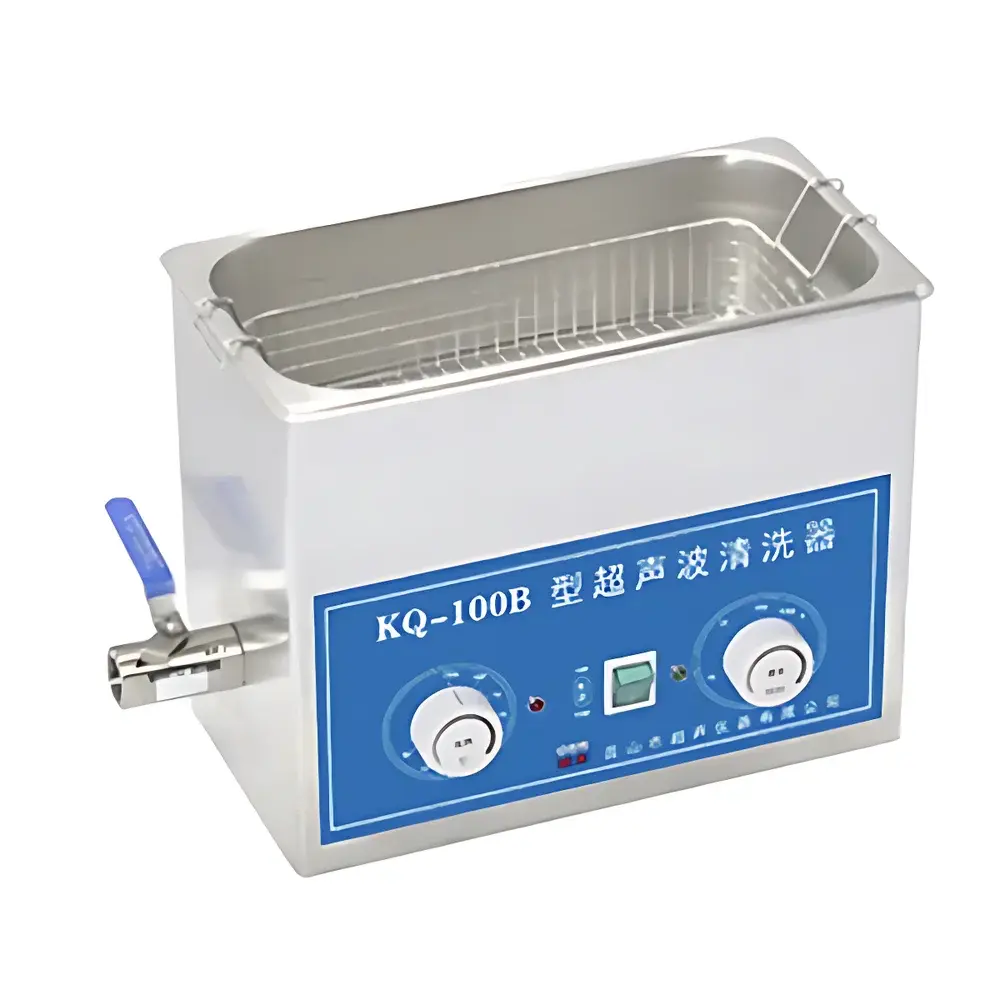
Supmile KQ-100B Benchtop Ultrasonic Cleaner
| Brand | Supmile |
|---|---|
| Origin | Jiangsu, China |
| Manufacturer Type | Authorized Distributor |
| Instrument Type | General-Purpose Ultrasonic Cleaner |
| Tank Capacity | 4 L |
| Ultrasonic Frequency | 40 kHz |
| Ultrasonic Power Output | 100 W |
| Temperature Control Range | Ambient to 80 °C |
| Timer Adjustment | 1–20 min |
| Drain/Refill Method | Manual Valve |
| Heating Power | 400 W |
| Tank Dimensions (L×W×H) | 300 × 150 × 100 mm |
| Overall Dimensions (L×W×H) | 320 × 174 × 280 mm |
| Construction Material | 304 Stainless Steel |
| Power Supply | 220 V AC, 50 Hz |
| Standard Accessories | Stainless Steel Mesh Basket, Manual Fill/Drain Fitting |
Overview
The Supmile KQ-100B is a compact, benchtop ultrasonic cleaner engineered for precision cleaning of delicate laboratory components, glassware, surgical instruments, optical elements, and small mechanical parts. It operates on the principle of high-frequency acoustic cavitation—generated by piezoelectric transducers bonded to the stainless steel tank base—at a fixed frequency of 40 kHz. This frequency delivers optimal balance between cleaning efficacy and part safety, minimizing surface erosion while effectively dislodging particulate contaminants, organic residues, and loosely adhered biofilms. The unit features a thermally insulated 4 L tank constructed entirely from medical-grade 304 stainless steel, ensuring corrosion resistance, long-term dimensional stability, and compatibility with aqueous cleaning solutions, mild alkaline detergents, and low-concentration ethanol-based rinses. Its integrated heating system (400 W) enables temperature-controlled cleaning cycles up to 80 °C—critical for enhancing surfactant activity and reducing surface tension in stubborn residue removal—while maintaining thermal uniformity across the tank volume within ±2 °C under steady-state conditions.
Key Features
- Benchtop footprint (320 × 174 × 280 mm) optimized for space-constrained lab environments including QC labs, research hoods, and cleanroom support areas.
- Robust 304 stainless steel tank and housing, resistant to chlorinated solvents, acidic rinse agents, and repeated thermal cycling.
- Fixed-frequency 40 kHz transducer array delivering consistent cavitation intensity; dual 50 W transducers provide uniform energy distribution across the full 300 × 150 × 100 mm tank cavity.
- Analog timer dial with precise 1–20 minute adjustment range and automatic shutdown—designed for repeatable process validation without software dependency.
- Adjustable thermostatic control (ambient to 80 °C) with independent heater circuitry and over-temperature cut-off protection (95 °C fail-safe).
- Manual fill/drain valve positioned at tank base for controlled solution exchange and minimal operator exposure to hot or chemically active media.
- Included stainless steel mesh basket (120 µm aperture) supports sample segregation, prevents direct contact with transducer surface, and facilitates drip-free transfer post-cleaning.
Sample Compatibility & Compliance
The KQ-100B is routinely deployed in applications requiring non-abrasive, non-contact cleaning of fragile or high-value items—including HPLC vials, pipette tips, microcentrifuge tubes, watch components, MEMS devices, and semiconductor wafers (pre-lithography). Its mechanical control architecture ensures electromagnetic compatibility (EMC) per IEC 61326-1 Class B requirements, making it suitable for proximity to sensitive analytical instrumentation such as mass spectrometers and electron microscopes. While not certified to ISO 13485 or FDA 21 CFR Part 11 out-of-the-box, its repeatable time/temperature profiles support GLP-compliant documentation when integrated into validated lab SOPs. The unit complies with GB/T 18402–2001 (Chinese national standard for ultrasonic cleaners) and meets CE marking requirements for electrical safety (IEC 61010-1) and EMC (EN 61326-1).
Software & Data Management
The KQ-100B operates exclusively via analog controls—no embedded firmware, no USB interface, and no data logging capability. This design prioritizes operational reliability, eliminates cybersecurity risks associated with networked lab equipment, and simplifies qualification in regulated environments where software validation burdens must be minimized. All operating parameters (time, temperature) are manually set and visually confirmed via front-panel dials and analog indicators. Users maintain full traceability through manual logbook entries or integration with external electronic lab notebooks (ELNs) that record start/end timestamps, bath temperature, and solution composition per cleaning cycle.
Applications
- Pre-analytical preparation of chromatography consumables and sampling vessels to eliminate carryover contamination.
- Removal of polishing compounds and oxide layers from metallographic specimens prior to SEM imaging.
- Cleaning of reusable surgical tools in university teaching hospitals and veterinary clinics (used in conjunction with WHO-recommended disinfectant protocols).
- Decontamination of quartz cuvettes and optical filters in spectroscopy labs to restore baseline transmission performance.
- Supporting ASTM D2621 and ISO 11553-1 procedures for evaluating cleaning agent efficacy on standardized test soils.
- Routine maintenance of precision weighing boats, crucibles, and calibration standards in metrology laboratories.
FAQ
Is the KQ-100B suitable for cleaning aluminum or soft metals?
Yes—when used with neutral pH aqueous solutions and limited exposure time (<10 min at ≤60 °C), it poses minimal risk of pitting or etching. Avoid chloride-containing cleaners.
Can I use organic solvents like acetone or IPA in this unit?
No. The KQ-100B is rated only for aqueous solutions. Flammable or volatile solvents present fire hazard and may damage seals or transducers.
Does the unit include degassing functionality?
No. Degassing must be performed separately using vacuum or standing time prior to initiating ultrasonic cycles.
What is the expected service life of the transducers under normal use?
With proper maintenance (avoiding dry operation, periodic descaling, and adherence to max temperature limits), transducers typically exceed 5,000 operational hours.
Is calibration required for routine operation?
No formal calibration is specified per manufacturer guidelines; however, users performing GxP work should verify temperature accuracy annually using an NIST-traceable thermometer and timer accuracy with a calibrated stopwatch.



