
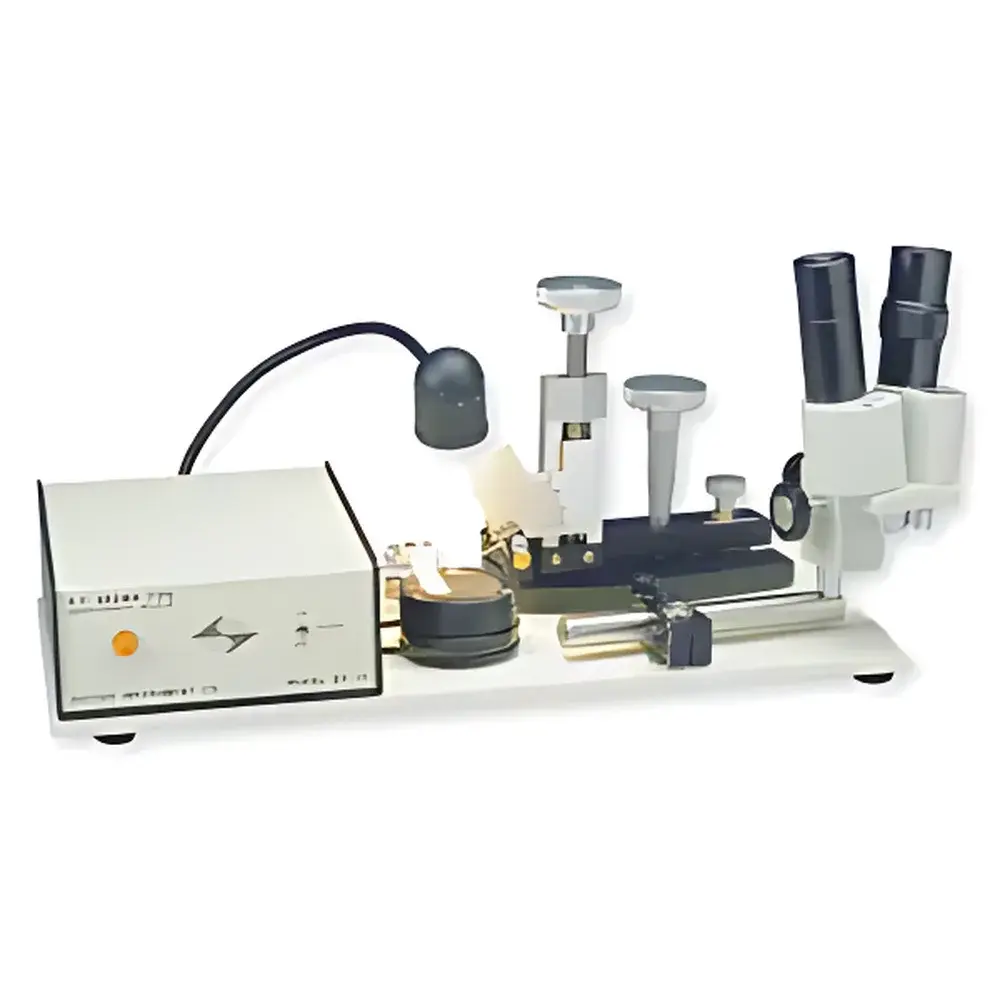
Sutter BV-10 Microelectrode Polishing System
| Brand | Sutter |
|---|---|
| Origin | USA |
| Model | BV-10 |
| Instrument Type | Microelectrode Processing System for Electrophysiology |
| Heating Elements | Pt/Ir wire and Sn-Pb alloy wire |
| Tip Diameter Capability | < 0.3 µm |
| Control | Triple independent digital controllers for heat, pull force, and timing |
| Microscopy | Integrated dual-magnification optical system (low- and high-power objectives) |
| Compliance | Designed for GLP-compliant electrophysiology lab workflows |
Overview
The Sutter BV-10 Microelectrode Polishing System is a precision-engineered instrument designed for post-pull optimization of glass micropipettes used in patch-clamp electrophysiology, intracellular recording, and single-cell ion channel studies. Unlike conventional electrode pullers, the BV-10 focuses exclusively on thermal polishing—a critical secondary processing step that refines the pipette tip geometry after initial fabrication. It operates on the principle of controlled resistive heating applied to the pipette tip under microscopic observation, enabling localized melting and surface tension-driven reshaping. This process eliminates micro-fractures, reduces tip asymmetry, and produces a smooth, conical, and electrically homogeneous aperture—essential for achieving gigaseal formation (>1 GΩ) with high reproducibility across biological preparations.
Key Features
- Triple independent digital controllers for precise, repeatable regulation of heating current, axial pull force, and dwell time—enabling fine-tuned thermal profiles tailored to glass composition (e.g., borosilicate, quartz) and tip geometry.
- Dual-magnification integrated optical system featuring interchangeable low-power (10×) and high-power (40×) objectives—optimized respectively for pipette alignment/coating and real-time tip morphology assessment during polishing.
- High-stability heating elements: platinum–iridium (Pt/Ir) wire for high-temperature, oxidation-resistant operation up to 1800 °C; tin–lead (Sn–Pb) alloy wire for lower-temperature, rapid-response thermal shaping (200–600 °C), minimizing thermal stress on delicate capillaries.
- Modular mechanical stage with micrometer-adjustable X/Y/Z positioning—ensuring sub-micron repeatability in tip-to-heater alignment and consistent spatial control over the polishing zone.
- EMI-shielded electronics and grounded chassis design—reducing electromagnetic interference that could compromise low-noise electrophysiological recordings downstream.
Sample Compatibility & Compliance
The BV-10 accommodates standard borosilicate (e.g., GC150F-15, BF150-86-10) and fused quartz capillaries (1.0–1.5 mm OD, 0.5–1.0 mm ID) commonly used in patch-clamp and sharp-electrode applications. Its thermal parameters are calibrated for optimal performance with filament-loaded or laser-based puller-fabricated pipettes. The system supports compliance with Good Laboratory Practice (GLP) requirements through traceable parameter logging (via optional RS-232/USB interface), operator ID tagging, and audit-ready session records—facilitating documentation for FDA 21 CFR Part 11–aligned workflows in regulated neuroscience and pharmacology laboratories.
Software & Data Management
While the BV-10 operates as a stand-alone analog-digital hybrid instrument, its digital controllers support external synchronization via TTL triggers and serial command protocols. When integrated with Sutter’s MPPI (Microelectrode Processing Interface) software suite (v3.2+), users gain access to programmable thermal ramping profiles, automated tip-diameter calibration routines using calibrated reference images, and exportable CSV logs containing timestamped heat/pull/timing sequences. All data files comply with MIAME/MINSEQE metadata standards for electrophysiology experiment reporting and are compatible with LabArchives ELN and Benchling LIMS platforms.
Applications
- Routine preparation of high-resistance patch pipettes for whole-cell, cell-attached, and perforated-patch configurations in primary neuronal cultures and brain slice preparations.
- Fabrication of ultra-fine intracellular electrodes (<0.3 µm tip opening) for low-noise voltage-clamp recordings in small-diameter cells (e.g., dendritic spines, cochlear hair cells).
- Thermal reconditioning of damaged or contaminated pipettes—restoring tip integrity without requiring full re-pulling.
- Development and validation of novel glass formulations (e.g., aluminosilicate-doped capillaries) where controlled thermal behavior must be empirically characterized.
- Training platform in graduate electrophysiology core facilities—enabling standardized, instructor-guided tip optimization protocols with objective morphometric feedback.
FAQ
What types of capillary glass are compatible with the BV-10?
Standard borosilicate (e.g., Harvard Apparatus GC150F-15) and fused quartz (e.g., Sutter QF100-75-10) capillaries with outer diameters between 1.0 mm and 1.5 mm are fully supported.
Can the BV-10 be used for both patch-clamp and sharp-electrode applications?
Yes—the system is optimized for both applications, with adjustable thermal profiles to produce either blunt-tipped electrodes for sharp intracellular recording or ultra-tapered tips for high-resistance seals.
Is calibration required before first use?
Factory calibration is performed prior to shipment; however, users should perform routine verification using NIST-traceable thermal test points and tip-diameter reference standards at least quarterly.
Does the BV-10 meet electromagnetic compatibility (EMC) standards for use in shielded electrophysiology rigs?
Yes—it complies with FCC Part 15 Class B and IEC 61326-1:2013 for industrial, scientific, and medical (ISM) equipment, ensuring minimal RF emission in Faraday cage environments.
How is maintenance performed on the heating elements?
Pt/Ir and Sn–Pb wires are field-replaceable modules; replacement kits include pre-aligned holders and torque-spec screwdrivers, with full procedures documented in the service manual (Sutter Doc# BV-10-SM-Rev4.1).
Related Products






