
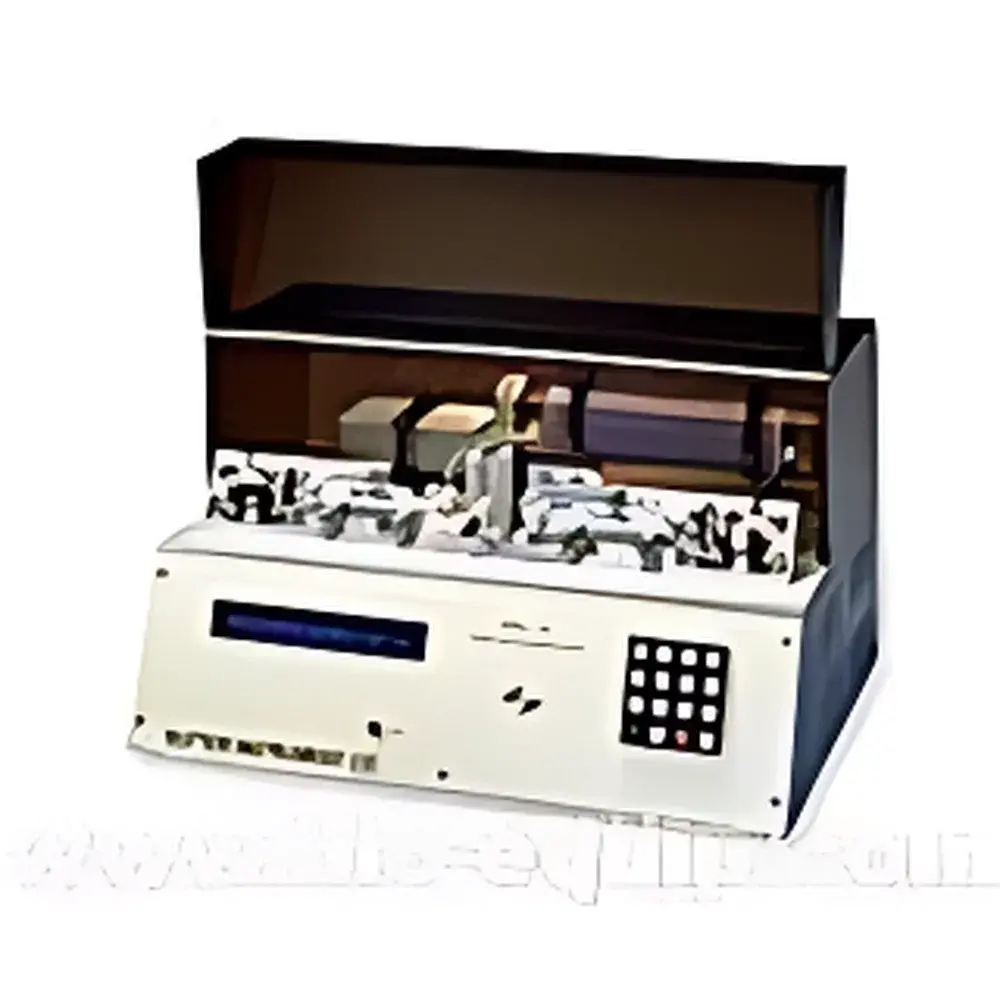
Sutter P-97 Micropipette Puller
| Brand | Sutter |
|---|---|
| Origin | USA |
| Model | P-97 |
| Type | Horizontal Programmable Micropipette Puller |
| Heating Mechanism | Dual-Independent Filament (Tungsten/Platinum) |
| Control Architecture | Microprocessor-Based with Ramp Detection Algorithm |
| Program Storage | 100 User-Defined Protocols with Write-Protection and Timestamping |
| Electrode Symmetry | Dual-Output Symmetric Pulling |
| Tip Diameter Reproducibility | Sub-100 nm (verified by SEM) |
| Integrated Gas System | Regulated Compressed Air with Particulate Filter, Desiccant Dryer, and Humidity Stabilization |
| Display | Vacuum Fluorescent Display (VFD) with Real-Time Parameter Monitoring |
| Compliance | Designed for GLP/GMP-aligned electrophysiology workflows |
Overview
The Sutter P-97 Micropipette Puller is a precision-engineered horizontal programmable instrument designed for the reproducible fabrication of glass and quartz micropipettes used in intracellular recording, patch-clamp electrophysiology, microinjection, and single-cell electrophysiological interrogation. It operates on the principle of controlled thermal softening and mechanical tension: dual independent tungsten or platinum filaments heat opposing ends of a glass capillary while programmable pneumatic force applies symmetrical axial pull. This coordinated thermal-mechanical process enables deterministic shaping of tip geometry—including outer diameter, taper angle, shank length, and tip opening—with sub-micron repeatability. Unlike vertical gravity-driven pullers, the P-97’s horizontal architecture eliminates gravitational bias, ensuring consistent symmetry between paired electrodes generated in a single pull cycle—critical for matched-pair experiments and dual-electrode voltage clamp configurations.
Key Features
- Dual-filament heating system with independent temperature calibration per filament, enabling precise differential heating for asymmetric pull protocols.
- Ramp Detection algorithm automatically characterizes filament aging and glass batch variability by performing real-time resistance profiling during initial heating cycles—adjusting baseline power delivery to maintain thermal consistency across consumables.
- Onboard microprocessor stores up to 100 user-defined pull protocols, each with timestamped creation/modification metadata and hardware-enforced write protection to prevent accidental overwrites.
- Integrated compressed air subsystem includes HEPA-grade particulate filtration, desiccant-based humidity control (<15% RH), and pressure regulation (0–100 psi), eliminating external gas source dependencies and reducing moisture-induced tip clogging.
- Vacuum fluorescent display provides simultaneous readout of real-time filament temperature (°C), applied pull force (psi), ramp slope (°C/s), and protocol execution status.
- Symmetric dual-output design produces two morphologically identical pipettes per pull—validated via scanning electron microscopy (SEM) for tip diameters consistently below 100 nm under optimized parameters.
Sample Compatibility & Compliance
The P-97 accommodates standard borosilicate (e.g., KG-33, BF150-86-10), aluminosilicate (e.g., 1B150F-4), and fused quartz capillaries (1.0–2.0 mm OD, wall thickness 0.5–1.0 mm). Its programmable ramp-and-hold thermal profile supports both one-step and multi-stage pulls—essential for fabricating patch pipettes with fire-polished tips, sharp intracellular electrodes, or double-barrel recording electrodes. The instrument meets electrical safety requirements per UL 61010-1 and IEC 61010-1. While not certified as medical device hardware, its operational traceability, protocol versioning, and internal memory integrity align with GLP documentation standards and serve as foundational infrastructure for FDA 21 CFR Part 11–compliant electrophysiology core facilities when integrated with validated LIMS or ELN platforms.
Software & Data Management
The P-97 operates autonomously without PC dependency; all parameter entry, execution, and diagnostics occur via front-panel interface. Internal non-volatile memory retains protocols and system logs across power cycles. Optional RS-232 serial interface enables integration with laboratory automation scripts for batch protocol deployment or centralized log archiving. When paired with third-party electrophysiology acquisition software (e.g., pCLAMP, Axograph), users may embed pull protocol IDs into experimental metadata—establishing bidirectional traceability between pipette morphology and recorded physiological data. Audit trail generation requires external logging middleware compliant with 21 CFR Part 11 electronic signature and record retention rules.
Applications
- Preparation of high-resistance (>10 MΩ) patch pipettes for whole-cell, cell-attached, and outside-out configurations.
- Fabrication of low-impedance (<5 MΩ) intracellular microelectrodes for sharp electrode recordings in neurons, oocytes, and cardiomyocytes.
- Production of double-barrel or triple-barrel pipettes for iontophoretic drug delivery combined with simultaneous voltage recording.
- Generation of quartz-coated or quartz-only pipettes for infrared laser-guided patching and two-photon imaging compatibility.
- Reproducible manufacturing of injection pipettes for CRISPR/Cas9 RNP delivery, mRNA transfection, or organelle targeting in live cells.
FAQ
What capillary types and dimensions are compatible with the P-97?
Standard borosilicate, aluminosilicate, and fused quartz capillaries with outer diameters from 1.0 mm to 2.0 mm and wall thicknesses between 0.5 mm and 1.0 mm.
Does the P-97 support multi-stage pull protocols?
Yes—users may define up to four sequential ramp-and-hold thermal phases, each with independent temperature setpoints, ramp rates, dwell times, and corresponding pull force profiles.
How is tip geometry verified post-pull?
Tip morphology is routinely assessed using scanning electron microscopy (SEM); optical microscopy with calibrated graticules provides preliminary verification, though sub-100 nm features require SEM or TEM validation.
Is humidity control mandatory for reliable pulling?
Yes—ambient moisture causes inconsistent glass softening and tip fracture. The integrated desiccant dryer maintains <15% RH at the filament zone, which is critical for achieving sub-100 nm reproducibility.
Can the P-97 be integrated into automated electrophysiology workflows?
Via RS-232 command set, it supports trigger-based pull initiation and status polling, enabling synchronization with robotic stage positioning or stimulus timing modules in custom-built rigs.




