
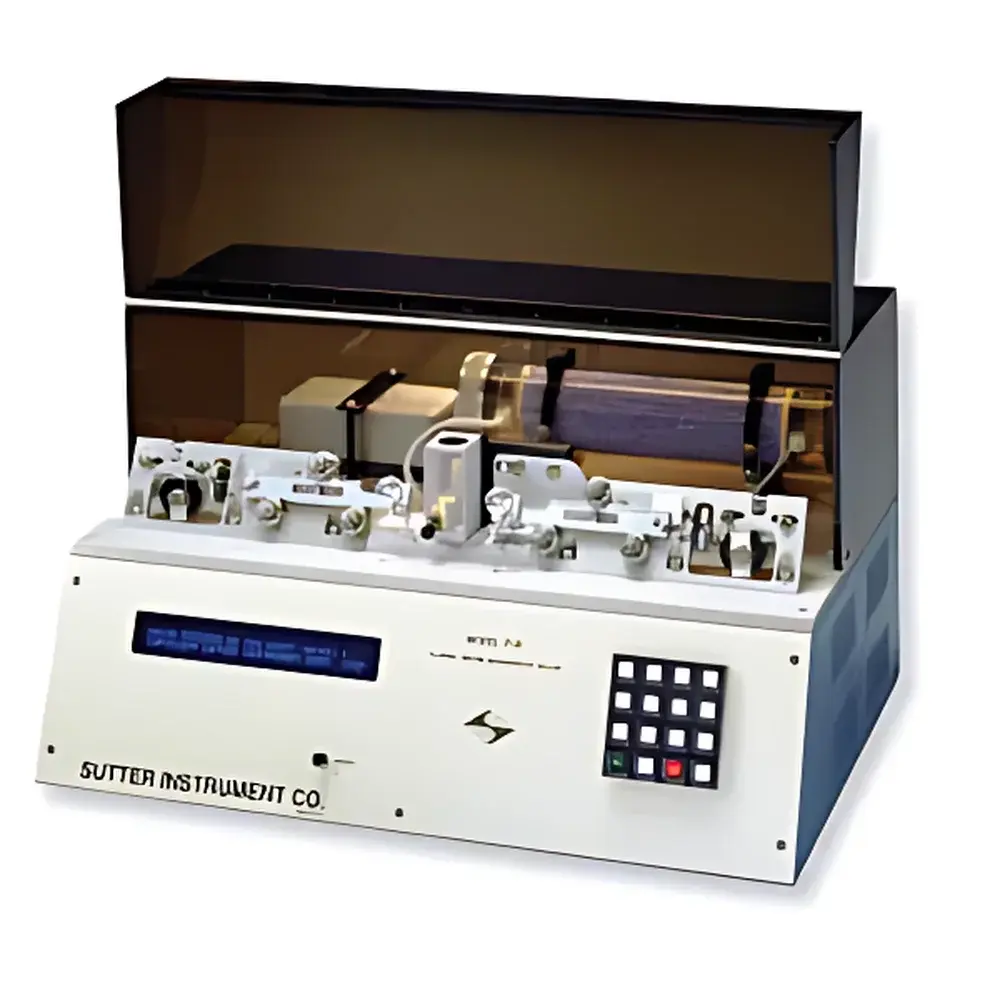
Sutter P97 Programmable Horizontal Micropipette Puller
| Brand | Sutter |
|---|---|
| Origin | USA |
| Model | P97 |
| Instrument Type | Electrochemical Micropipette Fabrication System |
| Heating Element | Dual-Loop Resistive Wire (NiChrome or Platinum) |
| Control Architecture | Embedded Microprocessor with Non-Volatile Program Memory |
| Max. Program Storage | 100 Protocols |
| Display | Vacuum Fluorescent Display (VFD), Omnidirectional View |
| Environmental Control | Integrated Humidity-Stabilized Chamber |
| Cooling Options | Pneumatic Blast Cooling (Selectable Mode) |
| Glass Compatibility | Single- and Multi-Barrel Capillaries (OD up to 2.0 mm) |
| Tip Diameter Resolution | Sub-100 nm (Typical for Borosilicate & Aluminosilicate Glass) |
| Compliance | Designed for GLP/GMP-Adjacent Electrophysiology Labs |
| Software Features | Date/Time-Stamped Protocol Logging, Write-Protected Program Mode, Atmospheric Pressure Compensation Parameter |
Overview
The Sutter P97 Programmable Horizontal Micropipette Puller is an advanced Flaming-Brown type microelectrode fabrication system engineered for precision, reproducibility, and adaptability in electrophysiological and microinjection applications. It operates on the principle of controlled resistive heating combined with programmable horizontal pulling force and pneumatic tension modulation. A dual-loop resistive wire (typically NiChrome or platinum) heats glass capillaries to their softening point, while synchronized horizontal translation—driven by a high-resolution stepper motor—induces controlled necking and tip formation. Unlike conventional pullers, the P97 integrates real-time thermal dynamics modeling into its control logic: initial pull velocity is modulated as viscosity decreases with rising temperature, followed by precise deceleration near the critical elongation threshold to minimize tip oscillation and ensure structural integrity. This results in consistently short-tapered, mechanically robust electrodes ideal for patch-clamp recording, intracellular injection, and scanning ion conductance microscopy (SICM).
Key Features
- Humidity-stabilized chamber surrounding the heating filament minimizes ambient moisture-induced variability in glass softening behavior—critical for inter-laboratory protocol transfer.
- 25% higher power output enables reliable pulling of large-diameter (up to 2.0 mm OD) and multi-barrel capillaries (e.g., theta, triple, or quadruple tubes) without thermal saturation.
- Redesigned low-thermal-mass metal clamps reduce heat retention at filament termini, improving thermal response fidelity and reducing program drift across successive runs.
- Pneumatic blast cooling mode—activated via programmable solenoid valve—provides rapid, localized quenching for enhanced taper control and reduced tip retraction artifacts.
- Vacuum fluorescent display (VFD) with omnidirectional visibility supports ergonomic operation in crowded rig environments and facilitates real-time monitoring of heating duration, pull timing, and atmospheric pressure compensation status.
- 100-user-program storage with timestamped creation/edit history and optional write protection ensures audit-ready protocol management in regulated research settings.
Sample Compatibility & Compliance
The P97 accommodates standard borosilicate (e.g., BF150-86-10), aluminosilicate (e.g., 1B150F-4), and quartz capillaries ranging from 0.5 mm to 2.0 mm outer diameter. Its programmable atmospheric pressure parameter allows automatic adjustment of heating profiles when operating at non-sea-level altitudes—a feature validated against ASTM E29-23 guidelines for environmental correction in precision instrumentation. The system’s low-noise electrical architecture complies with IEC 61326-1 for laboratory equipment electromagnetic compatibility. While not FDA-cleared, its design aligns with GLP documentation requirements—including full traceability of protocol parameters, operator ID (via external login integration), and change-controlled firmware revision logging—making it suitable for preclinical neurophysiology workflows subject to internal QA review.
Software & Data Management
The embedded microprocessor executes deterministic real-time control loops with sub-millisecond timing resolution. All protocols store metadata including creation date, last edit timestamp, atmospheric pressure setting, and user-defined notes. Write-protection mode prevents accidental overwrites during shared-use scenarios—common in core electrophysiology facilities. Export-capable serial interface (RS-232) supports integration with LabArchives or electronic lab notebooks (ELNs) for 21 CFR Part 11–compliant data archiving when paired with validated middleware. Firmware updates are delivered via secure USB dongle with cryptographic signature verification to maintain system integrity.
Applications
- High-yield fabrication of patch-clamp pipettes with tip diameters <100 nm and resistance values tunable between 2–15 MΩ (depending on glass composition and coating).
- Production of double-barrel or triple-barrel micropipettes for simultaneous iontophoresis and recording, where short taper geometry reduces inter-barrel capacitance and improves temporal resolution.
- Preparation of sharpened microinjection needles for zygote manipulation, CRISPR delivery, or single-cell metabolite sampling.
- Routine calibration of electrode geometry using integrated bending test function—quantifies filament-glass thermal coupling efficiency prior to full protocol deployment.
- Reproducible fabrication of SICM probes requiring symmetric, ultra-sharp tips with minimal cone angle (<5°) for nanoscale topographic mapping.
FAQ
Does the P97 support custom heating profiles beyond the standard ramp-hold-pull sequence?
Yes—the firmware permits multi-stage heating profiles with up to four independently defined temperature ramps, dwell periods, and slope-controlled transitions.
Can the P97 be integrated into automated electrophysiology workflows?
It features TTL-compatible trigger I/O and RS-232 command set for synchronization with stimulus isolators, amplifiers, or robotic stage controllers.
Is humidity calibration required before first use?
The chamber includes factory-calibrated relative humidity sensing; users may perform field verification using NIST-traceable hygrometers per ISO 17025 procedures.
What glass types are validated for sub-50 nm tip formation?
Aluminosilicate capillaries (e.g., GC150TF-10) consistently achieve 30–70 nm tips under optimized P97 programs; quartz requires elevated heating power and modified cooling timing.
How does the bending test function improve protocol development?
It measures mechanical deflection of the filament under known load, generating a thermal coupling coefficient used to auto-adjust nominal heating values for new glass batches—reducing empirical optimization time by ~60%.




