
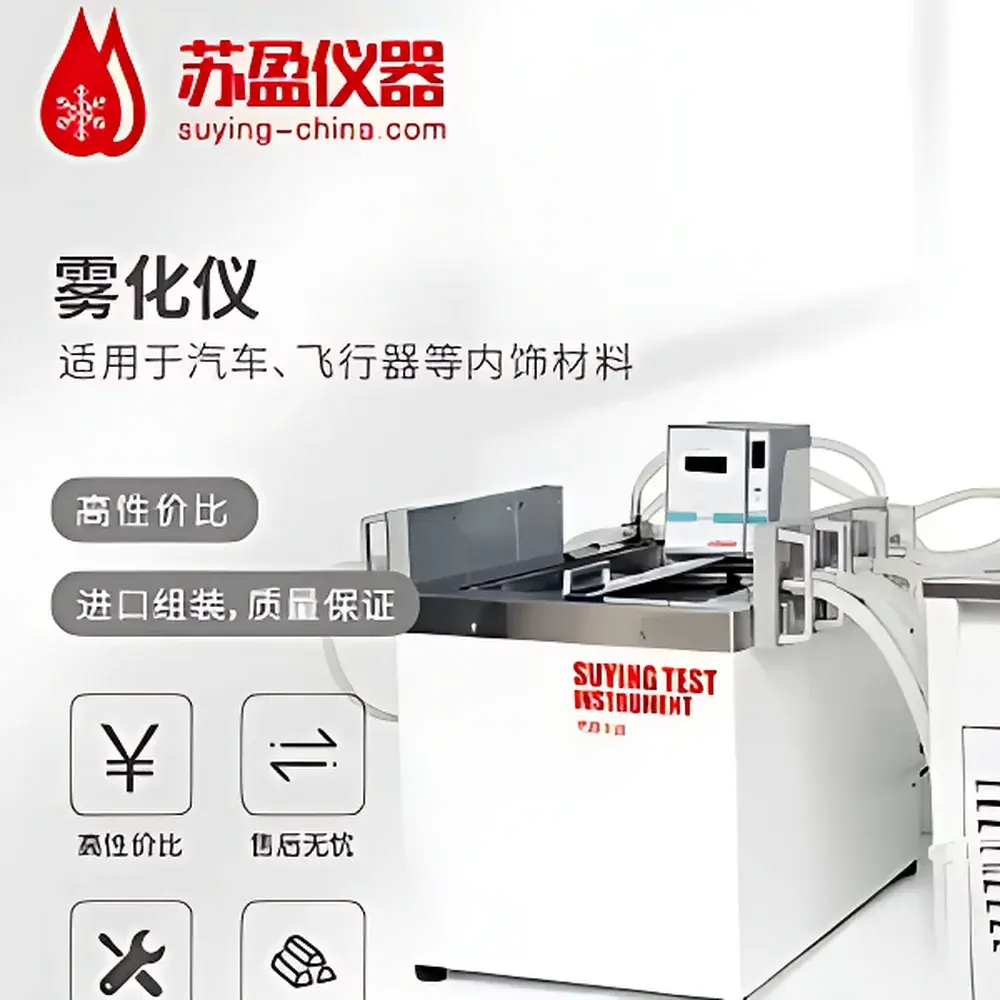
Suying WH-100 Automotive Interior Fogging Tester
| Brand | Suying |
|---|---|
| Origin | Shanghai, China |
| Manufacturer Type | Direct Manufacturer (not distributor) |
| Country of Manufacture | China |
| Model | WH-100 |
| Temperature Range – Heating Chamber | 45–160 °C |
| Temperature Range – Cooling Chamber | −28–100 °C |
| Compliance | ISO 6452, DIN 75201, SAE J1756, GB/T 27630 |
Overview
The Suying WH-100 Automotive Interior Fogging Tester is an engineered solution for quantitative assessment of volatile condensable emissions from interior materials used in automotive, aerospace, and rail cabin applications. It operates on the principle of thermal desorption followed by cold-surface condensation — a gravimetric method standardized under ISO 6452 (Rubber, vulcanized or thermoplastic — Determination of fogging characteristics of interior materials), DIN 75201 (Fogging test for interior materials), SAE J1756 (Fogging of Interior Trim Materials in Automobiles), and China’s GB/T 27630 (Guidelines for evaluation of interior air quality in passenger vehicles). During testing, a conditioned specimen is placed in a precisely controlled heating chamber (45–160 °C), where volatile organic compounds (VOCs) and semi-volatile organic compounds (SVOCs) are thermally released. These vapors migrate to a vertically aligned, temperature-regulated condensation surface (typically glass or aluminum foil) maintained within the cooling chamber (−28 to 100 °C). The mass of condensed residue — measured gravimetrically before and after exposure — yields the fogging value (mg), directly indicating material outgassing propensity under simulated service conditions.
Key Features
- Integrated dual-zone thermal control system: independent PID-regulated heating chamber (45–160 °C ±0.5 °C) and cooling chamber (−28–100 °C ±0.8 °C), ensuring reproducible thermal gradients critical for inter-laboratory comparability.
- Stainless-steel construction with electropolished interior surfaces to minimize VOC adsorption and facilitate cleaning between tests.
- Modular specimen holder design accommodating standard test substrates: glass slides (for photometric analysis), aluminum foil (for gravimetric determination), and optional quartz plates for FTIR-compatible residue characterization.
- Sealed chamber architecture with inert gas purge capability (N₂ or dry air) to suppress oxidation during high-temperature exposure and improve measurement stability.
- Compliance-ready hardware interface: supports external data logging via RS-485/Modbus RTU and analog 4–20 mA outputs for integration into centralized QC monitoring systems.
Sample Compatibility & Compliance
The WH-100 accepts a broad range of interior trim materials including polyurethane foam, PVC leatherette, ABS and PP composites, adhesives, sealants, and textile laminates. Specimens are cut to standardized dimensions (e.g., 50 mm × 50 mm or 10 g ±0.1 g per ISO 6452) and preconditioned per ASTM D618 or ISO 291 prior to testing. The instrument fully supports regulatory requirements for automotive OEM qualification protocols, including Volkswagen PV3920, Ford CETP 00.00-L-467, GMW15634, and Toyota TSL-0002G. Its operational parameters align with GLP-compliant workflows, enabling audit-ready documentation when paired with validated software (see Software & Data Management).
Software & Data Management
The WH-100 is compatible with Suying’s optional FogTest Suite v3.2 — a Windows-based application compliant with FDA 21 CFR Part 11 requirements. It provides electronic signatures, role-based user access control, full audit trail logging (including parameter changes, calibration events, and test initiation/termination timestamps), and automated report generation in PDF/A-1b format. Raw temperature profiles, chamber pressure traces, and gravimetric delta values are stored with SHA-256 checksum integrity verification. Export formats include CSV, XML, and LIMS-ready ASTM E1384-compliant data packets. All firmware updates undergo IEC 62304 Class B validation prior to release.
Applications
- Pre-release screening of seat foams, headliner substrates, and dashboard polymers for fogging compliance across Tier-1 and OEM supply chains.
- Root-cause analysis of haze formation on HUD displays and instrument cluster lenses using residue morphology correlation (via optional SEM-EDS add-on).
- Accelerated aging studies evaluating thermal stability of low-VOC formulations under cyclic temperature profiles (e.g., 85 °C/85% RH → 120 °C dry).
- Material substitution validation for sustainability initiatives (e.g., bio-based polyols in PU foam) without compromising interior air quality performance.
- Supporting R&D laboratories in developing ISO 12219-1–aligned cabin air quality test strategies beyond fogging (e.g., synergistic VOC emission profiling).
FAQ
What standards does the WH-100 support out-of-the-box?
The instrument is factory-configured for ISO 6452, DIN 75201, SAE J1756, and GB/T 27630. Optional firmware modules enable PV3920 and GMW15634 mode selection.
Is the cooling chamber capable of sub-zero operation during fogging tests?
Yes — the Peltier-based cooling system achieves stable operation down to −28 °C, essential for high-sensitivity detection of low-volatility condensables such as phthalate plasticizers and amine catalysts.
Can the WH-100 be integrated into an existing LIMS or MES environment?
Yes — via Modbus TCP/IP or OPC UA (with optional gateway), supporting structured metadata exchange including sample ID, operator credentials, environmental chamber logs, and pass/fail status per test cycle.
Does Suying provide IQ/OQ/PQ documentation packages?
Yes — a complete GMP-aligned qualification package is available, including traceable calibration certificates (NIST-traceable thermocouples and analytical balances), installation checklists, operational protocol scripts, and performance verification runs using certified reference materials (CRM-Fog-01 and CRM-Fog-02).




