
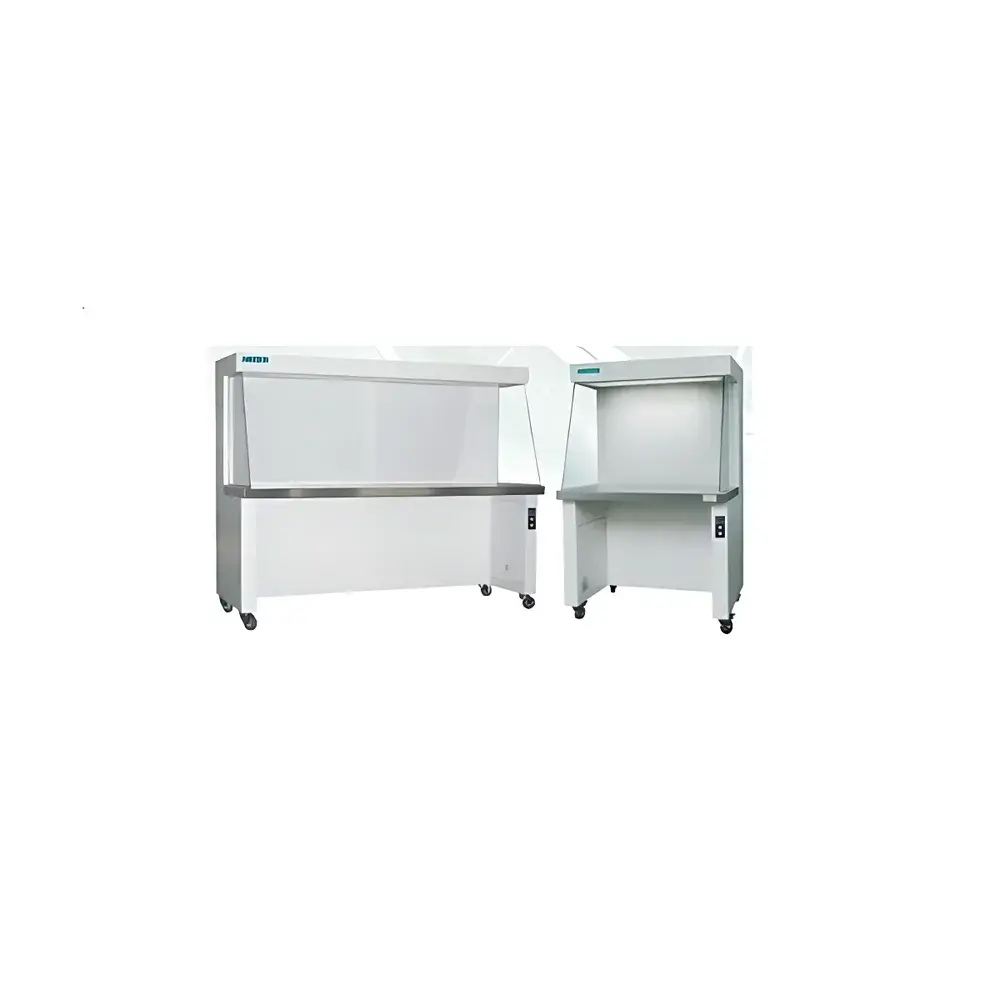
SW-CJ-1B Clean Bench (Horizontal Laminar Flow Workstation)
| Origin | Jiangsu, China |
|---|---|
| Manufacturer Type | Distributor |
| Origin Category | Domestic |
| Model | SW-CJ-1B |
| Price | USD 850 (est.) |
| Instrument Type | Horizontal Laminar Flow Clean Bench |
| Cleanliness Class | ISO Class 5 (equivalent to Fed. Std. 209E Class 100) |
| Noise Level | ≤62 dB(A) |
| User Capacity | Single-user, single-front configuration |
| Airflow Pattern | Horizontal laminar flow |
| Average Air Velocity | 0.3–0.6 m/s (adjustable) |
| Vibration (Half-Peak) | ≤3 µm |
| Illumination | ≥300 lx |
| Power Supply | AC 200 V, 1Φ, 50 Hz |
| Max. Power Consumption | 0.4 kW |
| Net Weight | 110 kg |
| Work Area Dimensions (W×D×H) | 820 × 480 × 600 mm |
| Overall Dimensions (W×D×H) | 900 × 700 × 1450 mm |
| HEPA Filter Spec. | 820 × 600 × 50 mm, single unit |
| Lighting | 20 W fluorescent lamp (1×), optional UV lamp (20 W, 1×) |
| Surface Material | Imported stainless steel work surface |
| Differential Pressure Gauge | Integrated |
| Fan System | Variable-speed centrifugal blower with touch-control voltage regulation |
Overview
The SW-CJ-1B Clean Bench is a horizontal laminar flow workstation engineered for non-hazardous applications requiring particulate-free environments. It operates on the principle of unidirectional horizontal airflow: ambient air is drawn through a pre-filter, conditioned, and then forced through a certified high-efficiency particulate air (HEPA) filter (≥99.99% @ 0.3 µm). The filtered air exits the filter face at a controlled, uniform velocity (0.3–0.6 m/s) across the entire work surface in parallel streamlines—minimizing turbulence and preventing cross-contamination between samples and operators. Unlike biological safety cabinets, the SW-CJ-1B does not provide personnel or environmental protection against biohazards; it is strictly intended for product protection in aseptic procedures where the process materials are non-toxic and non-infectious. Its ISO Class 5 (Fed. Std. 209E Class 100) performance complies with core requirements for sterile handling in pharmaceutical compounding, plant tissue culture, microbiological media preparation, and general laboratory benchtop asepsis.
Key Features
- Integrated differential pressure gauge enables real-time monitoring of HEPA filter resistance—critical for scheduled maintenance and timely filter replacement to sustain laminar integrity.
- Variable-speed centrifugal blower system with touch-sensitive voltage control allows precise adjustment of airflow velocity, ensuring consistent work-zone conditions despite filter loading or ambient pressure fluctuations.
- Work surface fabricated from imported electropolished stainless steel (AISI 304 grade), offering corrosion resistance, non-porosity, and compatibility with common disinfectants including 70% ethanol and sodium hypochlorite solutions.
- Dual lighting configuration: a 20 W fluorescent lamp provides ≥300 lx illumination across the work area per ISO 8596; an optional 20 W UV-C germicidal lamp (254 nm) supports surface decontamination during idle periods (interlocked to prevent operator exposure).
- Robust structural frame with powder-coated steel housing ensures mechanical stability and long-term dimensional integrity under continuous operation.
- No external ducting required—self-contained design simplifies installation in standard laboratory spaces without HVAC integration.
Sample Compatibility & Compliance
The SW-CJ-1B is validated for use with non-pathogenic microorganisms, cell cultures, sterile reagents, agar plates, glassware, and precision instrumentation components. It is routinely deployed in GLP-aligned environments for tasks including media pouring, inoculation, sterile filtration setup, and aseptic transfer of plant explants. While not certified to NSF/ANSI 49 or EN 12469 (standards governing biological safety cabinets), its airflow performance and construction meet baseline expectations for ISO 14644-1 Class 5 clean zones. Users must verify local regulatory alignment—for example, USP <797> requires Class 5 environments for low-risk sterile compounding, and the SW-CJ-1B may serve as a compliant primary engineering control when operated within a Class 7 or better background environment and maintained per written SOPs.
Software & Data Management
The SW-CJ-1B is a manually operated, hardware-controlled system with no embedded software or digital data logging capability. All operational parameters—including fan speed, lamp status, and filter pressure drop—are monitored via analog indicators and physical controls. For laboratories implementing electronic recordkeeping or audit-ready workflows, external validation documentation (e.g., ISO 14644-3 airborne particle counts, EN ISO 14644-4 airflow visualization) must be generated using third-party calibrated instruments. No firmware updates, network connectivity, or 21 CFR Part 11 compliance features are included—consistent with its classification as a passive containment device rather than a regulated analytical instrument.
Applications
- Pharmaceutical: Aseptic preparation of non-hazardous parenterals, ointments, and topical formulations under USP <797> low- and medium-risk conditions.
- Biotechnology: Handling of non-GMO plant callus cultures, protoplast isolation, and sterile seed germination in controlled-environment growth labs.
- Veterinary & Agricultural Research: Processing of non-infectious clinical specimens, vaccine adjuvant blending, and embryo transfer support workflows.
- Academic & Teaching Labs: Student-level microbiology exercises involving streak plating, serial dilution, and antibiotic susceptibility testing.
- Chemistry & Materials Science: Weighing of hygroscopic or oxidation-sensitive compounds in inert-atmosphere glovebox-adjacent workflows.
FAQ
Does the SW-CJ-1B protect the operator from hazardous aerosols?
No. It provides only product protection via horizontal laminar flow and offers no containment for volatile, toxic, or biohazardous agents.
Can the HEPA filter be replaced in-house?
Yes—filter replacement is designed for field service using standard tools; however, post-replacement certification (e.g., DOP/PAO testing per ISO 14644-3) is required before reuse.
Is UV lamp operation interlocked with the sash or fan?
Standard configuration includes manual UV activation only; optional interlock kits (fan-off + sash-closed sensing) are available upon request.
What is the recommended maintenance interval for the pre-filter?
Inspect weekly; replace every 3–6 months depending on ambient dust load and usage frequency—documented in the facility’s preventive maintenance log.
Does this unit comply with GMP Annex 1 requirements for Grade A environments?
It meets ISO Class 5 performance but must be installed, qualified (IQ/OQ/PQ), and operated within a suitably classified background room (Grade B or better) to satisfy EU GMP Annex 1 Clause 4.30–4.32.



