
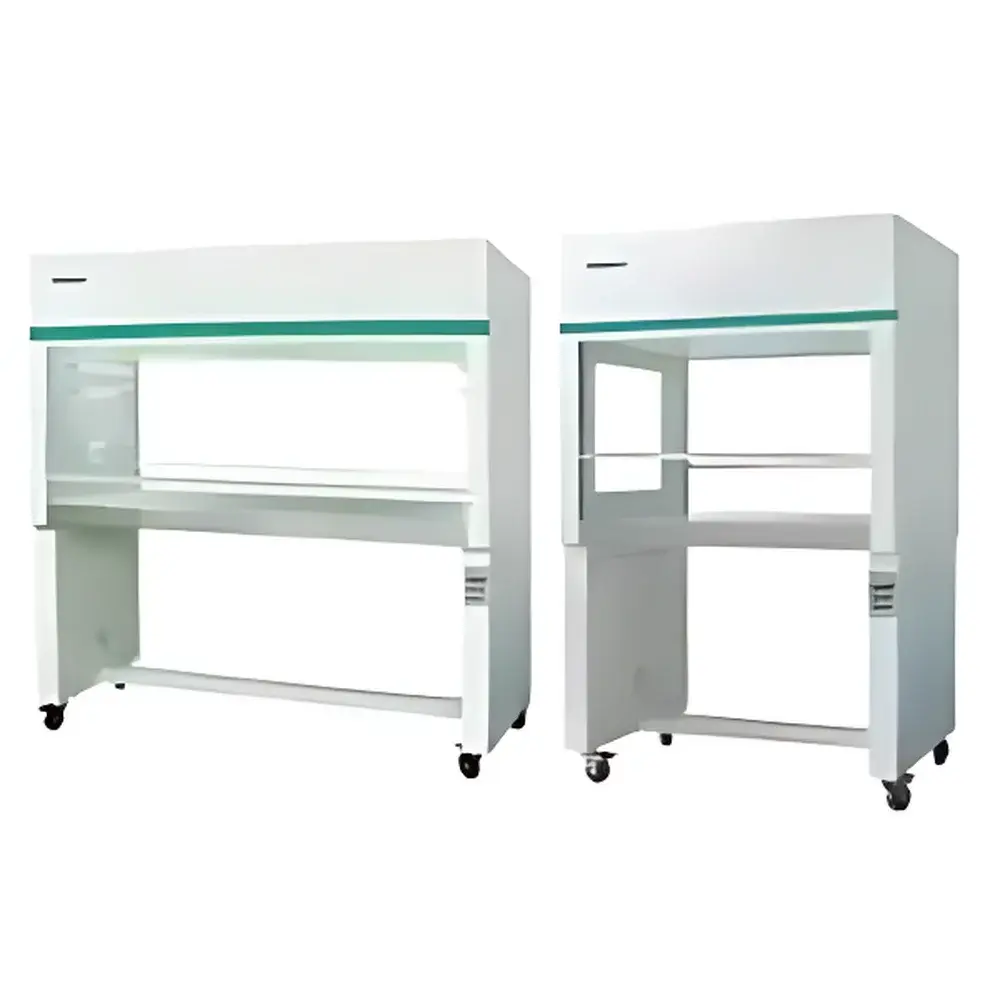
SW-CJ-1F Vertical Laminar Flow Clean Bench
| Origin | Jiangsu, China |
|---|---|
| Manufacturer Type | Distributor |
| Product Origin | Domestic |
| Model | SW-CJ-1F |
| Quotation | USD 980 (FOB Jiangsu) |
| Instrument Category | Vertical Flow Clean Bench |
| Cleanliness Class | ISO 5 (Class 100 per US Federal Standard 209E) |
| Noise Level | ≤62 dB(A) |
| User Capacity | Single-operator, dual-sided |
| Airflow Pattern | Vertical unidirectional laminar flow |
| Work Area Dimensions (W×D×H) | 870 × 690 × 520 mm |
| Overall Dimensions (W×D×H) | 1010 × 730 × 1600 mm |
| HEPA Filter | 820 × 650 × 50 mm, single unit |
| Average Air Velocity | ≥0.3 m/s (adjustable) |
| Illumination | ≥300 lx |
| UV Lamp | 14 W × 1 |
| Fluorescent Lamp | 14 W × 1 |
| Microbial Recovery | ≤0.5 CFU/plate (90 mm Petri dish, 1-hour exposure) |
| Power Supply | 220 V / 50 Hz |
| Input Power | 250 VA |
| Net Weight | 130 kg |
| Construction | Powder-coated steel frame with stainless steel work surface |
| Safety Interlock | UV lamp disabled when sash is open |
Overview
The SW-CJ-1F Vertical Laminar Flow Clean Bench is an ISO 5–certified (Class 100 per US FED-STD-209E) personnel-protective and product-protective workstation engineered for non-hazardous applications requiring particulate-free environments. It operates on the principle of vertical unidirectional laminar airflow: air is drawn through a prefilter, conditioned, and then forced downward through a certified HEPA filter (≥99.99% efficiency at 0.3 µm) to create a uniform, low-turbulence velocity field across the work surface. This design ensures continuous removal of airborne contaminants generated during sample handling, pipetting, or sterile assembly—without recirculation or cross-contamination. Unlike biological safety cabinets, the SW-CJ-1F does not provide operator protection against biohazards; it is strictly intended for aseptic techniques in microbiology, cell culture preparation, pharmaceutical QC sampling, and electronics assembly where environmental particulate control—not pathogen containment—is the primary objective.
Key Features
- Vertical laminar airflow architecture with adjustable fan speed via touch-sensitive voltage control, maintaining consistent face velocity between 0.3–0.5 m/s across the full work area.
- Quasi-enclosed work chamber with dual-side access ports and front-facing sash opening—optimized for ergonomic single-operator use while minimizing external air intrusion and operator exposure to volatile reagents.
- Stainless steel work surface (304 grade) welded seamless and sloped for easy decontamination and liquid runoff; powder-coated mild steel housing provides corrosion resistance and structural rigidity.
- Integrated dual-lighting system: 14 W fluorescent lamp for task illumination (≥300 lx at work surface) and 14 W UV-C germicidal lamp (254 nm) with mechanical interlock—UV automatically deactivates upon sash opening to prevent ocular/skin exposure.
- Noise-optimized blower assembly achieving ≤62 dB(A) at 1 m distance—compliant with ISO 7779 and ANSI S12.55 standards for laboratory ambient noise limits.
- Modular HEPA filtration: single 820 × 650 × 50 mm filter with validated integrity testing protocol (DOP/PAO scan optional per ISO 14644-3); filter service life monitored via differential pressure gauge (optional).
Sample Compatibility & Compliance
The SW-CJ-1F supports routine aseptic manipulation of Petri dishes, test tubes, microcentrifuge tubes, vials, and small-scale bioreactors. Its ISO 5 classification confirms compliance with critical requirements of ISO 14644-1:2015 (Cleanrooms and associated controlled environments), EU GMP Annex 1 (2022 revision), and USP for non-hazardous sterile compounding. While not certified to NSF/ANSI 49 or EN 12469 (as it lacks inward inflow and exhaust ducting), its performance aligns with ASTM E2500-13 (Standard Guide for Specification, Design, and Verification of Pharmaceutical and Biopharmaceutical Manufacturing Systems) for clean bench validation. Routine certification includes particle count verification (ISO 21501-4 compliant counters), airflow uniformity mapping (ASTM F2566), and microbial recovery assessment using settle plates per ISO 14698-1.
Software & Data Management
The SW-CJ-1F is a standalone mechanical system with no embedded firmware or digital interface. However, it is fully compatible with third-party environmental monitoring systems (EMS) via analog 4–20 mA outputs (optional add-on) for real-time logging of static pressure differential across the HEPA filter and cabin temperature/humidity (when integrated with external sensors). All operational parameters—including UV exposure duration, lamp usage hours, and maintenance intervals—are recorded manually in GLP-compliant logbooks. For regulated environments, users may implement electronic audit trails using validated LIMS or ELN platforms (e.g., LabWare, Thermo Fisher SampleManager) to document filter replacement dates, particle count reports, and annual requalification data—ensuring traceability per FDA 21 CFR Part 11 requirements.
Applications
- Aseptic preparation of culture media, inoculation of agar plates, and handling of non-pathogenic bacterial/fungal strains in academic and industrial microbiology labs.
- Cell line passaging, transfection reagent dispensing, and sterile filtration of growth supplements under ISO 5 conditions—common in upstream bioprocess development.
- QC release testing of sterile pharmaceuticals (e.g., parenteral vial inspection, filter integrity testing) per USP and Ph. Eur. 5.1.1.
- Microelectronics: solder paste application, PCB component placement, and optical sensor calibration where sub-5 µm particulate exclusion is mandatory.
- Plant tissue culture labs performing meristem isolation and callus induction without biosafety-level constraints.
FAQ
Does the SW-CJ-1F protect the operator from biological hazards?
No. It provides product protection only. For personnel and environmental protection against biohazards, a Class II biological safety cabinet compliant with NSF/ANSI 49 is required.
What is the recommended HEPA filter replacement interval?
Under typical laboratory use (8 hrs/day, 5 days/week), replace every 18–24 months—or sooner if differential pressure exceeds 250 Pa or particle counts exceed ISO 5 limits during routine monitoring.
Can the SW-CJ-1F be installed in a non-ventilated room?
Yes. It is self-contained and does not require external ducting or make-up air. Ambient room temperature should be maintained between 15–30 °C and relative humidity below 70% to prevent condensation on filters.
Is UV irradiation time programmable?
No. UV exposure is manually initiated and terminated via the front panel switch. Users must adhere to institutional SOPs specifying minimum dwell time (typically 15–30 minutes pre-use) and post-irradiation ventilation before operation.
Does the unit comply with electromagnetic compatibility (EMC) directives?
Yes. It meets IEC 61326-1:2023 for laboratory equipment emissions and immunity, verified by third-party testing reports available upon request.



