
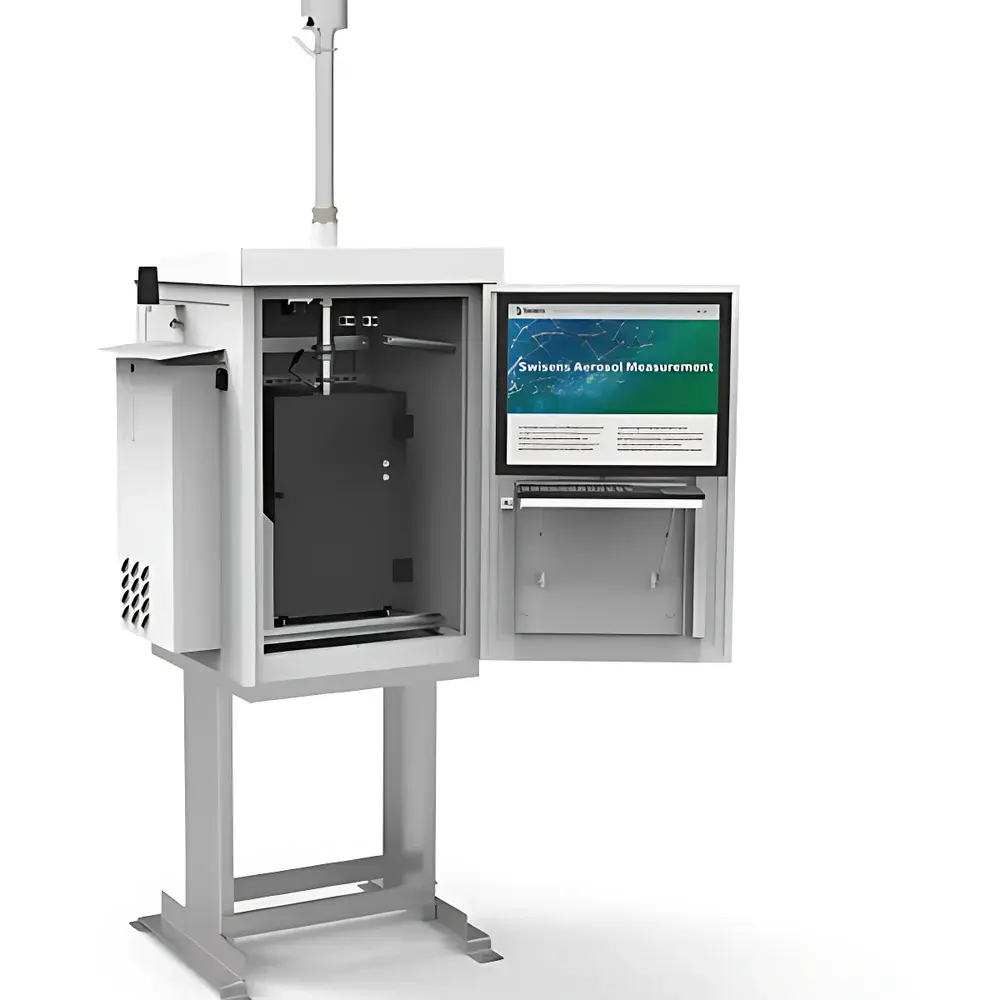
SwisensPoleno Jupiter Pollen and Bioaerosol Automatic Monitoring System
| Brand | WD Precision |
|---|---|
| Origin | Switzerland |
| Manufacturer Type | Authorized Distributor |
| Origin Category | Imported |
| Model | SwisensPoleno Jupiter |
| Price | USD 420,000 (FOB Zurich) |
Overview
The SwisensPoleno Jupiter is a high-fidelity, real-time optical monitoring system engineered for autonomous identification and quantification of airborne biological particles—including pollen grains, fungal spores, bacterial aggregates, and other bioaerosols—in ambient air. Unlike conventional filter-based or culture-dependent methods, the Jupiter employs multi-modal single-particle optical metrology: digital in-line holography, multi-wavelength fluorescence spectroscopy, polarized light scattering, and machine learning–driven classification. This integrated approach enables label-free, non-destructive, and near-instantaneous characterization of individual particles in situ—without sample preparation, culturing, or chemical labeling. Designed for both long-term unattended outdoor deployment and controlled laboratory operation, the system delivers minute-resolution concentration time series across the 0.5–300 µm aerodynamic diameter range. Its architecture supports continuous operation under field conditions (−20 to +50 °C, 0–100% RH), with IP65-rated enclosure integrity and robust thermal management via integrated climate control.
Key Features
- Real-time particle classification at up to 30,000 particles/m³ (10–300 µm) and 1,000,000 particles/m³ (2 µm), with <1-minute temporal resolution
- Integrated particle concentrator (concentration factor: 1000× for 10–300 µm particles) enabling detection of low-abundance bioaerosols
- Automated self-cleaning mechanism for optical windows and sampling inlet, minimizing maintenance intervals
- Remote diagnostics, firmware updates, and data retrieval via encrypted Ethernet or optional 4G LTE connectivity
- Modular hardware expansion: SwisensAtomizer for dry-particle aerosolization and calibration; HEPA exhaust filtration for safe indoor operation
- Open-source software stack (Python-based) with documented APIs, supporting user-defined ML model training and algorithm validation
Sample Compatibility & Compliance
The SwisensPoleno Jupiter is validated for ambient air, indoor air, and controlled chamber environments. It complies with ISO 21501-4 (light scattering particle size analyzers), EN 13725 (odor measurement), and supports GLP/GMP-aligned data integrity workflows. All raw holographic, fluorescence, and scattering datasets are timestamped, checksummed, and stored with full audit trails—meeting requirements for FDA 21 CFR Part 11-compliant environments when deployed with validated IT infrastructure. The system does not require radioactive sources, hazardous reagents, or consumables beyond standard HEPA filters (class H14). Calibration protocols are traceable to NIST-traceable PSL and silica microsphere standards. For coastal or high-salinity deployments, optional conformal coating and stainless-steel inlet upgrades are available upon consultation.
Software & Data Management
The Jupiter runs SwisensOS—a Linux-based, containerized operating system with dual-mode operation: standalone edge processing (on-board industrial PC) or cloud-synchronized analysis. Particle-level metadata—including holographic reconstruction parameters, fluorescence decay kinetics (τ₁, τ₂), depolarization ratio (δ), and morphological descriptors (sphericity, convexity, aspect ratio)—are exported in HDF5 format with embedded schema definitions. The open-source SwisensML toolkit provides Jupyter notebooks for supervised training (e.g., Random Forest, XGBoost, CNN on hologram patches), cross-validation pipelines, and confusion matrix visualization. All classification models retain full provenance: training dataset version, hyperparameters, and validation metrics are logged automatically. Data export supports CSV, NetCDF, and MQTT streaming for integration into environmental data platforms (e.g., Copernicus Atmosphere Monitoring Service, national air quality networks).
Applications
- Public health surveillance: Real-time pollen forecasting for allergic rhinitis risk modeling and clinical triage support
- Agricultural biosecurity: Early detection of plant-pathogenic spores (e.g., Puccinia, Alternaria) in field boundary air
- Biodefense and biosafety: Discrimination of viable vs. inert particles in HVAC exhaust or cleanroom environments
- Climate–biosphere interaction studies: Quantifying bioaerosol contributions to cloud condensation nuclei (CCN) and ice-nucleating particle (INP) populations
- Ecological phenology: Correlating airborne pollen dynamics with satellite-derived vegetation indices and flowering phenophase records
- Method validation: Reference-grade ground truth for remote sensing (LIDAR) and low-cost sensor network calibration
FAQ
How does the Jupiter differentiate pollen from non-biological dust particles?
It combines morphological reconstruction (via dual-angle digital holography) with intrinsic fluorescence signatures (tryptophan, NADH, and riboflavin excitation at 280/365/405 nm) and depolarized scattering response—biological particles exhibit characteristic spectral-temporal fluorescence decays and lower sphericity than mineral dust.
Can users retrain the classifier for region-specific pollen taxa?
Yes—the open-source SwisensML framework allows ingestion of locally collected, expert-annotated hologram–fluorescence datasets to fine-tune or replace default classifiers without vendor dependency.
What maintenance is required for unattended year-round operation?
Scheduled replacement of HEPA exhaust filter (every 6 months), inlet mesh cleaning (quarterly), and annual optical alignment verification using built-in laser reference paths.
Is the system compatible with existing environmental monitoring networks?
Yes—it supports standardized data exchange via MQTT, REST API, and FTP push, with metadata compliant to OGC SensorThings API and INSPIRE Air Quality schemas.
Does the Jupiter meet regulatory requirements for official air quality reporting?
While not certified as a reference method under EU Directive 2008/50/EC, it is widely adopted as a complementary monitoring tool by national agencies (e.g., German Umweltbundesamt, Swiss FOEN) for bioaerosol trend analysis and early-warning applications.
Related Products







