
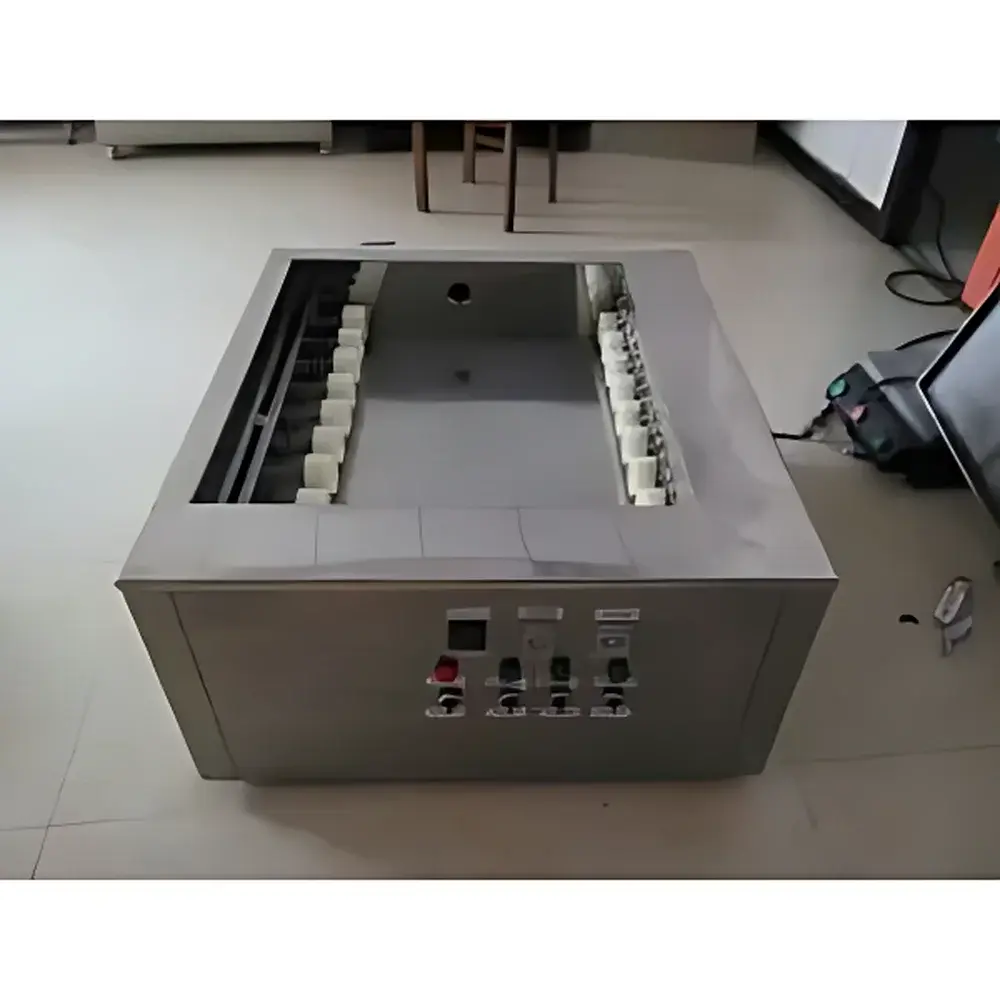
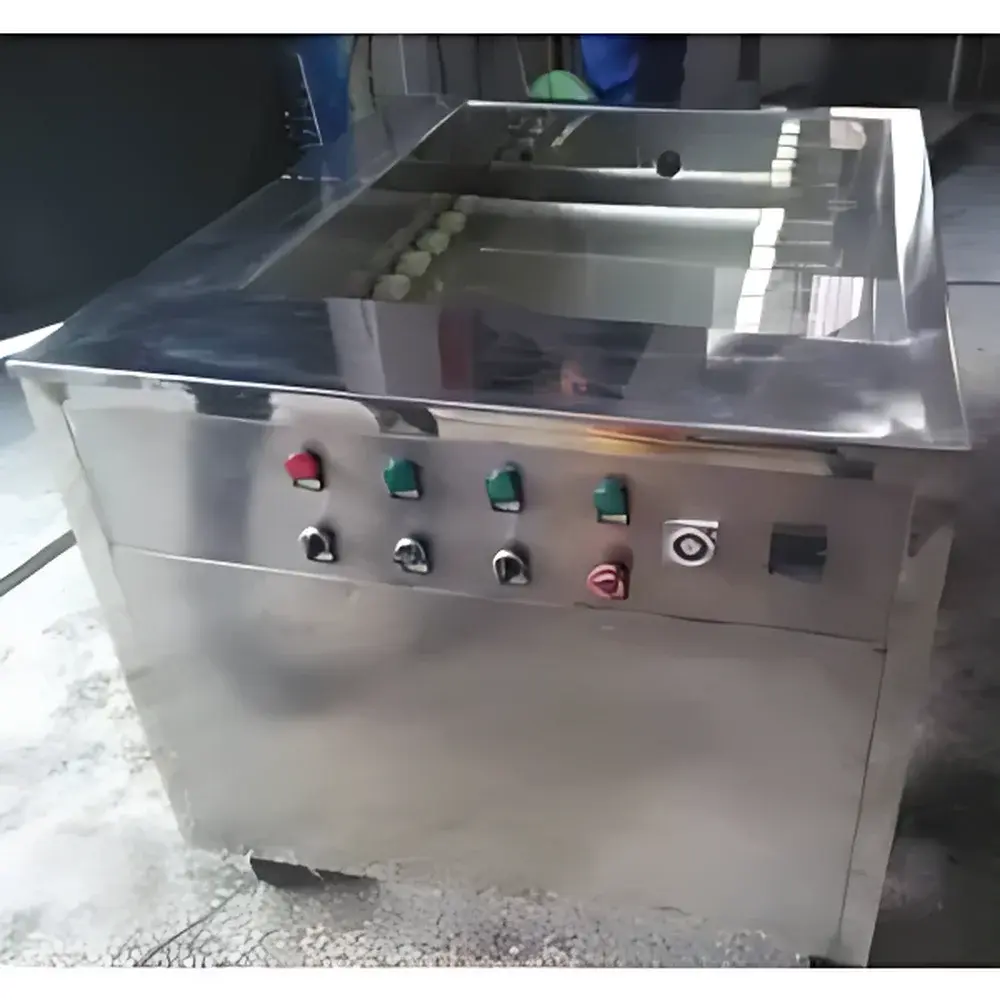
SYC-SYS Filter Cartridge Ultrasonic Cleaning System
| Brand | SYC-Ultrasonics |
|---|---|
| Origin | Shanghai, China |
| Model | SYC-SYS |
| Tank Capacity | 134 L |
| Ultrasonic Frequency | 28 kHz |
| Ultrasonic Power Output | 2500 W |
| Heating Power | 3000 W |
| Temperature Control Range | 0–80 °C (digital PID controller) |
| Rotation Motor Power | 180 W |
| Rotation Speed | ~30 rpm |
| Rotation Mechanism | 8-cartridge parallel drive via stainless steel chain transmission |
| Backflush Interface | Dedicated SUS304 quick-connect couplings enabling simultaneous backflush during rotation |
| Bearing Material | Stainless steel |
| Shut-off Actuation | Solenoid-valve controlled full-cycle backflush |
| Power Supply | AC 380 V, 50 Hz |
| Dimensions (Tank) | 700 × 800 × 240 mm (L×W×H) |
| Overall Dimensions | 900 × 900 × 800 mm (L×W×H) |
| Tank Material | Interior – 2.5 mm thick SUS316L electropolished acid- and alkali-resistant stainless steel |
| Exterior Cladding | SUS304 stainless steel |
| Filtration Compatibility | Cylindrical cartridges, 495 mm length, 30 mm ID / 60 mm OD, threaded end fittings, nominal pore size range 0.01–50 µm |
| Batch Capacity | 8 cartridges per cycle |
| Alarm | Audible completion signal |
Overview
The SYC-SYS Filter Cartridge Ultrasonic Cleaning System is an industrial-grade, purpose-built cleaning platform engineered for the rigorous decontamination and particulate removal from cylindrical filtration elements used in pharmaceutical, biotechnology, food & beverage, and high-purity water processing applications. Unlike general-purpose ultrasonic cleaners, this system integrates synchronized mechanical rotation, programmable thermal control, and integrated backflush capability—operating on the principle of cavitation-enhanced fluid dynamics within a precisely engineered acoustic field. At its core, the 28 kHz transducer array generates stable, low-frequency cavitation bubbles whose implosion energy dislodges sub-micron contaminants—including biofilms, protein residues, colloidal silica, and metal oxides—from both internal lumen surfaces and pleated membrane structures. The system’s 134 L tank volume accommodates full-length (495 mm) cartridges while maintaining uniform energy distribution across all eight fixtures, ensuring reproducible cleaning efficacy validated under ISO 13485-aligned process verification protocols.
Key Features
- Robust SUS316L electropolished tank interior (2.5 mm thickness) certified for repeated exposure to aggressive cleaning agents (e.g., NaOH, citric acid, hydrogen peroxide) and high-temperature cycles up to 80 °C.
- Simultaneous dual-action cleaning: 2500 W ultrasonic energy coupled with 30 rpm continuous rotational agitation ensures complete circumferential exposure of cartridge surfaces to cavitation zones.
- Digital PID temperature controller with ±1.0 °C stability over 0–80 °C range; independent 3000 W heating circuit enables rapid thermal ramping and hold-phase consistency critical for thermal desorption of hydrophobic residues.
- Integrated backflush subsystem utilizing solenoid-actuated SUS304 quick-connect couplings—designed to deliver reverse-flow pressure pulses (up to 3 bar) directly into cartridge lumens during rotation, enhancing removal of embedded particles from asymmetric membranes.
- Heavy-duty stainless steel drive train with sealed stainless bearings and maintenance-free chain transmission—rated for >10,000 operational cycles under continuous duty.
- AC 380 V, 50 Hz three-phase power architecture compliant with IEC 61000-6-3 EMC emission standards and CE-marked for industrial laboratory environments.
Sample Compatibility & Compliance
The SYC-SYS is specifically validated for cylindrical filter cartridges with standardized dimensions: 495 mm length, 30 mm inner diameter, 60 mm outer diameter, and NPT or ISO-KF threaded end connections. It supports nominal pore sizes ranging from 0.01 µm (ultrafiltration) to 50 µm (pre-filtration), including polyethersulfone (PES), polyvinylidene fluoride (PVDF), polypropylene (PP), and stainless steel sintered media. Cleaning validation studies may be conducted in accordance with ASTM F3255-21 (Standard Guide for Validation of Filter Cleaning Processes) and aligned with FDA expectations for reusable device reprocessing as outlined in 21 CFR Part 211. The system’s construction materials meet USP Class VI biocompatibility requirements, and its non-shedding surface finish complies with ASME BPE-2022 sanitary design criteria for pharmaceutical fluid systems.
Software & Data Management
This model operates via hardwired digital controls without embedded microprocessor-based software. All operating parameters—including temperature setpoint, heating duration, and total cycle time—are configured manually using front-panel rotary dials and LED indicators. A built-in audible alarm signals cycle completion, supporting manual logbook entry per GLP/GMP documentation requirements. For traceability, users are advised to integrate external data loggers (e.g., calibrated thermocouple arrays and pressure transducers) connected to validated SCADA or LIMS platforms. While no native USB/RS-485 interface is provided, the system’s solenoid valves and heater relays can be externally triggered via dry-contact inputs compatible with programmable logic controllers (PLCs) used in regulated cleanroom automation environments.
Applications
- Pre-use cleaning of sterilizing-grade PES or PVDF membrane cartridges prior to integrity testing (e.g., bubble point or diffusion test per ASTM F838).
- Post-use recovery of high-value depth filters in bioprocessing skids, minimizing replacement costs and reducing single-use plastic waste.
- Routine maintenance of compressed air and instrument gas filtration systems in ISO Class 5–7 cleanrooms.
- Removal of endotoxin-laden residues from stainless steel sintered filters used in ultra-pure water distribution loops (UPW).
- Validation support for cleaning process qualification (CPQ) per Annex 15 of the EU GMP Guidelines and ISPE Baseline Guide Volume 4: Water and Steam Systems.
FAQ
Is the ultrasonic frequency adjustable?
No. The system operates exclusively at 28 kHz—a frequency selected for optimal penetration depth and particle dislodgement efficiency in viscous or high-aspect-ratio filter geometries.
Can the unit be integrated into a fully automated clean-in-place (CIP) line?
Yes—via optional dry-contact I/O modules that allow synchronization with central PLCs for start/stop commands, temperature feedback, and alarm status reporting.
Does the system include validation documentation or IQ/OQ templates?
The manufacturer supplies material certifications (MTRs) for all wetted parts and electrical safety test reports. Site-specific IQ/OQ protocols must be developed by the end user in alignment with their quality management system.
What is the expected service life of the transducer array under continuous operation?
Rated for ≥20,000 hours of cumulative runtime when operated within specified temperature and duty-cycle limits; transducers are field-replaceable without tank disassembly.
Is operator training provided?
Basic installation and safety commissioning support is included. Advanced cleaning protocol development and validation assistance are available through authorized service partners under separate technical service agreements.



